JSTOR Global Plants Home
  • Home
  • Browse
  • About
  • Access
  • Account
    • Saved Items
    • Profile
  • Log in

Global Plants

Skip to Main Content
  • JSTOR Global Plants Home
  • Global Plants

    • Browse
    • About
    • Access
    • Account
      • Saved Items
      • Profile
Log in
  • Browse
  • About
  • Access
  • Account
    • Saved Items
    • Profile
Advanced Search

Compilation
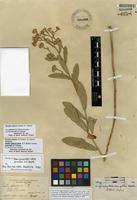
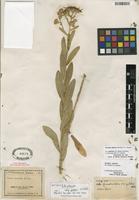
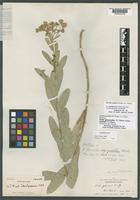
Eurybia pulchra

3 Images see all

Isotype of Eurybia pulchra (S.F. Blake) G.L. Nesom [family ASTERACEAE]
Isotype of Aster glaucodes S. F. Blake ssp. pulcher S. F. Blake [family ASTERACEAE]
Previous
Next

Name

Identification
Isotype of Eurybia pulchra (S.F. Blake) G.L. Nesom [family ASTERACEAE ] (stored under name); Verified by L. Brouillet (MT),, Aster glaucus (Nutt.) Torr. & A. Gray [family ASTERACEAE ] Verified by Not on sheet, Aster glaucodes Not on sheet [family ASTERACEAE ] Verified by L. Williams,, Eurybia glauca Not on sheet [family ASTERACEAE ] Verified by L. Brouillet (MT),, Isotype of Aster glaucodes Not on sheet [family ASTERACEAE ] Verified by Not on sheet,
Related name
  • Aster glaucodes
  • Eurybia glauca
  • Aster glaucus
  • Eurybia pulchra
Common name
  • Beautiful aster, Flora of North America Vol. 20

Flora

Entry for Herrickia glauca (Nuttall) Brouillet var. pulchra (S. F. Blake) Brouillet [family COMPOSITAE]
Herbarium
Flora of North America (FNA)
Collection
Flora of North America
Resource Type
Reference Sources
Entry From
Flora of North America, Vol 20,
Names
Herrickia glauca (Nuttall) Brouillet var. pulchra (S. F. Blake) Brouillet [family COMPOSITAE], Sida, 21: 897. 2004
Aster glaucodes S. F. Blake subsp. pulcher S. F. Blake [family COMPOSITAE], Proc. Biol. Soc. Wash., 35: 174. 1922
Aster wasatchensis (M. E. Jones) S. F. Blake var. pulcher (S. F. Blake) S. L. Welsh [family COMPOSITAE]
Eurybia pulchra (S. F. Blake) G. L. Nesom [family ]
Eurybia glauca (Nuttall) G. L. Nesom var. pulchra (S. F. Blake) Brouillet [family ]
Treatment Author(s)
Luc Brouillet
Information
Plants 40–80 cm, short-stipitate-glandular. Stems 1–3+, glabrous or glabrescent proximally, ± densely stipitate-glandular distally. Leaf blades ovate-, elliptic-, or obovate-oblong to lanceolate, 20–90 × 5–21 mm, faces usually glabrous (proximal), sometimes sparsely stipitate glandular or abaxial midnerves stipitate-glandular (distal often). Heads 10–30+. Peduncles ± densely stipitate-glandular; bracts 0–2, foliaceous, densely stipitate-glandular. Involucres campanulate to cylindro campanulate, 6.5–9.5 mm. Phyllaries 26–40, ± densely stipitate-glandular (outer, green zones) or eglandular (inner). Ray florets 10–14; laminae 11.5–16 × 2.2–2.9 mm. Disc florets 29–40; corollas 7–8.5 mm, lobes 1–1.8 mm.
Conservation Status
of conservation concern;
Phenology
aug (summer), sep-oct (fall)
Altitude range
800–2200 m;
Distribution
USA Ariz.USA Utah.
Discussion
Variety pulchra is known only from the San Juan River basin (Washington and Kane counties, Utah; Coconino County, Arizona). It is of conservation concern in Utah. Recently, S. L. Welsh (Welsh et al. 2003) transferred var. pulchra from Aster glaucodes (syn. H. glauca) to A. wasatchensis on the grounds of its glandularity and “general conformation,” while acknowledging the glaucous foliage shared with Herrickia glauca. Yet the variety does not share critical features of the involucre with H. wasatchensis, and the glandularity is most likely a shared primitive feature within the group and is therefore not indicative of a particular relationship within the group. Distribution and morphology strongly suggest the relationships reported here. Alternately, var. pulchra may represent a distinct species, as hypothesized by G. L. Nesom (1994b).

Related Materials

  • Terms and Conditions
  • Privacy Policy
  • Cookie Policy
  • Cookie Settings
  • Accessibility
  • Help
  • Contact Us
  • Facebook
  • Twitter
ITHAKA

JSTOR is part of ITHAKA, a not-for-profit organization helping the academic community use digital technologies to preserve the scholarly record and to advance research and teaching in sustainable ways.

©2000-2026 ITHAKA. All Rights Reserved. JSTOR®, the JSTOR logo, JPASS®, Aluka®, and ITHAKA® are registered trademarks of ITHAKA.

╳