JSTOR Global Plants Home
  • Home
  • Browse
  • About
  • Access
  • Account
    • Saved Items
    • Profile
  • Log in

Global Plants

Skip to Main Content
  • JSTOR Global Plants Home
  • Global Plants

    • Browse
    • About
    • Access
    • Account
      • Saved Items
      • Profile
Log in
  • Browse
  • About
  • Access
  • Account
    • Saved Items
    • Profile
Advanced Search

Compilation
Euphorbia wildii

6 Images see all

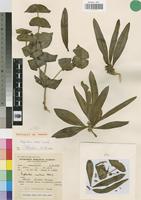
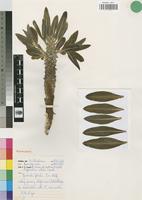
Lectotype of Euphorbia wildii Leach [family EUPHORBIACEAE]
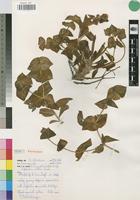
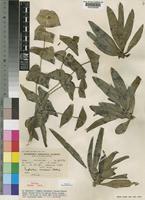
Paratype of Euphorbia wildii Leach [family EUPHORBIACEAE]
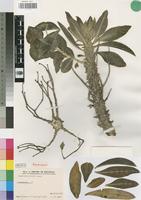
Isotype of Euphorbia wildii L.C.Leach [family EUPHORBIACEAE]
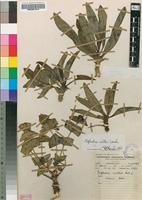
Paratype of Euphorbia wildii Leach [family EUPHORBIACEAE]
Isotype of Euphorbia wildii L.C.Leach [family EUPHORBIACEAE]
Previous
Next

Name

Identification
Isotype of Euphorbia wildii L.C.Leach [family EUPHORBIACEAE ] (stored under name);
Related name
  • Euphorbia wildii

Flora

Entry for Euphorbia wildii L.C. Leach [family EUPHORBIACEAE]
Herbarium
Royal Botanic Gardens, Kew (K)
Collection
Flora Zambesiaca
Resource Type
Reference Sources
Entry From
FZ, Vol 9, Part 5, (2001) Author: S. Carter & L.C. Leach
Names
Euphorbia wildii L.C. Leach [family EUPHORBIACEAE], in Kirkia 6: 139, photos 8–11 (1968); in Kirkia 10: 293 (1975)*. Type: Zimbabwe, Mazowe Distr., Mvurwi Range (Umvukwes), Ruorka Ranch, 16.xii.1952, Wild 3981 (SRGH, lectotype).
Euphorbia monteiri [family EUPHORBIACEAE], sensu Wild in Kirkia 5: 77 (1965) non Hook.f.
Information
Stout succulent shrub to 3 m high, glabrous, sparingly branched; branches to 5 cm in diameter, tuberculate; tubercles tightly spiralled in 5–8 or more series, rhomboid to about 15 × 15 mm, very prominent, bearing the leaves at their apices.Leaves subsessile; lamina to 12 × 4 cm, obovate-lanceolate, acute and apiculate at the apex, tapering to the base, entire.Cymes in axillary and terminal 1–5-branched umbels produced on slender leafy branches to 10 cm long, arising from the tubercle axils, with primary rays to 7 cm long, each forking many times and the dry remains persisting towards the apex of the main branches.Bracts sessile, c. 3.5 × 4 cm, deltoid, apex acuminate, base subcordate, the bracts below the umbel larger and more leaf-like.Cyathia on peduncles c. 2 mm long, 7 × 15 mm with cup-shaped involucres; glands 4(5), c. 2 × 3.5 mm, transversely elliptic, outer margin with 2–7 finger-like processes 2–4 mm long with swollen, sometimes scarcely bifid tips, green; lobes 3 × 3 mm, subquadrate, margin very deeply toothed, puberulous.Male flowers: bracteoles fan-shaped, laciniate, feathery; stamens 8 mm long.Female flower: ovary pedicellate; styles c. 4 mm long, joined to halfway, with spreading slightly thickened apices.Fruit exserted on a curved pedicel c. 1 cm long; capsule to 10 × 13 mm, subglobose, 3-lobed.Seeds 4 × 3.5 mm, ovoid, apex very obtuse, surface very obscurely wrinkled, brown.
Habitat
On rocky slopes of serpentine hills with a high chrome content
Range
Endemic to the Mvurwi (Umvukwes) Mts.
Altitude range
1480–1700 m.
1700
1480
Distribution
Zimbabwe N Zvimba Distr., west side of Mvurwi (Umvukwes) Range, c. 3 km north of Kildonan, fl. 24.x.1959, Leach 9498 (K; LISC; SRGH); Mutorashanga (Mutoroshanga), fl. 17.ii.1966, Leach, Simon & Scott 13196 (BM; COI; K; LISC; SRGH).

Related Materials

  • Terms and Conditions
  • Privacy Policy
  • Cookie Policy
  • Cookie Settings
  • Accessibility
  • Help
  • Contact Us
  • Facebook
  • Twitter
ITHAKA

JSTOR is part of ITHAKA, a not-for-profit organization helping the academic community use digital technologies to preserve the scholarly record and to advance research and teaching in sustainable ways.

©2000-2026 ITHAKA. All Rights Reserved. JSTOR®, the JSTOR logo, JPASS®, Aluka®, and ITHAKA® are registered trademarks of ITHAKA.

╳