JSTOR Global Plants Home
  • Home
  • Browse
  • About
  • Access
  • Account
    • Saved Items
    • Profile
  • Log in

Global Plants

Skip to Main Content
  • JSTOR Global Plants Home
  • Global Plants

    • Browse
    • About
    • Access
    • Account
      • Saved Items
      • Profile
Log in
  • Browse
  • About
  • Access
  • Account
    • Saved Items
    • Profile
Advanced Search

Compilation
Euphorbia verruculosa

2 Images see all

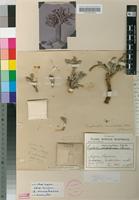
Type of Euphorbia verruculosa N.E.Br. [family EUPHORBIACEAE]
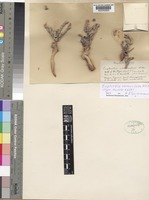
Euphorbia verruculosa N.E.Br. [family EUPHORBIACEAE]
Previous
Next

Name

Identification
Euphorbia verruculosa N.E.Br. [family EUPHORBIACEAE ] (stored under name); Verified by Not on sheet,
Related name
  • Euphorbia verruculosa

Flora

Entry for Euphorbia verruculosa N.E. Br. [family EUPHORBIACEAE]
Herbarium
Royal Botanic Gardens, Kew (K)
Collection
Flora Capensis
Resource Type
Reference Sources
Entry From
Flora Capensis, Vol 5, Part 2, page 580, (1925) Author: (By S. A. SKAN.)
Names
Euphorbia verruculosa N.E. Br. [family EUPHORBIACEAE]
Information
rootstock woody, 1/2 in. or more thick, apparently extensively creeping underground, giving off erect or ascending shoots dividing at the surface of the ground into a compact cluster of branches 2–3 in. high, glabrous in all parts; branches leafless, succulent, 1–3 in. long, 3–3 1/2 lin. thick, usually bearing a compact irregular cluster of short branchlets at the apical part; when alive covered with alternate and more or less spirally arranged very obtusely rounded tubercles 1/2–1 lin. high, prominent and verruculose all over; when dried the tubercles almost disappear and the verruculose skin shrivels and has a whitish papillate papery appearance; leaves practically absent, reduced to very minute rudiments, alternate; male involucres in small sessile cymes or clusters at the tips of the branchlets, sessile, 1 lin. in diam. and about 3/4 lin. deep, cup-shaped, with 5 or occasionally 4 transversely oblong contiguous glands about 1/2 lin. in their greater diam., and with 2 or occasionally 3 broadly ovate fleshly keeled bracts at the base; female involucres and fruit not seen. null
Distribution
WESTERN REGION Great Namaqualand; Angra Pequena, Marloth, 4639!
Notes
This very distinct species is evidently allied to E. gentilis, E. stapelioides, E. karroensis and E. spicata, but differing from all in its alternate and more tuberculate branches, with a distinctly verruculose epidermis, which on dried specimens assumes a finely wrinkled whitish papery appearance, quite unlike that of any species I have seen.

Related Materials

  • Terms and Conditions
  • Privacy Policy
  • Cookie Policy
  • Cookie Settings
  • Accessibility
  • Help
  • Contact Us
  • Facebook
  • Twitter
ITHAKA

JSTOR is part of ITHAKA, a not-for-profit organization helping the academic community use digital technologies to preserve the scholarly record and to advance research and teaching in sustainable ways.

©2000-2026 ITHAKA. All Rights Reserved. JSTOR®, the JSTOR logo, JPASS®, Aluka®, and ITHAKA® are registered trademarks of ITHAKA.

╳