JSTOR Global Plants Home
  • Home
  • Browse
  • About
  • Access
  • Account
    • Saved Items
    • Profile
  • Log in

Global Plants

Skip to Main Content
  • JSTOR Global Plants Home
  • Global Plants

    • Browse
    • About
    • Access
    • Account
      • Saved Items
      • Profile
Log in
  • Browse
  • About
  • Access
  • Account
    • Saved Items
    • Profile
Advanced Search

Compilation
Euphorbia valida

2 Images see all

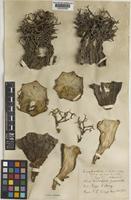
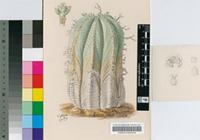
Type of Euphorbia valida N.E.Br. [family EUPHORBIACEAE]
Euphorbia valida N.E.Br.
Previous
Next

Name

Identification
Euphorbia valida N.E.Br. [family EUPHORBIACEAE ]
Related name
  • Euphorbia valida

Flora

Entry for EUPHORBIA valida N. E. Br. [family EUPHORBIACEAE]
Herbarium
Royal Botanic Gardens, Kew (K)
Collection
Flora Capensis
Resource Type
Reference Sources
Entry From
Flora Capensis, Vol 5, Part 2, page 216, (1925) Author: (By N. E. BROWN, J. HUTCHINSON and D. PRAIN.)
Names
EUPHORBIA valida N. E. Br. [family EUPHORBIACEAE]
Information
stem solitary, about 6–7 in. high, 3–3 1/2 in. thick, in the specimens seen unbranched, succulent, leafless and spineless, but bearing on the upper part the hard woody remains of numerous branched cymes, cylindric-oblong in old plants, probably subglobose when young, not or scarcely depressed at the rounded apex, 8-angled above, becoming cylindric at the base, glabrous, dull green or purplish-green, or transversely marked with pale green lines or narrow bands, becoming entirely brown on the basal part, unisexual; leaves rudimentary, about 1 lin. long, deltoid or deltoid-ovate, acute, soon deciduous; cymes 1 1/4–2 in. long and in diam., arising from the angles at the apex, gradually developing 3 branches, which become 2 to 4 times forked, on peduncles 3–10 lin. long, 1–1 1/2 lin. thick, erect or standing out from the stem, minutely puberulous, green, becoming woody, brown and persisting for several years; bracts few and scattered on the peduncle, with a pair under each involucre, about 1 lin. long, narrowly oblong, obtuse, apiculate, puberulous; involucre sessile within the bracts, 1 3/4 lin. in diam., cup-shaped, very minutely puberulous outside, rather dull green, with 5 glands and 5 reddish-tipped subquadrate ciliate lobes; glands subcontiguous, erect, 2/3– 3/4 lin. in their greater diam., reniform, slightly pitted-rugulose, dingy green or olive-green; ovary and fruit not seen. null
Distribution
CENTRAL REGION Jansenville Div.; near Waterford, Drège!
Notes
Described from living plants sent by Mr. I. L. Drège of Port Elizabeth to Kew in Aug. 1912, where it flowered in June, 1913. A photograph accompanied the specimens, showing it growing as a solitary plant upon the plain.

Related Materials

  • Terms and Conditions
  • Privacy Policy
  • Cookie Policy
  • Cookie Settings
  • Accessibility
  • Help
  • Contact Us
  • Facebook
  • Twitter
ITHAKA

JSTOR is part of ITHAKA, a not-for-profit organization helping the academic community use digital technologies to preserve the scholarly record and to advance research and teaching in sustainable ways.

©2000-2026 ITHAKA. All Rights Reserved. JSTOR®, the JSTOR logo, JPASS®, Aluka®, and ITHAKA® are registered trademarks of ITHAKA.

╳