JSTOR Global Plants Home
  • Home
  • Browse
  • About
  • Access
  • Account
    • Saved Items
    • Profile
  • Log in

Global Plants

Skip to Main Content
  • JSTOR Global Plants Home
  • Global Plants

    • Browse
    • About
    • Access
    • Account
      • Saved Items
      • Profile
Log in
  • Browse
  • About
  • Access
  • Account
    • Saved Items
    • Profile
Advanced Search

Compilation
Euphorbia rhipsaloides

9 Images see all

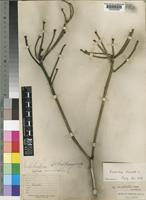
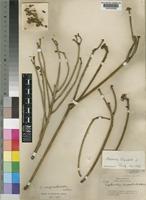
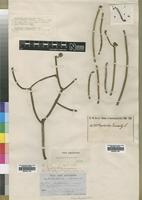
Syntype of Euphorbia rhipsaloides N.E.Br. [family EUPHORBIACEAE]
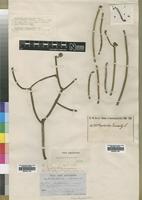
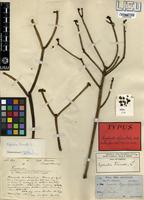
Syntype of Euphorbia rhipsaloides Welw. ex N.E.Br. [family EUPHORBIACEAE]
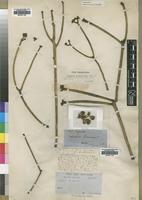
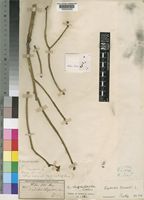
Lectotype of Euphorbia rhipsaloides Welw. ex N.E.Br. [family EUPHORBIACEAE]
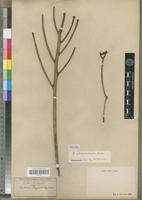
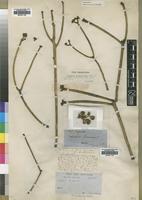
Type of Euphorbia rhipsaloides Welw. [family EUPHORBIACEAE]
Syntype of Euphorbia rhipsaloides N.E.Br. [family EUPHORBIACEAE]
Type of Euphorbia rhipsaloides Welw. [family EUPHORBIACEAE]
Euphorbia tirucalli L. [family EUPHORBIACEAE]
Type of Euphorbia rhipsaloides Welw. ex N.E.Br. [family EUPHORBIACEAE]
Previous
Next

Name

Identification
Euphorbia rhipsaloides Welw. ex N.E.Br. [family EUPHORBIACEAE ] (stored under name);
Related name
  • Euphorbia rhipsaloides
  • Euphorbia tirucalli

Flora

Entry for EUPHORBIA rhipsaloides Welw. [family EUPHORBIACEAE]
Herbarium
Royal Botanic Gardens, Kew (K)
Collection
Flora of Tropical Africa
Resource Type
Reference Sources
Entry From
Flora of Tropical Africa, Vol 6, Part 1, page 441, (1913) Author: (By J. G. Baker, with additions by C. H. Wright.)
Names
EUPHORBIA rhipsaloides Welw. [family EUPHORBIACEAE], in Ann. Consel. Ultramar. Lisb. 1856, no. 24, parte não offic. 252, no. 11.
EUPHORBIA Tirucalli Ficalho [family EUPHORBIACEAE], Pl. Uteis, 248, and Hiern in Cat. Afr. Pl. Welw. i. 949, partly, not of Linnæus.
Information
A succulent bush 8–12 ft. high, or a tree 15–20 ft. high, with a trunk 6–8 in. in diam. (Welwitsch). Branches forked or alternately branching or the branchlets more or less clustered, distinctly jointed to the stems and branches, terete, 2–12 in. long, 1 1/4–3 lin. thick in the specimens seen, naked, spineless, marked with very small alternate leaf-scars, glabrous. Leaves, according to Welwitsch, linear, not seen, only present on young growing branchlets, deciduous. Cymes crowded in terminal head-like clusters 1/3– 1/2 in. in diam., sessile or subsessile, each with 2–3 involucres. Bracts scale-like, 1/2– 3/4 lin. long, broadly ovate or rounded. Involucre 2 lin. in diam. and 1 1/2 lin. deep, cup-shaped, minutely woolly-puberulous on the upper part, with 5 glands and 5 erect subquadrate toothed or subentire puberulous lobes, yellowish; glands 2/3– 3/4 lin. in their greater diam., peltate, transversely elliptic, apparently somewhat 2-lipped, entire. Ovary with a calyx at its base, divided into three ovate acute or obtuse entire lobes 1/2– 2/3 lin. long, pubescent, exserted on a pubescent pedicel about 4 lin. long; styles 1 lin. long, united to the middle or slightly beyond, puberulous, with spreading arms, channelled above and 2-lobed at thea pex. Capsule 5 lin. in diam., subglobose, obscurely trigonous, pubescent, with woody cell-walls 1/3 in. thick. Seeds not seen, destroyed by a gall-fly in the specimens seen.
Distribution
Angola Lower Guinea Loanda; about Loanda, Welwitsch, 630! Gossweiler, 474! Rattray! Buchner, 532! Golungo Alto; thickets of Sobato de Bumba, near Camilungo, Welwitsch, 651!
Notes
This may be the plant quoted by Pax as E. Tirucalli, Linn., in Bull. Soc. Bot. Belg. xxxvii. 108; in De Wild. & Durand, Contrib. Fl. Congo, i. 52, and Reliq. Dewevr. 203, and in De Wild. Miss. É. Laurent, i. 143. But it is quite distinct from the true E. Tirucalli, Linn., which is an Indian plant.

Related Materials

  • Terms and Conditions
  • Privacy Policy
  • Cookie Policy
  • Cookie Settings
  • Accessibility
  • Help
  • Contact Us
  • Facebook
  • Twitter
ITHAKA

JSTOR is part of ITHAKA, a not-for-profit organization helping the academic community use digital technologies to preserve the scholarly record and to advance research and teaching in sustainable ways.

©2000-2026 ITHAKA. All Rights Reserved. JSTOR®, the JSTOR logo, JPASS®, Aluka®, and ITHAKA® are registered trademarks of ITHAKA.

╳