JSTOR Global Plants Home
  • Home
  • Browse
  • About
  • Access
  • Account
    • Saved Items
    • Profile
  • Log in

Global Plants

Skip to Main Content
  • JSTOR Global Plants Home
  • Global Plants

    • Browse
    • About
    • Access
    • Account
      • Saved Items
      • Profile
Log in
  • Browse
  • About
  • Access
  • Account
    • Saved Items
    • Profile
Advanced Search

Compilation
Euphorbia polygona

5 Images see all

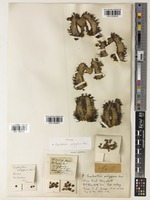
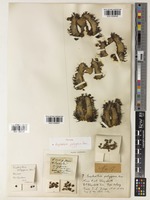
Euphorbia polygona Haw. [family EUPHORBIACEAE]
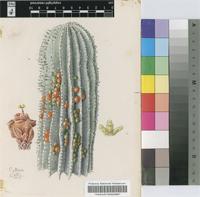
Euphorbia polygona Haw.
Neotype of Euphorbia polygona Haw. [family EUPHORBIACEAE]
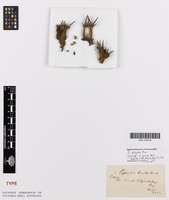
Isolectotype of Euphorbia horrida Boiss. [family EUPHORBIACEAE]
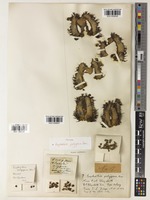
Euphorbia polygona Haw. [family EUPHORBIACEAE]
Previous
Next

Name

Identification
Euphorbia polygona Haw. [family EUPHORBIACEAE ]
Related name
  • Euphorbia polygona

Flora

Entry for EUPHORBIA polygona Haw. [family EUPHORBIACEAE]
Herbarium
Royal Botanic Gardens, Kew (K)
Collection
Flora Capensis
Resource Type
Reference Sources
Entry From
Flora Capensis, Vol 5, Part 2, page 216, (1925) Author: (By N. E. BROWN, J. HUTCHINSON and D. PRAIN.)
Names
EUPHORBIA polygona Haw. [family EUPHORBIACEAE], Misc. Nat. 184, and Syn. Pl. Succ. 129;—Spreng. Syst. Veg. iii. 786; Boiss. in DC. Prodr. xv. ii. 88; Berger, Sukk. Euphorb. 99–100, fig. 25.
Information
diœcious; stems simple or slightly branching at the base, perhaps several from the same root, succulent, leafless, spiny or nearly spineless, erect, 1–2 ft. high, 3–4 in. thick, when very young 7-angled, with age developing 10–20 angles, glabrous, green and slightly glaucous on the young growth in wild plants, not glaucous when cultivated under glass, becoming grey with age; angles vertical or slightly spiral, acute, slightly crenulate, often wavy, separated by acute furrows about 2/3 in. deep; leaves rudimentary, 1/2–1 1/2 lin. long, oblong-lanceolate or deltoid-lanceolate, acuminate, rigid and hard, soon deciduous, dark reddish-brown or blackish; spines (modified peduncles) solitary or 2–3 from a flowering-eye, scattered along the angles, 2–4 lin. long, bearing a few minute scattered bracts, dark purple or blackish-brown, becoming grey; flowers arising at and near the apex of the stems, often one on each side and at the base of a previously formed spine; peduncles 1–2 lin. long, bearing 1 involucre and several bracts, dull purple; upper bracts 1 1/2–2 1/4 lin. long, 1–2 lin. broad, obovate, obtusely rounded at the apex, glabrous above, minutely puberulous beneath, minutely ciliate; lower bracts much smaller and oblong; involucre unisexual, 2 1/2–3 1/2 lin. in diam. and 1 1/2 lin. deep, cup-shaped, nearly or quite glabrous outside, dark purple, with 5 glands and 5 rounded minutely toothed lobes; glands not quite contiguous; slightly sloping outwards, 1–1 3/4 lin. in their greater diam., transversely elliptic or elliptic-oblong, dark purple; capsule 2 1/2–3 lin. in diam., globose or very slightly 3-lobed as seen from above, velvety-pubescent, erect, exserted on a pedicel not exceeding the involucre; styles united into a column about 1/2 lin. long, with spreading arms of the same length, minutely bifid at the tips; seeds 1 1/2 lin. long, ovoid, acute at one end, obscurely 4-angled, smooth, brown. null
Distribution
COAST REGION Uitenhage Div.; Red Hill, Mrs. Paterson, 1173! Port Elizabeth Div.; Commadagga, Miss Sangster! near Port Elizabeth, Drège, 7! Mrs. Paterson, 1143! and cultivated plants!
Notes
Described from living plants cultivated at Kew and others sent to Kew by Mr. I. L. Drège and Mrs. Paterson. Boissier and Berger both state that the plant grows to 4–5 ft. high, but no example I have seen has been more than 20 inches high, and Mr. Drège writes that out of thousands he has seen none have been more than 2 ft. high.

Related Materials

  • Terms and Conditions
  • Privacy Policy
  • Cookie Policy
  • Cookie Settings
  • Accessibility
  • Help
  • Contact Us
  • Facebook
  • Twitter
ITHAKA

JSTOR is part of ITHAKA, a not-for-profit organization helping the academic community use digital technologies to preserve the scholarly record and to advance research and teaching in sustainable ways.

©2000-2026 ITHAKA. All Rights Reserved. JSTOR®, the JSTOR logo, JPASS®, Aluka®, and ITHAKA® are registered trademarks of ITHAKA.

╳