JSTOR Global Plants Home
  • Home
  • Browse
  • About
  • Access
  • Account
    • Saved Items
    • Profile
  • Log in

Global Plants

Skip to Main Content
  • JSTOR Global Plants Home
  • Global Plants

    • Browse
    • About
    • Access
    • Account
      • Saved Items
      • Profile
Log in
  • Browse
  • About
  • Access
  • Account
    • Saved Items
    • Profile
Advanced Search

Compilation
Euphorbia perpera

2 Images see all

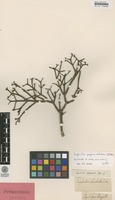
Isotype of Euphorbia perpera N.E. Br. [family EUPHORBIACEAE]
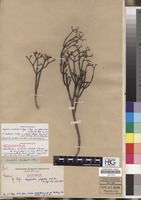
Isotype of Euphorbia perpera N.E.Br. [family EUPHORBIACEAE]
Previous
Next

Name

Identification
Isotype of Euphorbia perpera N.E. Br. [family EUPHORBIACEAE ] (stored under name); Verified by HBG-formal name entry, 2010 Arthrothamnus brachiatus Klotzsch & Garcke [family EUPHORBIACEAE ] Verified by HBG-formal name entry, 2010 Euphorbia brachiata (Klotzsch & Garcke) Boiss. p.p. [family EUPHORBIACEAE ] Verified by Not on sheet,
Related name
  • Arthrothamnus brachiatus
  • Euphorbia brachiata
  • Euphorbia perpera

Flora

Entry for EUPHORBIA perpera N. E. Br. [family EUPHORBIACEAE]
Herbarium
Royal Botanic Gardens, Kew (K)
Collection
Flora Capensis
Resource Type
Reference Sources
Entry From
Flora Capensis, Vol 5, Part 2, page 216, (1925) Author: (By N. E. BROWN, J. HUTCHINSON and D. PRAIN.)
Names
EUPHORBIA perpera N. E. Br. [family EUPHORBIACEAE]
EUPHORBIA brachiata, letter b E. Meyer [family EUPHORBIACEAE], in Drège, Zwei Pfl. Documente, 184, name only, and Boiss. in DC. Prodr. xv. ii. 74, partly (excl. Drège, 2948, and E. muricata, Thunb.).
Arthrothamnus brachiatus Klotzsch & Garcke [family EUPHORBIACEAE], in Abhandl. Akad. Berlin, 1860, 62.
Information
a much-branched succulent shrub or shrublet, leafless and spineless; branches and branchlets all opposite or forking, more or less constricted or jointed at their origin, diverging from each other at an angle of not more than 60°–75°, fleshy when young, glabrous; leaves rudimentary, deciduous, scale-like, opposite, sessile, spreading or with abruptly recurved tips, 1/2 lin. long and more in breadth, very broadly deltoid, acute, scarcely channelled, glabrous; cymes terminal, 1/2–1 in. in diam., formed of 2 diverging branchlets 1/4– 1/2 in. long, each once or twice forking into shorter branchlets, the ultimate bearing 3 involucres; bracts shorter than the involucres, scale-like, 1/2 lin. long, deltoid-ovate, acute or subobtuse, glabrous; involucres sessile, 3/4 lin. in diam., cup-shaped, glabrous, with 5 glands and 5 minute oblong or spathulate-oblong slightly ciliate lobes; glands 1/4 lin. in their greater diam., transversely oblong or elliptic-oblong; ovary ellipsoid, trigonous, narrowing at the apex, glabrous; styles 1/3– 2/5 lin. long, united at the basal half, ascending-spreading above, with bifid tips; capsule about 1 1/2 lin. long and 1 1/3 lin. in diam., trigonous, exserted just beyond the involucre; seed about 1 lin. long, pyramidal, subtruncate at the base, obscurely 4-angled, densely covered with very minute whitish tubercles on a dark brown ground. null
Distribution
WESTERN REGION Little Namaqualand; along the Orange River, between Verleptpram and its mouth, Drège!
Notes
This plant bears a superficial resemblance to E. muricata, Thunberg, but the peculiar tubercles, grooves and angles on the stems of that species are quite absent from this and it grows in a different region, about 200 miles farther south. Boissier has associated this and 3 other perfectly distinct species under the name of E. brachiata, E. Meyer, and I believe his description of the flowers and fruit under that name are taken from this species. No specimen of E. perpera exists in E. Meyer's Herbarium, his type of E. brachiata being quite distinct from it.

Related Materials

  • Terms and Conditions
  • Privacy Policy
  • Cookie Policy
  • Cookie Settings
  • Accessibility
  • Help
  • Contact Us
  • Facebook
  • Twitter
ITHAKA

JSTOR is part of ITHAKA, a not-for-profit organization helping the academic community use digital technologies to preserve the scholarly record and to advance research and teaching in sustainable ways.

©2000-2026 ITHAKA. All Rights Reserved. JSTOR®, the JSTOR logo, JPASS®, Aluka®, and ITHAKA® are registered trademarks of ITHAKA.

╳