

Name
Identification
Euphorbia pentagona Haw. [family EUPHORBIACEAE ]
Related name
- Euphorbia pentagona
Flora
Entry for EUPHORBIA pentagona Haw. [family EUPHORBIACEAE]
Herbarium
Royal Botanic Gardens, Kew (K)
Collection
Flora Capensis
Resource Type
Reference Sources
Entry From
Flora Capensis, Vol 5, Part 2, page 216, (1925) Author: (By N. E. BROWN, J. HUTCHINSON and D. PRAIN.)
Names
EUPHORBIA pentagona Haw. [family EUPHORBIACEAE], in Phil. Mag. 1828, 187;—Boiss. in DC. Prodr. xv. ii. 89; Berger, Sukk. Euphorb. 93.
EUPHORBIA heptagona Berger [family EUPHORBIACEAE], Sukk. Euphorb. 93 and 94, fig. 23, not of Linn.
EUPHORBIA tetragona Sim [family EUPHORBIACEAE], For. Fl. Cape Col. 316, partly, and t. 141, fig. iii. 2 and 3, not of Haw.
Information
a succulent spiny shrub, 4–9 ft. high, “forming a dense rounded bush” (Wood), unisexual, with the stems and branches bearing clusters or whorls of branches at intervals 4–18 in. apart, all erect and somewhat closely packed, 2/3–1 1/4 in. thick or perhaps thicker when old, usually 5–6- (occasionally 4- or 7-) angled, glabrous, green, becoming grey; angles acute, 1–2 lin. prominent, very slightly toothed or nearly even, with broad triangular grooves between them, each marked with an impressed line down the centre; leaves rudimentary, spreading, 1–2 or under cultivation up to 3 1/2 lin. long, 1/2 lin. broad, linear or linear-lanceolate, acute, slightly channelled down the face, glabrous, withering and persisting for a time (at least under cultivation), then deciduous; spines (modified peduncles) solitary, regularly scattered along the angles or sometimes few or nearly or quite absent, 3–7 (rarely up to 10) lin. long, bearing 2–3 minute alternate scale-leaves, glabrous, light brown; peduncles solitary, clustered at the apex of the branches, 2–6 lin. long, with 2–3 minute alternate bracts on the lower part, and a whorl of 3 at its apex, and developing 1–3 involucres, very minutely puberulous or perhaps sometimes glabrous, light brown, ultimately persistent and transformed into spines; bracts under the involucre spreading, 1–1 3/4 lin. long, 2/3–1 lin. broad, oblong or oblong-obovate, obtuse or rounded at the apex, minutely puberulous on the upper side, glabrous on the back, dull purple; involucre (male) 2 lin. in diam., cup-shaped, entirely dark dull purple, with 5 glands and 5 subquadrate or transversely oblong minutely ciliate lobes; glands not contiguous 2/3–1 lin. in their greater diam., transversely oblong or elliptic, entire; stamens densely white-pubescent; ovary and capsule not seen. null
Distribution
COAST REGION Albany Div.; hill sides near Alicedale, Marloth, 4373! 4380! King Williamstown Div.; Quarry Hill, near King Williamstown, Galpin, 8101! East London Div.; dry rocky places near East London, Rattray, 382! banks of the Nahoon River, about 3 miles from its mouth, Wood! Komgha Div.; rocky places near Keimouth, Flanagan, 2344!SOUTH AFRICA without locality, Bowie, and cultivated specimens!
Notes
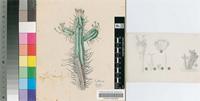
Described from living plants cultivated at Kew and from living specimens sent to Kew by Messrs. Galpin and Rattray. In the Kew Herbarium is preserved a drawing of a branch (probably a rooted cutting) of this plant introduced by Bowie in 1823. This drawing represents a very poor shrivelled and spineless branch, and although doubtless the species, is evidently not the actual specimen, described by Haworth, since he describes its spines. Galpin's 8101 is stouter than the other living specimens seen, but is quite the same as the Alicedale and Keimouth plants.