JSTOR Global Plants Home
  • Home
  • Browse
  • About
  • Access
  • Account
    • Saved Items
    • Profile
  • Log in

Global Plants

Skip to Main Content
  • JSTOR Global Plants Home
  • Global Plants

    • Browse
    • About
    • Access
    • Account
      • Saved Items
      • Profile
Log in
  • Browse
  • About
  • Access
  • Account
    • Saved Items
    • Profile
Advanced Search

Compilation
Euphorbia parvifolia

8 Images see all

Syntype of Euphorbia parvifolia E.Mey. ex Boiss. [family EUPHORBIACEAE]
Filed as Euphorbia parvifolia Boiss. [family EUPHORBIACEAE]
Syntype of Euphorbia parvifolia E. Mey. ex Boiss. [family EUPHORBIACEAE]
Euphorbia inaequilatera Sond. var. inaequilatera [family EUPHORBIACEAE]
Filed as Euphorbia inaequilatera Sond. [family EUPHORBIACEAE]
Filed as Euphorbia parvifolia E.Mey. ex Boiss.; nom. illeg. [family EUPHORBIACEAE]
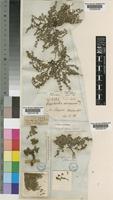
Isotype of Euphorbia parvifolia E. Mey. [family EUPHORBIACEAE]
Filed as Euphorbia parvifolia E.Mey. ex Boiss.; nom. illeg. [family EUPHORBIACEAE]
Previous
Next

Name

Identification
Isotype of Euphorbia parvifolia E. Mey. [family EUPHORBIACEAE ] (stored under name); Verified by Not on sheet,
Related name
  • `
  • Euphorbia sanguinea
  • Euphorbia parvifolia
  • Euphorbia inaequilatera

Flora

Entry for EUPHORBIA inæquilatera Sond. [family EUPHORBIACEAE]
Herbarium
Royal Botanic Gardens, Kew (K)
Collection
Flora Capensis
Resource Type
Reference Sources
Entry From
Flora Capensis, Vol 5, Part 2, page 216, (1925) Author: (By N. E. BROWN, J. HUTCHINSON and D. PRAIN.)
Names
EUPHORBIA inæquilatera Sond. [family EUPHORBIACEAE], in Linnæa, xxiii. 105;—Walp. Ann. iii. 358.
EUPHORBIA parvifolia E. Meyer [family EUPHORBIACEAE], in Drège, Zwei Pfl. Documente, 184 (name only), and ex Boiss. in DC. Prodr. xv. ii. 34, 35.
EUPHORBIA setigera E. Meyer [family EUPHORBIACEAE], in Drège, Zwei Pfl. Documente, 184 (name only), and ex Boiss. in DC. Prodr. xv. ii. 34, 35.
EUPHORBIA sanguinea Hochst. & Steud. ex Boiss. [family EUPHORBIACEAE], in DC. Prodr. xv. ii. 35 (including vars. setigera and natalensis, Boiss.); N. E. Br. in Dyer, Fl. Trop. Afr. vi. i. 508.
Anisophyllum inæquilaterum Klotzsch & Garcke [family ], in Abhandl. Akad. Berlin, 1860, 22.
Anisophyllum Mundii Klotzsch & Garcke [family ], l.c. 25.
Anisophyllum setigerum Klotzsch & Garcke [family ], l.c. 29.
Information
annual; stems several, prostrate or occasionally apparently erect, 1–6 in. long, spreading from the crown of the root, pinnately branched, often angular, glabrous all round; leaves opposite, shortly petiolate, 1–5 lin. long, 1/3–2 1/2 lin. broad, oblong or obliquely elliptic, obtusely rounded at the apex, obliquely half-cordate at the base, entire or toothed, glabrous on both sides, herbaceous or subcoriaceous, sometimes marked with a red spot or blotch; stipules all free or those on the underside of the stem more or less united, subulate or cut into filiform segments, often as long as or longer than the petioles; involucres solitary and axillary on very short axillary branchlets, minute, very shortly pedunculate, 1/3– 1/2 lin. long and as much in diam., subcampanulate or globose-campanulate, glabrous, with 4 glands and 5 minute ciliate lobes; glands minute, half surrounded by a narrow entire or 2–3-toothed appendage, sometimes almost obsolete; capsule 3/4–1 lin. in diam., glabrous, exserted on a pedicel slightly longer than the involucre and recurved; styles very minute, bifid; seeds 2/3– 3/4 lin. long, 4-angled, with slight transverse rugosities, pale reddish or whitish. null
Range
Also in Tropical Africa and Arabia.
Distribution
CENTRAL REGION Calvinia Div.; Bitterfontein, Zeyher, 1541! Prince Albert Div.; by the Gamka River, Mund & Maire, 15! Jansenville Div.; Zwartruggens, Drège, 8191! Graaff Reinet Div.; Ryneveldt Pass, Bolus, 412! Murraysburg Div.; near Murraysburg, Tyson, 338! Albert Div., Cooper, 786!COAST REGION Bedford Div.; Goba River, MacOwan, 1469! Fort Beaufort Div.; Adelaide, Rogers, 4494! Queenstown Div.; near Queenstown, Galpin, 1950! King Williamstown Div.; near King Williamstown, Schlechter, 6122! East London  Div.; near East London, Rattray, 882! Komgha Div.; banks of the Kei River, Drège, 4618!EASTERN REGION Natal; near Ladysmith, Gerrard, 611! Clairmont, Wood, 1432! near Weenen, Wood, 4436! near Durban, Miss Owen! and without precise locality, Gerrard, 60! Var. β: near Tugela, Wood, 3552! near Durban, Miss Owen!KALAHARI REGION Griqualand West; Kimberley, Marloth, 745! Orange River Colony; Thaba Unchu, Burke! Sand River, Burke! Bloemfontein, Burtt-Davy, 11849! 11850! Transvaal; various localities, Rehmann, 6673! Wilms, 1338! Miss Leendertz, 18! 36! Burtt-Davy, 51, 1164! 1194! 1226! 1459! Var. β: Orange River Colony; Sand River, Burke, 507! Bechuanaland; near the sources of the Kuruman River, Burchell, 2476; between the sources of the Kuruman River and Kosifontein, Burchell, 2535! Transvaal; Fourteen Streams, Burtt-Davy, 1544! Schweizer Reneke, Burtt-Davy, 1695! Waterval, Miss Leendertz, 823! hills near Wilge River, Schlechter, 3744! near Pretoria, Kirk, 49! and without precise locality, Zeyher, 1542!WESTERN REGION Great Namaqualand; various localities, Pearson, 3161! 3736! 4285! 4327! 4689! 4769! 4776! 8181! Little Namaqualand; between Holgat River and the Orange River, Drège, 2953!
Notes
When working out the Tropical African species of Euphorbia I had not investigated those of South Africa, but now that I have done so, I find that all the names above referred to this species certainly belong to one and the same plant. It therefore becomes necessary in accordance with the rule of priority to adopt the name E. inæquilatera, Sond., for this species instead of that of E. sanguinea, Hochst. and Steud., adopted in the Flora of Tropical Africa, because it is the first name for the plant that was published with a description. E. inæquilatera was published in 1850, and although the names E. parvifolia and E. setigera were published by Drège in 1843, they are mere names in a catalogue, unaccompanied by any description, and the name E. sanguinea was not published until 1862, when Boissier gave a description of it, as he then also did of E. parvifolia and E. setigera for the first time.

Related Materials

  • Terms and Conditions
  • Privacy Policy
  • Cookie Policy
  • Cookie Settings
  • Accessibility
  • Help
  • Contact Us
  • Facebook
  • Twitter
ITHAKA

JSTOR is part of ITHAKA, a not-for-profit organization helping the academic community use digital technologies to preserve the scholarly record and to advance research and teaching in sustainable ways.

©2000-2026 ITHAKA. All Rights Reserved. JSTOR®, the JSTOR logo, JPASS®, Aluka®, and ITHAKA® are registered trademarks of ITHAKA.

╳