JSTOR Global Plants Home
  • Home
  • Browse
  • About
  • Access
  • Account
    • Saved Items
    • Profile
  • Log in

Global Plants

Skip to Main Content
  • JSTOR Global Plants Home
  • Global Plants

    • Browse
    • About
    • Access
    • Account
      • Saved Items
      • Profile
Log in
  • Browse
  • About
  • Access
  • Account
    • Saved Items
    • Profile
Advanced Search

Compilation
Euphorbia nigrispina

2 Images see all

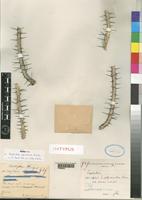
Isotype of Euphorbia nigrispina [family EUPHORBIACEAE]
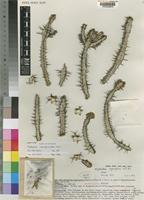
Euphorbia nigrispinoides M.G.Gilbert [family EUPHORBIACEAE]
Previous
Next

Name

Identification
Euphorbia nigrispina N.E.Br. [family EUPHORBIACEAE ] (stored under name); Verified by Data not digitized, Isotype of Euphorbia nigrispina [family EUPHORBIACEAE ] Verified by Data not digitized,
Related name
  • Euphorbia nigrispina
  • Euphorbia nigrispinoides

Flora

Entry for EUPHORBIA nigrispina N. E. Br. [family EUPHORBIACEAE]
Herbarium
Royal Botanic Gardens, Kew (K)
Collection
Flora Somalia
Resource Type
Reference Sources
Entry From
Flora Somalia, Vol 1, (1993) Author: by S. Carter (Euphorbia, Monadenium), M. G. Gilbert (Acalypha, Andrachne, Antidesma, Bridelia, Caperonia, Cephalocroton, Chrozophora, Clutia, Dalechampia, Flueggea, Givotia, Manihot, Meineckia, Micrococca, Oldfieldia, Phyllanthus, Ricinus, Suregada, Tragia), and M. Thulin (Croton, Drypetes, Erythrococca, Excoecaria, Jatropha, Spirostachys and Thecacoris) [updated by M. Thulin 2008]
Names
EUPHORBIA nigrispina N. E. Br. [family EUPHORBIACEAE], (1911).
Information
Densely branched compact shrub 0.5–1.5 m high, but when growing in shade sometimes to 2 m high with lax branching from a central stem. Branches erect, fleshy, 4(–6)-angled, c. 1 cm wide without constrictions, or occasionally sturdier to 2 cm wide with slight constrictions forming segments c. 3–6 cm long; angles straight or very shallowly toothed. Spine-shields 3–8 mm long, truncate at the base, joined to form a continuous horny margin 1.5–2.5 mm wide along the angles, sometimes very robust to 4 mm wide, interrupted by the flowering eyes on young growth; spine-pairs usually very irregular in length, (1–)5–10(–15) mm long, slender or sometimes robust; prickles minute, conical. Cymes solitary, subsessile, 1-forked with subsessile cyathia. Cyathia 4 mm in diam.; glands 1.75 mm broad, touching, yellow. Styles 2 mm long. Capsule sessile, obtusely 3-lobed, 3.5 x 4.5 mm, purplish black. Seeds ovoid, 1.7 x 1.5 mm, densely tuberculate, buff.
Range
N1, 2
Altitude range
675–1700 m.
Distribution
SOMALIA Gillett 4440, 22862; Bally 10354.
Distribution (external)
Djibouti
E Ethiopia
Notes
Delamah duh, dibu, dibu yer (Som.). One of the most common species of succulent Euphorbia along the northern mountain ranges, variable in habit and robustness. Plants in shade, or on slopes influenced by the mist belt, tend to be taller, developing an obvious central stem with lax branching (e.g. Carter 896). Shrubs on drier south-facing slopes become more robust, with wider branches and a stronger spinescence (e.g. Bally 9671). Spine-length is typically very variable on each branch, but at times of good growth spines can be of equal length (e.g. Bally 7115), or become almost obsolete at times of little growth (e.g. Gillett 4585). From herbarium specimens the Somali populations appear to be conspecific with plants from the Gobelli Valley, south of Harar in Ethiopia, which are identified in Fl. Eth. Er. 2(2): 342 (1995) as E. nigrispina. However, until more is known of E. nigrispina at its type locality some distance to the south at Ueb Caranle, identification of Somali material as this species cannot be made with absolute certainty. In Somalia, more than one taxon may also be involved. Gillett 4256 was erroneously identified as E. inaequispina N. E. Br. in Kew Bull. 2: 111 (1941), and 4585 (as 4584) as E. infausta N. E. Br., a synonym of E. polyacantha Boiss.

Related Materials

  • Terms and Conditions
  • Privacy Policy
  • Cookie Policy
  • Cookie Settings
  • Accessibility
  • Help
  • Contact Us
  • Facebook
  • Twitter
ITHAKA

JSTOR is part of ITHAKA, a not-for-profit organization helping the academic community use digital technologies to preserve the scholarly record and to advance research and teaching in sustainable ways.

©2000-2026 ITHAKA. All Rights Reserved. JSTOR®, the JSTOR logo, JPASS®, Aluka®, and ITHAKA® are registered trademarks of ITHAKA.

╳