JSTOR Global Plants Home
  • Home
  • Browse
  • About
  • Access
  • Account
    • Saved Items
    • Profile
  • Log in

Global Plants

Skip to Main Content
  • JSTOR Global Plants Home
  • Global Plants

    • Browse
    • About
    • Access
    • Account
      • Saved Items
      • Profile
Log in
  • Browse
  • About
  • Access
  • Account
    • Saved Items
    • Profile
Advanced Search

Compilation
Euphorbia muirii

6 Images see all

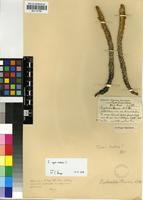
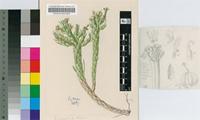
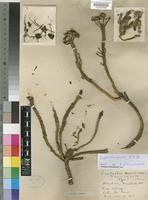
Syntype of Euphorbia muirii N.E.Br. [family EUPHORBIACEAE]
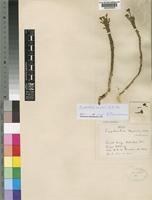
Euphorbia muirii N.E.Br. [family EUPHORBIACEAE]
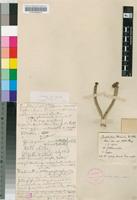
Type of Euphorbia muirii N.E.Br. [family EUPHORBIACEAE]
Euphorbia muirii N.E.Br.
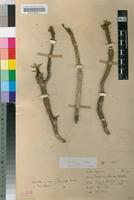
Type of Euphorbia muirii N.E.Br. [family EUPHORBIACEAE]
Previous
Next

Name

Identification
Euphorbia muirii N.E.Br. [family EUPHORBIACEAE ]
Related name
  • Euphorbia muirii

Flora

Entry for EUPHORBIA Muirii N. E. Br. [family EUPHORBIACEAE]
Herbarium
Royal Botanic Gardens, Kew (K)
Collection
Flora Capensis
Resource Type
Reference Sources
Entry From
Flora Capensis, Vol 5, Part 2, page 216, (1925) Author: (By N. E. BROWN, J. HUTCHINSON and D. PRAIN.)
Names
EUPHORBIA Muirii N. E. Br. [family EUPHORBIACEAE]
Information
rootstock or main body of the plant buried in the ground, not seen; stems or branches 6–8 in. (or perhaps more) high, 3 1/2–4 1/2 lin. thick when dried, evidently much stouter when alive, erect, simple or with a whorl of 3–7 branches at or near the top, succulent, cylindric, covered with rhomboid tubercles 2 1/2–6 lin. long, 1 1/2–2 lin. broad and 1/2–1 lin. prominent, tipped with a white leaf-scar, spineless, but often with (sometimes without) some persistent peduncles, glabrous; leaves erect, 2 1/2–5 1/2 lin. long, 1/2– 3/4 lin. broad, linear, acute, fleshy, apparently channelled down the face and keeled on the back, glabrous; peduncles 4–11 lin. long, solitary in the axils of the tubercles, usually forming an umbel-like cluster at the tips of the branches, glabrous, bearing 4–6 bracts and 1 involucre; bracts 1 1/2–2 lin. long, oblong to elliptic-obovate, concave, entire, glabrous outside, thinly pubescent within, ciliate; involucre 4–4 1/2 lin. in diam., probably larger when alive, broadly cup-shaped, with 5 glands and 5 large transversely elliptic toothed lobes, thinly pubescent outside and in front of the glands and on the lobes within; glands 1 1/3–2 lin. in diam., broadly cuneate, palmatifidly divided to about half-way down into 4–6 abruptly reflexed linear segments, dilated and entire or slightly toothed at their apices; undivided part entirely glandular, most minutely rugulose, not pitted, apparently yellowish-green, with the inner margin turned up, forming a small lip; segments apparently white; ovary sessile, included, glabrous; styles 1 1/2 lin. long, united into a column nearly to the apex, with slightly spreading thickened subentire tips; capsule sessile, 3 lin. long and 4 1/2 lin. in diam., very obtusely and shallowly 3-lobed as seen from above, glabrous; seeds 1 3/4–2 lin. long, ovoid, usually slightly keeled on the back, minutely scabrid-tuberculate all over, blackish-brown. null
Distribution
COAST REGION Robertson Div.; Sand Berg, Pearson, 2261! Riversdale Div.; Albertina, Muir! and Muir, 174, from Stil Bay, probably also belongs here, but the specimen seen is without flowers or fruit.
Notes
Dr. Muir informed me the above-ground stems or branches of this species are solitary.

Related Materials

  • Terms and Conditions
  • Privacy Policy
  • Cookie Policy
  • Cookie Settings
  • Accessibility
  • Help
  • Contact Us
  • Facebook
  • Twitter
ITHAKA

JSTOR is part of ITHAKA, a not-for-profit organization helping the academic community use digital technologies to preserve the scholarly record and to advance research and teaching in sustainable ways.

©2000-2026 ITHAKA. All Rights Reserved. JSTOR®, the JSTOR logo, JPASS®, Aluka®, and ITHAKA® are registered trademarks of ITHAKA.

╳