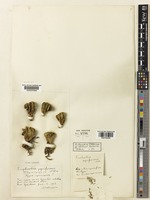
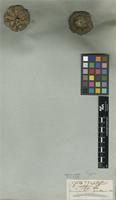
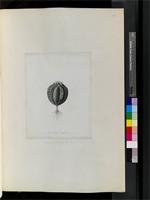
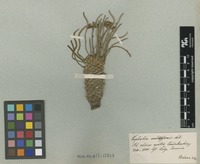
plant solitary, unbranched, succulent, subglobose, depressed at the apex, 2–6 in. in diam., diœcious, unbranched, usually 8-angled, leafless, spineless, but in the male plant with persistent hardened remains of the flower-cymes, glabrous, usually marked, with oblique transverse light green and purple-brown or darker green bands, rarely entirely green; angles vertical or spiral, obtuse or subacute, obscurely crenate, with leaf- or cyme-scars 1 1/2–3 lin. apart; leaves rudimentary, soon deciduous, 1/2–1 1/2 lin. long, linear, channelled, acute, tipped with a short subulate point, minutely ciliate; cymes arising at the centre of the apex of the plant, spreading over and pressed down near the surface, those of the male 1/3–2 1/2 in. long, divided at 1–3 lin. above the base into 3 spreading once- or twice-forked rays, those of the female sessile or subsessile, 1/4– 1/2 in. long, divided close to the base into 2–3 simple or once-forked rays, puberulous in both sexes, often persistent on the male, deciduous from the female plant; bracts about 1 lin. long, oblong, obtuse, apiculate, minutely ciliate; male involucre about 2 lin. and the female 1–1 1/2 (or in mature fruit 2) lin. in diam., cup-shaped, puberulous outside, green, with 5 glands and 5 transversely oblong or subquadrate ciliate lobes; glands 1/4– 2/3 lin. in their greater diam., transversely oblong or elliptic or with the inner margin somewhat excavated, entire, light green and minutely punctate in both sexes; capsule sessile, about 1/4 in. in diam., very obtusely trigonous, minutely puberulous; styles 1/2– 2/3 lin. long, very shortly united at the base, with broadly cuneate spreading 2-lobed tips, 1/2– 2/3 lin. broad; seeds 1 1/2 lin. long, conical-ovoid, acute, smooth, greyish-brown. null