

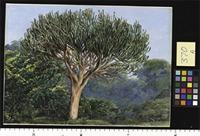
Name
Identification
Euphorbia grandidens
Related name
- Euphorbia grandidens
Flora
Entry for EUPHORBIA ingens E. Meyer [family EUPHORBIACEAE]
Herbarium
Royal Botanic Gardens, Kew (K)
Collection
Flora Capensis
Resource Type
Reference Sources
Entry From
Flora Capensis, Vol 5, Part 2, page 216, (1925) Author: (By N. E. BROWN, J. HUTCHINSON and D. PRAIN.)
Names
EUPHORBIA ingens E. Meyer [family EUPHORBIACEAE], in Drège, Zwei Pfl. Documente, 184, ex Boiss. in DC. Prodr. xv. ii. 87
EUPHORBIA Cooperi Berger [family EUPHORBIACEAE], Sukk. Euphorb. 84, fig. 21 only, not as to description.
EUPHORBIA grandidens Adlam [family EUPHORBIACEAE], in Gard. Chron. 1886, xxvi. 720, fig. 139, not of Haw.
Information
a tree, 20–30 ft. high, succulent, leafless, spiny, branching in a broadly obconical manner; branches erect or ascending, straight, subparallel, all attaining to about the same general level; flowering branches 4–7-angled, constricted into segments 3–6 in. long, 1 1/2–3 in. (or perhaps more) in diam., with the solid central part 3/4–1 in. in diam.; angles wing-like, 2 1/2–3 lin. thick at the obscurely crenate or sinuate margin, 3/4–1 1/4 in. broad, deep green; leaves rudimentary and scale-like, 1–1 1/2 lin. long, obovate or broadly ovate, acute, with a hard rigid dark brown auricle (stipule) on each side at the base, glabrous, soon deciduous; spine-shields 2/3– 3/4 in. apart, 2–2 1/2 lin. in diam., suborbicular or transversely elliptic or reniform, usually poorly developed and formed of a thin rust-coloured disintegrating substance, spineless or with a pair of reduced spines 1/4–1 lin. long; flowering-eyes nearly or quite contiguous to the spine-shields, each with 3 cymes on stout peduncles 1–1 1/2 lin. long, bearing 3 involucres, all at first sessile, the lateral ultimately on very short branches; bracts 1 1/2–2 1/2 lin. long, 2–3 lin. broad, very broadly rounded, obtuse or subacute, concave, glabrous; involucres 4–5 lin. in diam., cup-shaped or somewhat obconic, glabrous outside, pale green, with 5 glands and 5 transversely oblong or subquadrate fringed lobes; glands contiguous, 1 1/2–2 1/2 lin. in their greater diam., somewhat half circular in outline when seen from above, and from beneath somewhat triangular with rounded auricles at the base, thick and fleshy, with a sharp ridge along their inner margin, thence sloping to the acute edge of the outer margin, smooth, but in dried flowers more or less wrinkled, “light green” (Marloth); ovary at first subsessile, with a conspicuous 3-lobed calyx at its base, becoming exserted in young fruit on a stout pedicel as long as the involucre, glabrous; calyx-lobes in fruit very broadly cuneate or transversely rectangular at the basal part and produced into 2–3 linear-filiform segments 1–2 lin. long; styles united into a column 3/4 lin. long, with radiating arms 3/4–1 lin. long, subentire or minutely 2-lobed at the apex; capsule erect, 4–5 lin. in diam., with the outer substance evidently somewhat fleshy, glabrous; seeds 1 3/4–2 lin. long, ellipsoid, with a slight groove down the ventral side, and a slight keel down the dorsal, very faintly and minutely tuberculate as seen under a lens, brown. null
Distribution
EASTERN REGION Natal; in woods near Durban, Drège, 4614! Inchanga, Marloth, 5111! and probably a flowerless specimen from steep rocky hillsides near Camperdown, Burtt-Davy, 10434!KALAHARI REGION Transvaal; near Barberton, Pole Evans, 2919! 2931! Pruizen Farm, Potgieters Rust, Burtt-Davy, 2200! 5658!
Notes
Of this species, Drège only collected a few transverse sections and strips from the angles of the branches, which have been badly eaten by insects. The flowers of his specimen are very young, with neither stamens nor ovary exserted from the involucre, but in the form, size and glands of the involucre, and in the very distinct calyx under the ovary and in the styles, it exactly agrees with the Inchanga and Transvaal plants, of which latter I have seen good fruiting specimens, but none in young flower. There are no leaves upon Drège's specimen, but upon the Camperdown and Transvaal specimens they are as described above. Upon a plant brought from Inchanga in Natal by Dr. R. Marloth and cultivated by him at Cape Town, the well-developed leaves are 3/4–1 in. long and 5–6 lin. broad, sessile, oblong-obovate, obtusely rounded and mucronate or slightly toothed at the apex.