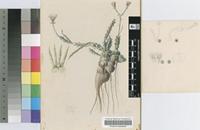
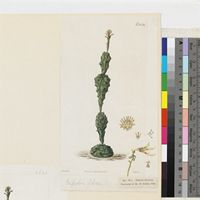
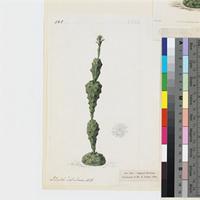
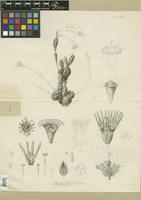
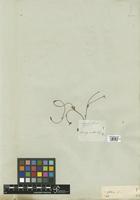
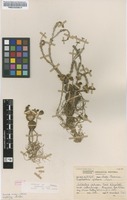
plant (excl. the flowers) 1–3 in. high, succulent, spineless, consisting of a cluster of branches superposed or connected together like beads on a string; branches or joints usually depressed-globose, thicker than long and 1/2–1 in. in diam., but sometimes ellipsoid, obovoid or clavate and 1/2–1 in. long, 1/3–1 1/8 in. thick, marked in a somewhat tessellate manner by impressed lines into irregularly 6-angled flattish or slightly prominent tubercles, with a slightly raised leaf-scar at their centre, glabrous, dull green or purplish where exposed to the sun, not glaucous, becoming pale grey or brownish with age; leaves rudimentary, deciduous, 3/4–1 1/2 lin. long, lanceolate, acute, erect or spreading; peduncles terminal, some not more than 1–2 lin. long, bearing 1 involucre and usually perfecting fruit, others (and the more numerous) 1/2–3 in. long, bearing about 2 minute leaves near the base and a whorl of 3–4 larger ovate or elliptic-lanceolate acute leaves 2–2 1/2 lin. long and 1 lin. broad under the solitary involucre at the apex, occasionally they fork 1–3 times into a lax cyme and bear three to several involucres, male or perfecting fruit, glabrous; involucre (including the glands) 1/2– 2/3 in. in diam., obconic, glabrous, green, with 5 glands and 5 inflexed-connivent quadrate entire minutely ciliate lobes; glands ascending-spreading, 2–3 lin. long and nearly quite as broad, deeply divided into 3–4 subulate green segments with minute white-margined pits scattered along their upper side and a white and pitted margin to the cavity in the united basal part, which has a small white lobe folded over it; capsule very obtusely and slightly 3-lobed, exserted and curved to one side, glabrous; styles 1 1/2 lin. long, united for about half their length, slightly spreading above and slightly thickened at the entire tips. null