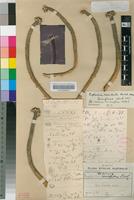
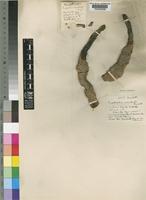
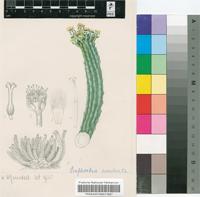
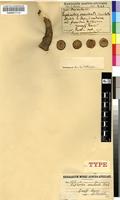
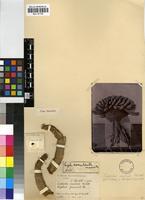
very dwarf, succulent, spineless and leafless; main stem buried in the ground nearly to the top, club-shaped or obconic, 4–8 in. thick, with the central part of the flat or slightly depressed top covered with conical acute tubercles and the outer part bearing a rosette (in old plants attaining to 18 in. in diam.) of very numerous crowded branches in several series, glabrous, green on the young parts, becoming pale brown with age; branches radiately spreading, 2–8 in. long, 1/2–1 in. thick, cylindric or the outermost tapering from the base to the obtuse apex, quite unbranched, tessellately tuberculate; tubercles densely crowded in many spirals, flattish, scarcely or but very slightly prominent, 1 1/2–3 lin. in diam., usually a little longer than broad, obovate-rhomboid or subhexagonal, with a minute central leaf-scar; leaves rudimentary, minute, soon deciduous; peduncles clustered at the ends of the branches, 1/2–2 lin. long, stout, with 2–3 alternate and 2 opposite bracts and 1 involucre, glabrous, not persisting more than one season; bracts oblong or oblong-spathulate, glabrous; ciliate; involucres 1 3/4–2 1/2 lin. in diam., broadly and shallowly cup-shaped, glabrous except on the back of the lobes, with 5–6 glands and 5–6 broad transversely oblong ciliate lobes and densely filled with white-woolly bracteoles; glands distant, reflexed and closely pressed to the involucre, 1/2–1 lin. in their greater diam., transverse and somewhat reniform or irregular in outline, more or less deeply fissured and sometimes divided into 2 or more parts, rather thick and fleshy, convex, slightly corrugated, brown; ovary sessile, glabrous; styles united into a column about 1 lin. long with recurved-spreading arms 1/2– 2/3 lin. long, with very large stigmas deeply channelled down the face; capsule and seeds not seen. null