JSTOR Global Plants Home
  • Home
  • Browse
  • About
  • Access
  • Account
    • Saved Items
    • Profile
  • Log in

Global Plants

Skip to Main Content
  • JSTOR Global Plants Home
  • Global Plants

    • Browse
    • About
    • Access
    • Account
      • Saved Items
      • Profile
Log in
  • Browse
  • About
  • Access
  • Account
    • Saved Items
    • Profile
Advanced Search

Compilation
Euphorbia conspicua

3 Images see all

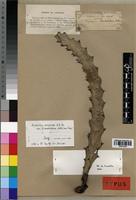
Isotype of Euphorbia conspicua N. E. Br. [family EUPHORBIACEAE]
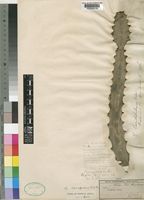
Euphorbia conspicua N.E.Br. [family EUPHORBIACEAE]
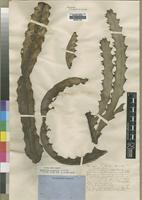
Isolectotype of Euphorbia candelabrum Welw. ex Hiern [family EUPHORBIACEAE]
Previous
Next

Name

Identification
Euphorbia conspicua N.E.Br. [family EUPHORBIACEAE ] (stored under name); Euphorbia candelabrum Welw. ex Hiern [family EUPHORBIACEAE ]
Related name
  • Euphorbia candelabrum
  • Euphorbia conspicua

Flora

Entry for EUPHORBIA conspicua N. E. Br. [family EUPHORBIACEAE]
Herbarium
Royal Botanic Gardens, Kew (K)
Collection
Flora of Tropical Africa
Resource Type
Reference Sources
Entry From
Flora of Tropical Africa, Vol 6, Part 1, page 441, (1913) Author: (By J. G. Baker, with additions by C. H. Wright.)
Names
EUPHORBIA conspicua N. E. Br. [family EUPHORBIACEAE]
EUPHORBIA Candelabrum Welw. [family EUPHORBIACEAE], in Annaes Conselho Ultramar. Lisb. no. 24 (1856), 251, n. 5; Hiern in Cat. Afr. Pl. Welw. i. 946.
EUPHORBIA Monteiro [family EUPHORBIACEAE], Angola, i. 24, 27, 29, t. 1.
Information
A succulent tree 15–50 ft. high, leafless and spiny, with a trunk 1–2 1/2 ft. thick. Branches and branchlets more or less whorled, radiately spreading and ascending-curved, with the trunk and main branches 3–8-angled, narrowed to the distant constrictions; branchlets mostly 3-angled, 1–1 1/2 in. broad across each face; angles wing-like, sinuately toothed, with the teeth 1/2–1 1/2 lin. apart and projecting 1 1/2–2 lin., bearing a pair of dark brown diverging spines 1–3 lin. long on a dark brown horny shield which is decurrent to an acute point 1 1/2–3 lin. below the spines. Flowering-eyes 2–2 1/2 lin. above the spines, separate or sometimes connected with the spine-shields by a horny border. Cymes 1–3 at each eye, crowded at the ends of the branchlets, with stout glabrous peduncles about 5 lin. long. Involucres apparently 2 1/2–3 lin. in diam., but all damaged by insects on the specimens seen, red (Welwitsch).
Distribution
Angola Lower Guinea Loanda, Welwitsch, 641! coast region to about 20 miles inland, plentiful, ex Monteiro.
Notes
Probably Welwitsch, 637 and 641B, from near Mangue and Candumba in Pungo Andongo, and 636 from the Chella Mountains in Bumbo, also belong to this species, but good flowering and fruiting material are wanting for correct identification.

Related Materials

  • Terms and Conditions
  • Privacy Policy
  • Cookie Policy
  • Cookie Settings
  • Accessibility
  • Help
  • Contact Us
  • Facebook
  • Twitter
ITHAKA

JSTOR is part of ITHAKA, a not-for-profit organization helping the academic community use digital technologies to preserve the scholarly record and to advance research and teaching in sustainable ways.

©2000-2026 ITHAKA. All Rights Reserved. JSTOR®, the JSTOR logo, JPASS®, Aluka®, and ITHAKA® are registered trademarks of ITHAKA.

╳