JSTOR Global Plants Home
  • Home
  • Browse
  • About
  • Access
  • Account
    • Saved Items
    • Profile
  • Log in

Global Plants

Skip to Main Content
  • JSTOR Global Plants Home
  • Global Plants

    • Browse
    • About
    • Access
    • Account
      • Saved Items
      • Profile
Log in
  • Browse
  • About
  • Access
  • Account
    • Saved Items
    • Profile
Advanced Search

Compilation
Euphorbia benguelensis

2 Images see all

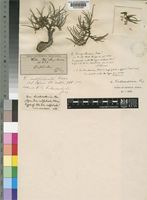
Euphorbia trichadenia Pax [family EUPHORBIACEAE]
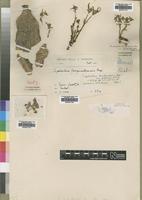
Syntype of Euphorbia benguelensis Pax [family EUPHORBIACEAE]
Previous
Next

Name

Identification
Euphorbia benguelensis Pax [family EUPHORBIACEAE ] Euphorbia trichadenia N.E.Br. [family EUPHORBIACEAE ] (stored under name);
Related name
  • Euphorbia subfalcata
  • Euphorbia trichadenia
  • Euphorbia benguelensis

Flora

Entry for EUPHORBIA trichadenia Pax [family EUPHORBIACEAE]
Herbarium
Royal Botanic Gardens, Kew (K)
Collection
Flora Capensis
Resource Type
Reference Sources
Entry From
Flora Capensis, Vol 5, Part 2, page 216, (1925) Author: (By N. E. BROWN, J. HUTCHINSON and D. PRAIN.)
Names
EUPHORBIA trichadenia Pax [family EUPHORBIACEAE], in Engl. Jahrb. xix. 125;—N. E. Br. in Dyer, Fl. Trop. Afr. vi. i. 523.
EUPHORBIA benguelensis Pax [family EUPHORBIACEAE], in Bull. Herb. Boiss. vi. 741.
EUPHORBIA subfalcata Hiern [family EUPHORBIACEAE], Cat. Afr. Pl. Welw. i. 948.
EUPHORBIA Gossweileri Pax [family EUPHORBIACEAE], in Engl. Jahrb. xliii. 88.
Information
a perennial herb; rootstock a tuber with an elongated neck, producing annual herbaceous stems 1–4 in. high, branching from the base, puberulous or glabrous; leaves opposite at the flowering nodes and forkings of the stem, alternate elsewhere, sessile, thinly coriaceous or perhaps slightly fleshy, 3/4–2 1/2 in. long, 1/2–2 1/2 lin. broad, linear, acute, usually slightly curved, often longitudinally folded, glabrous on both sides, sometimes ciliate on the narrow cartilaginous margins; lowest leaves and sometimes those under the involucres (bracts) much smaller, lanceolate, linear-lanceolate or scale-like; stipules none; involucres solitary in the forkings of the stems or sometimes 3–5 in small terminal cymes, shortly pedunculate, 4–5 lin. in diam., cup-shaped, glabrous or minutely puberulous outside, with 5 glands and 5 transversely rectangular or subquadrate fringed lobes; glands 1 1/3–1 2/3 lin. long, 1 1/2–2 lin. broad, palmate or somewhat fan-shaped, deeply divided into 3–7 (or more?) linear or filiform segments 3/4–1 1/2 lin. long, once or twice forked at the apex, flat or channelled but not corrugated on their upper surface, with the undivided basal part concave or 2-lipped from the inner margin being inflexed; capsule 5–5 1/2 lin. in diam., glabrous, exserted on an erect pedicel equalling or exceeding the involucre; styles united into a column 1–1 3/4 lin. long, with revolute arms 3/4–1 1/4 lin. long, minutely 2-lobed at the tips; seeds 1 1/2–2 lin. in diam., globose, acutely pointed at one end, thinly and minutely subrugulose with what appear to be irregular agglutinated masses of minute hairs. null
Range
Also in Tropical Africa.
Distribution
KALAHARI REGION Transvaal; tops of mountains at Rietfontein in Zoutpansberg district, Miss Leendertz, 872! Warmbath, Burtt-Davy, 5337! Pilgrims Rest, Greenstock! between Komati River Drift and Crocodile River, Bolus, 9766! and without precise locality, Burke! Zeyher, 1539 partly!
Notes
Growths springing up after the vegetation has been burnt are very short and totally unlike those normally developed.

Related Materials

  • Terms and Conditions
  • Privacy Policy
  • Cookie Policy
  • Cookie Settings
  • Accessibility
  • Help
  • Contact Us
  • Facebook
  • Twitter
ITHAKA

JSTOR is part of ITHAKA, a not-for-profit organization helping the academic community use digital technologies to preserve the scholarly record and to advance research and teaching in sustainable ways.

©2000-2026 ITHAKA. All Rights Reserved. JSTOR®, the JSTOR logo, JPASS®, Aluka®, and ITHAKA® are registered trademarks of ITHAKA.

╳