JSTOR Global Plants Home
  • Home
  • Browse
  • About
  • Access
  • Account
    • Saved Items
    • Profile
  • Log in

Global Plants

Skip to Main Content
  • JSTOR Global Plants Home
  • Global Plants

    • Browse
    • About
    • Access
    • Account
      • Saved Items
      • Profile
Log in
  • Browse
  • About
  • Access
  • Account
    • Saved Items
    • Profile
Advanced Search

Compilation
Euphorbia basutica

4 Images see all

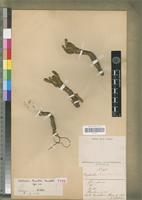
Type? of Euphorbia basutica Marloth [family EUPHORBIACEAE]
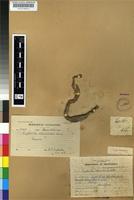
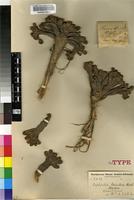
Type of Euphorbia basutica Marloth [family EUPHORBIACEAE]
Isotype of Euphorbia basutica Marloth [family EUPHORBIACEAE]
Previous
Next

Name

Identification
Euphorbia basutica Marloth [family EUPHORBIACEAE ] Euphorbia clavarioides Boiss. [family EUPHORBIACEAE ] (stored under name);
Related name
  • Euphorbia clavarioides
  • Euphorbia basutica

Flora

Entry for EUPHORBIA basutica Marloth [family EUPHORBIACEAE]
Herbarium
Royal Botanic Gardens, Kew (K)
Collection
Flora Capensis
Resource Type
Reference Sources
Entry From
Flora Capensis, Vol 5, Part 2, page 216, (1925) Author: (By N. E. BROWN, J. HUTCHINSON and D. PRAIN.)
Names
EUPHORBIA basutica Marloth [family EUPHORBIACEAE], in Trans. Roy. Soc. S. Afr. i. 408, t. 27, fig. 6, excl. syn.
Information
dwarf, succulent, spineless; main body of the plant subglobose or obconic, nearly buried in the ground, and excepting a small central tuberculate area covered over the top with very numerous (50–60) branches arranged in 4–5 series, forming a clump about 4 in. in diam. (not sparingly branched as originally described); branches 3/4–1 1/2 in. long, 4 1/2–6 lin. thick, simple or occasionally branching, more or less clavate, covered with transversely rhomboid or subhexagonal tubercles 1 1/2–2 lin. in diam. and 1/2– 3/4 lin. prominent, glabrous, green at the upper part, brown below; leaves rudimentary, soon deciduous, 1 lin. long, 1/2 lin. broad, lanceolate or narrowly elliptic, obtuse, very concave above as if longitudinally folded, very convex beneath, thick and fleshy; involucres solitary in the axils of tubercles near the apex of the branches, subsessile or on peduncles 1/2–1 lin. long, rather shallowly basin- or somewhat funnel-shaped, 3 1/2–4 lin. in diam., glabrous, with 5 glands and 5 transversely rectangular deeply toothed lobes; glands spreading, 1 1/3–2 lin. in their greater diam., subcontiguous or slightly separated, transversely oblong, with about 6 short entire or denticulate teeth along the outer margin, and the entire inner margin more or less turned up, forming a slight cavity in front of it, somewhat greenish; ovary sessile, included in the involucre, glabrous; styles united into a stout column 2/3– 3/4 lin. long, scarcely exceeding the lobes of the involucre, their very stout tips exserted, recurved-spreading, entire, broadly cuneate-obovate, channelled down the face, 2/3 lin. long and as much in breadth. null
Distribution
KALAHARI REGION Basutoland; Maseru (not Leribe as originally stated), Mrs. A. Dieterlen, 415!
Notes
Described partly from a branch in fluid accompanied by an excellent life-sized photograph from the type plant, communicated by Dr. E. P. Phillips, and partly from flowers in fluid from the same plant, kindly lent by Dr. Marloth and from which he made his original description. Dr. Marloth has, however, unfortunately identified this plant with E. Caput-Medusæ of DC. Plantes Grasses, t. 150, from which it is entirely different, that plant being E. Bergeri, N. E. Br., with different leaves and flowers and much longer persistent peduncles. Also at the time when the plant figured by De Candolle was introduced, Basutoland was practically an unknown country, and the plant could not have come from there.

Related Materials

  • Terms and Conditions
  • Privacy Policy
  • Cookie Policy
  • Cookie Settings
  • Accessibility
  • Help
  • Contact Us
  • Facebook
  • Twitter
ITHAKA

JSTOR is part of ITHAKA, a not-for-profit organization helping the academic community use digital technologies to preserve the scholarly record and to advance research and teaching in sustainable ways.

©2000-2026 ITHAKA. All Rights Reserved. JSTOR®, the JSTOR logo, JPASS®, Aluka®, and ITHAKA® are registered trademarks of ITHAKA.

╳