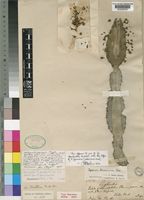
A candelabrum-like tree, 20 ft. high, leafless, spiny. Branches probably 4-angled; the only specimen seen consists of a piece 1 ft. long, with 2 angles, constricted into 5 narrowly elliptic joints 1 1/4–3 1/2 in. long and 5/6–1 3/4 in. broad, glabrous; angles wing-like, with even (not at all sinuate-toothed) margins. Spines 1–2 lin. long, in pairs 1/4– 1/2 in. apart, sometimes with another pair of minute or rudimentary spines or points 1/2– 3/4 lin. above them, diverging, dark brown, on horny brown orbicular shields, 1–1 1/2 lin. in diam., becoming grey with age. Flowering-eyes touching the shields, producing 2–3 cymes with peduncles 2–3 lin. long, each bearing 3 involucres, with the lateral on branches 1 1/2–2 1/2 lin. long, glabrous. Bracts membranous, suborbicular, about 1 1/2 lin. in diam., obtuse or apiculate, entire or minutely denticulate, glabrous. Involucre subsessile or very shortly pedunculate, 3 1/2–4 lin. in diam. and 1 1/2 lin. deep, shallowly cup-shaped, glabrous, with 5 glands and 5 short transverse fringed lobes; glands contiguous, about 1 3/4 lin. in their greater diam., reniform or transversely oblong, entire, unequally 2-lipped or with the inner margin turned up. Ovary subsessile, only partly exserted from the involucre, glabrous, with a calyx of about 5 filiform segments 2/3–1 lin. long; styles 1 lin. long, united at the base, thickened and 2-lobed at the apex. Fruit and seeds not seen.