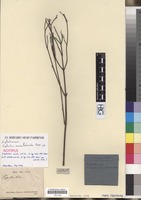
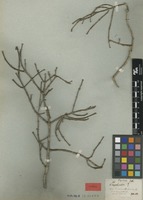
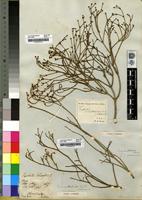
a much-branched succulent bush, 3/4–1 ft. high, leafless and spineless, unisexual; main stems 1 1/2–2 lin. thick at the base; main branches in 3–4 pairs, opposite, 1/2–1 lin. thick when dried, variably diverging, dichotomously and trichotomously forking into numerous branchlets, often variably curved, terete, usually slightly rough from minute papilla-like and mostly laterally compressed tubercles; leaves rudimentary, opposite, sessile or subsessile, often recurved, 2/3–1 lin. long, broadly ovate, oblong or oblong-obovate, very obtuse or subapiculate, usually with a small tooth or angle on each side near the base, slightly concave and puberulous on the upper surface, convex and glabrous on the back, dark brown, persistent; cymes once or twice forked, their ultimate branchlets 1 1/2–9 lin. long, 1-flowered; bracts shorter than the involucre, 3/4–1 lin. long, somewhat obovate or subspathulate or like the leaves; involucre unisexual, 1 1/4–1 3/4 lin. in diam. cup-shaped, very minutely puberulous at the very base, otherwise glabrous outside, with 5 glands and 5 oblong fringe-toothed lobes; glands 1/3– 3/4 lin. in their greater diam., transversely oblong, entire; capsule 2 lin. in diam., glabrous, with a circular disc-like calyx at its base and just exserted beyond the involucre; styles very shortly united at the base, with radiating arms 2/5 lin. long, bifid to below the middle; seeds about 1 lin. long, ovoid, subobtuse at the apex, truncate at the base, rugose. null