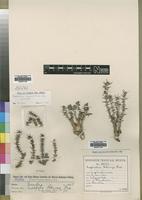
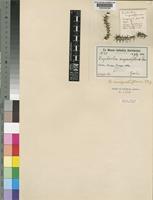
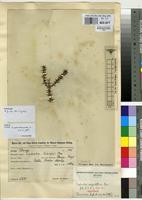
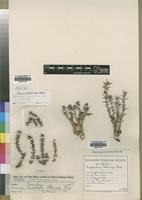
Isotype of Euphorbia angustifloraPax [family EUPHORBIACEAE ] (stored under name); Verified by Carter,S.,
Related name
Euphorbia angustiflora
Euphorbia schinzii
Flora
Entry for EUPHORBIA angustiflora Pax [family EUPHORBIACEAE]
Herbarium
Royal Botanic Gardens, Kew (K)
Collection
Flora of Tropical Africa
Resource Type
Reference Sources
Entry From
Flora of Tropical Africa, Vol 6, Part 1, page 441, (1913) Author: (By J. G. Baker, with additions by C. H. Wright.)
Names
EUPHORBIA angustifloraPax [family EUPHORBIACEAE], in Engl. Jahrb. xxxiv. 82.
EUPHORBIA SchinziiPax [family EUPHORBIACEAE], in Engl. Jahrb. xxx. 341, not of Bull. Herb. Boiss. vi. 739.
Information
A dwarf much-branched very spiny leafless succulent about 1 ft. high or less. Branches 1/4– 1/2 in. in diam. (less when dried), mostly 4-angled, with the opposing angles constricted so as to form opposite teeth or lobes 1/4– 2/3 in. apart and nearly truncate at the top and sloping inwards below the spines to form the constriction, sometimes with only 3 spirally twisted toothed angles, glabrous. Leaves rudimentary, 1/2 lin. long and nearly as broad, deltoid-ovate, acute; soon deciduous. Spines in pairs at the apex of the teeth, 2–3 1/2 lin. long, slender but very rigid, diverging, dark brown, with a pair of prickles 1/2–1 lin. long at their base or sometimes nearly obsolete, seated on narrow horny bright chestnut-brown shields, decurrent 1 1/2–3 lin. below the spines, but never forming a continuous horny margin to the angles. Flowering-eyes nearly or quite touching the apex of the shields. Cymes on peduncles 1/2–1 lin. long, glabrous, very immature in the specimens seen, with 3 involucres, the central on a distinct peduncle 1/2– 2/3 lin. long, subglobose and 2/3– 3/4 lin. in diam., but evidently only in bud, glabrous with 5 glands and 5 cuneately subquadrate fringed lobes; glands immature 1/3 lin. broad, half-circular; lateral involucres in very young bud.
Distribution
German East Africa Mozamb. Dist. Ubungu; on the Olunga Mountains, 4900 ft., Goetze, 1095!
Notes
Described from the type. This is extremely like E. Schinzii in appearance, but the pedunculate cymes, with the central involucre also pedunculate, easily distinguish it from that species.