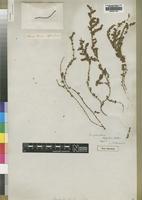
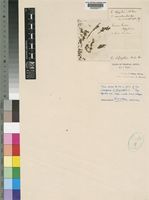
Euphorbia afzeliiN.E.Br. [family EUPHORBIACEAE ] (stored under name);
Related name
Euphorbia thymifolia
Euphorbia afzelii
Euphorbia convolvuloides
Flora
Entry for EUPHORBIA Afzelii N. E. Br. [family EUPHORBIACEAE]
Herbarium
Royal Botanic Gardens, Kew (K)
Collection
Flora of Tropical Africa
Resource Type
Reference Sources
Entry From
Flora of Tropical Africa, Vol 6, Part 1, page 441, (1913) Author: (By J. G. Baker, with additions by C. H. Wright.)
Names
EUPHORBIA AfzeliiN. E. Br. [family EUPHORBIACEAE]
Information
Habit as in E. ægyptiaca, Boiss., but perhaps perennial, with slender pinnately branching prostrate stems up to 1 ft. long, minutely puberulous with adpressed curved hairs all round or more or less glabrous on the under side, naked and somewhat woody with thickened nodes at the basal parts. Leaves opposite, shortly petiolate, very crowded on the lateral branches, 2–3 lin. long, 1/21 1/2 lin. broad, oblong or oblong-ovate, obtuse or acute at the apex, oblique or subequal at the rounded base, entire or minutely toothed, glabrous or with a few hairs above, thinly pubescent beneath. Stipules all free or those on the under side of the stem united. Inflorescence as in E. ægyptiaca, but involucre smaller, 1/3 lin. in diam.; glands with distinct although minute petaloid appendages much larger than themselves; styles 1/4 lin. long, deeply bifid. Capsule and seeds not seen.