JSTOR Global Plants Home
  • Home
  • Browse
  • About
  • Access
  • Account
    • Saved Items
    • Profile
  • Log in

Global Plants

Skip to Main Content
  • JSTOR Global Plants Home
  • Global Plants

    • Browse
    • About
    • Access
    • Account
      • Saved Items
      • Profile
Log in
  • Browse
  • About
  • Access
  • Account
    • Saved Items
    • Profile
Advanced Search

Compilation
Euphorbia acrurensis

3 Images see all

Isotype of Euphorbia acrurensis N. E. Br. [family EUPHORBIACEAE]
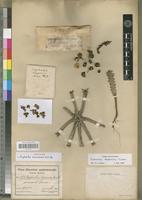
Euphorbia abyssinica J.F.Gmel. [family EUPHORBIACEAE]
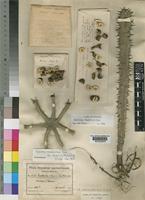
Isotype of Euphorbia acrurensis N.E.Br. [family EUPHORBIACEAE]
Previous
Next

Name

Identification
Euphorbia abyssinica J.F.Gmel. [family EUPHORBIACEAE ] (stored under name); Verified by Gilbert,M.G., Euphorbia candelabrum Tremaut ex Kotschy [family EUPHORBIACEAE ] Verified by Bally, Euphorbia acrurensis N.E.Br. [family EUPHORBIACEAE ]
Related name
  • Euphorbia acrurensis
  • Euphorbia candelabrum
  • Euphorbia abyssinica

Flora

Entry for EUPHORBIA acrurensis N. E. Br. [family EUPHORBIACEAE]
Herbarium
Royal Botanic Gardens, Kew (K)
Collection
Flora of Tropical Africa
Resource Type
Reference Sources
Entry From
Flora of Tropical Africa, Vol 6, Part 1, page 441, (1913) Author: (By J. G. Baker, with additions by C. H. Wright.)
Names
EUPHORBIA acrurensis N. E. Br. [family EUPHORBIACEAE]
EUPHORBIA abyssinica Schweinf. [family EUPHORBIACEAE], in Bull. Herb. Boiss. vii. App. ii. 317, partly; Pax in Engl. Jahrb. xxxiv. 77, partly.
Information
Arborescent, succulent, spiny.Branches of the dried specimens seen 7-angled and about 4 1/2 in. in diam., with the solid central part about 1–1 1/4 in. thick and much less in diam. than the angles are broad (seedling plant 3-angled and 1–1 1/4 in. in diam.); angles wing-like, 2 in. broad and 2 lin. thick at the edge in the dried specimen, with triangular channels 1 3/4 in. deep between them. Leaves not seen. Spines 1 1/2–5 lin. long, in pairs, diverging, stout at the base, blackish-grey on the seedling, becoming grey with darker tips with age, on suborbicular horny shields 3–4 lin. in diam. on the mature branch, much smaller on the seedling, not connected by a horny border along the angles, becoming grey with age, with the flowering-eye touching or subincluded in their apical part. Cymes (detached, but distributed with the stem-sections) on peduncles 1/4– 1/3 in. long, bearing 3 involucres, the middle one sessile and the two lateral on cyme-branches 1 lin. long, glabrous. Bracts thin, adpressed, broken, but apparently suborbicular and about 3 lin. long and 2 1/2–3 1/2 lin. broad, very concave. Involucres 1/4– 1/3 in. in diam., cup-shaped, golden-yellow (Schweinfurth), with 5–8 glands and 5–8 transversely rectangular fringed lobes, glabrous; glands 1 1/2–2 lin. in their greater diam., erect in dried flowers, transverse, reniform, with the middle of the inner margin turned in and forming a small lip, or crescent-shaped, with the inner margin concave, in dried specimens with the outer margin more or less incurved. Ovary subsessile and included when young, in fruit exserted and curved to one side on a short stout pedicel, glabrous; perianth fleshy, with 3 lobes 2–2 1/2 lin. long, deeply cut into 2 or more filiform segments or entire and subulate-acuminate, in fruit reflexed and the segments often broken off; styles 1 3/4–2 lin. long, shortly united at the base, rather stout, slightly thickened and minutely 2-lobed at the apex. Capsule 5–6 lin. long and 8–10 lin. in diam., deeply 3-lobed as seen from above (globose-triangular and reddish when alive, Schweinfurth), glabrous; cell-walls very thick and woody. Seeds slightly compressed-subglobose, 1 3/4–2 lin. in diam., with a slight furrow on one side, smooth, light grey or whitish, slightly marbled, with a dull surface.
Distribution
Eritrea Nile Land vicinity of Acrur, Schweinfurth, 1351, partly!
Notes
There appears to be some confusion with regard to the succulent tree-like Euphorbias growing in Eritrea which Schweinfurth and others have referred to E. abyssinica. None of the specimens which I have seen belong to that species. Schweinfurth and also Pax certainly include two or more species under that name. The former states that it varies in appearance, growing 10 to 30 ft. in height, sometimes with a short trunk and a large crown of longer branches, sometimes with the trunk as tall as the obconic flat-topped crown. Seedling plants are 3-soon becoming 4-angled. Young unbranched trunks are sometimes up to 9-angled. The main branches are 4–6 in. in diam. and 6–9-angled and the secondary branches about 5-angled. Leaves of young shoots and seedlings are up to 3/4 in. long, oblanceolate, slightly cuspidate at the apex, cuneate at the base, passing into a petiole. The spines are rarely more than 4 lin. long, grey with black tips, in pairs about 7 lin. apart. I do not know if this description refers to the Acrur plant or not, as I have not seen leaves of the plant I describe, but only a seedling plant, with stem-sections and loose flowers and fruit. I therefore restrict my description of E. acrurensis to the Acrur plant with 6–7-or more angled stems, to which I suppose the pedunculate cymes distributed with the stem-sections may belong, Schweinfurth & Riva, 1351, collected in 1892 (not 1891). Unfortunately fragments with sessile fruiting cymes have also been distributed under the same number and date, but the structure of the spine-shields and flowering-eyes on the scraps of stem-angle with these fragments and that of the cymes and involucres is identical with those of E. disclusa, N. E. Br., to which species I believe they belong. Schweinfurth 1351 of the 1891 collection is probably a variety of E. Erythrææ, N. E. Br. All these have been distributed as E. abyssinica, Raenschel, from which they differ totally in having the branches constricted into parallel-sided or slightly conical (not elliptic or orbicular) segments.

Related Materials

  • Terms and Conditions
  • Privacy Policy
  • Cookie Policy
  • Cookie Settings
  • Accessibility
  • Help
  • Contact Us
  • Facebook
  • Twitter
ITHAKA

JSTOR is part of ITHAKA, a not-for-profit organization helping the academic community use digital technologies to preserve the scholarly record and to advance research and teaching in sustainable ways.

©2000-2026 ITHAKA. All Rights Reserved. JSTOR®, the JSTOR logo, JPASS®, Aluka®, and ITHAKA® are registered trademarks of ITHAKA.

╳