

Compilation
Eulophia richardsiae
1 Images see all
Name
Identification
Eulophia epiphanoides Schltr. [family ORCHIDACEAE ] Eulophia richardsiae P.J.Cribb & I.la Croix [family ORCHIDACEAE ] (stored under name);
Related name
- Eulophia epiphanoides
- Eulophia richardsiae
Flora
Entry for Eulophia richardsiae P.J. Cribb & la Croix [family ORCHIDACEAE]
Herbarium
Royal Botanic Gardens, Kew (K)
Collection
Flora Zambesiaca
Resource Type
Reference Sources
Entry From
FZ, Vol 11, Part 2, (1998) Author: I. la Croix & P.J. Cribb
Names
Eulophia richardsiae P.J. Cribb & la Croix [family ORCHIDACEAE], in Kew Bull. 52: 1001 (1997). TAB. 173. Type: Zambia, Mbala Distr., near Katanga (Katenga) Falls, 5.vi.1957, Richards 10034 (K, holotype).
Information
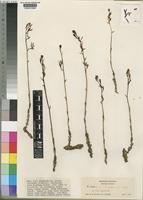
Slender terrestrial saprophyte 18–25 cm high, arising from a horizontal or ascending cigar-shaped rhizome over 4 cm long and 0.5–1 cm in diameter, with numerous papery sheathing bracts; roots absent.Leaves absent.Inflorescence erect, rather laxly up to 10-flowered; peduncle lacking in chlorophyll, with many loose, broad sheathing bracts, up to 10 × 8 mm, set close together towards the base, becoming narrower and more widely spaced up the stem.Flowers not opening wide, dull brownish-cream with brown veins; lip dull cream with tiny reddish-brown veins.Pedicel 5 mm long, ovary 4–5 mm long at anthesis, soon enlarging.Bracts c. 10 mm long.Dorsal sepal erect, 13–15 × 2–2.5 mm, oblanceolate, acute; lateral sepals suberect, similar but slightly shorter and oblique at the base.Petals suberect, 9–12 × 1.2–1.5 mm, oblanceolate, acute, with a narrow claw 4 mm long.Lip c. 7.5 × 3 mm, very concave, 3-lobed near the base; side lobes small, erect, tooth-like; mid-lobe narrowly elliptic, acute; callus basal, bilobed.Spur 5 mm long, cylindrical-tapering, lying parallel to and appressed to the lip.Column 4 mm long; pollinia 2, porate, attached by a linear stipe to an oblong gland.
Habitat
Brachystegia woodland
Range
Not known elsewhere
Altitude range
c. 1500 m.
1500
1500
Distribution
Zambia N Mbala Distr., woodlands near Katanga (Katenga) Falls, 1500 m, fl. 5.vi.1957, Richards 10034 (K).
Notes
This species resembles Eulophia galeoloides Kraenzl. and E. epiphanoides Schltr., but is a much smaller plant than the former, and differs from both in having a lip with a smooth, rounded callus rather than a series of ridges, and in the narrow, stalk-like base to the sepals and petals.The species apparently forms colonies where it grows; this is suggested by the fact that 6–7 plants of Richards 10034 are mounted on the herbarium sheet.It may not be as rare as would appear from the lack of collections, because small brown-flowered plants growing on the woodland floor are easily overlooked, particularly as many saprophytes seem to be self-pollinating and are in flower for only a very short time.