JSTOR Global Plants Home
  • Home
  • Browse
  • About
  • Access
  • Account
    • Saved Items
    • Profile
  • Log in

Global Plants

Skip to Main Content
  • JSTOR Global Plants Home
  • Global Plants

    • Browse
    • About
    • Access
    • Account
      • Saved Items
      • Profile
Log in
  • Browse
  • About
  • Access
  • Account
    • Saved Items
    • Profile
Advanced Search

Compilation
Eulophia nyasae

11 Images see all

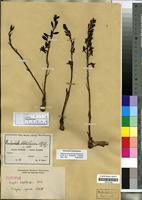
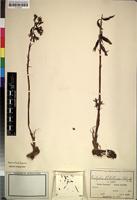
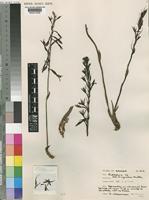
Isotype of Eulophia bletilloides Schltr. [family ORCHIDACEAE]
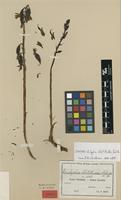
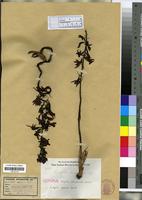
Filed as Eulophia nyasae Rendle [family ORCHIDACEAE]
Eulophia nyasae Rendle [family ORCHIDACEAE]
Isotype of Eulophia bletilloides Schltr. [family ORCHIDACEAE]
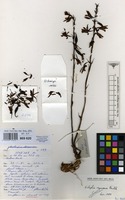
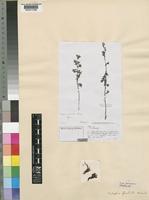
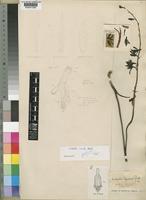
Isotype of Eulophia limodoroides Kränzl. [family ORCHIDACEAE]
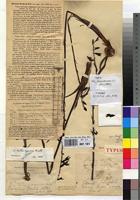
Type of Eulophia florulenta Kraenzl. [family ORCHIDACEAE]
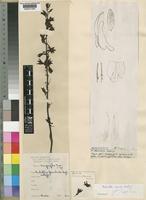
Holotype of Eulophia hockii De Wild. [family ORCHIDACEAE]
Eulophia ecalcarata G.Will. [family ORCHIDACEAE]
Type of Eulophia florulenta Kränzl. [family ORCHIDACEAE]
Eulophia bletilloides Schltr. [family ORCHIDACEAE]
Previous
Next

Name

Identification
Eulophia hockii De Wild. [family ORCHIDACEAE ] Verified by Not on sheet, Eulophia nyasae Rendle [family ORCHIDACEAE ] (stored under name); Verified by Geerinck D., 1984
Related name
  • Eulophia hockii
  • Eulophia florulenta
  • Eulophia ecalcarata
  • Eulophia limodoroides
  • Eulophia nyasae
  • Eulophia monile
  • Eulophia bletilloides

Flora

Entry for Eulophia nyasae Rendle [family ORCHIDACEAE]
Herbarium
Royal Botanic Gardens, Kew (K)
Collection
Flora Zambesiaca
Resource Type
Reference Sources
Entry From
FZ, Vol 11, Part 2, (1998) Author: I. la Croix & P.J. Cribb
Names
Eulophia nyasae Rendle [family ORCHIDACEAE], in Trans. Linn. Soc. London, Ser. 2, Bot. 4: 44 (1894). —Rolfe in F.T.A. 7: 57 (1897). —Summerhayes in Norlindh & Weimarck in Bot. Not. 1937: 199 (1937). —Grosvenor in Excelsa 6: 81 (1976), as “nyassae”. —Cribb in F.T.E.A., Orchidaceae pt. 3: 469 (1989). —la Croix et al., Orch. Malawi: 318 (1991). —Geerinck in Fl. Afr. Centr., Orchidaceae pt. 2: 687 (1992). Type: Malawi, Mt. Mulanje, Whyte s.n. (BM, holotype; K).
Eulophia florulenta Kraenzl. [family ORCHIDACEAE], in Bot. Jahrb. Syst. 33: 66 (1902). —Grosvenor in Excelsa 6: 81 (1976). —Williamson, Orch. S. Centr. Africa: 162 (1977). Type from Tanzania.
Eulophia limodoroides Kraenzl. [family ORCHIDACEAE], in Bot. Jahrb. Syst. 51: 387 (1914). Type: Zambia, near Chibenga Stream, Kassner 2080 (B†, holotype; K).
Eulophia bletilloides Schltr. [family ORCHIDACEAE], in Bot. Jahrb. Syst. 53: 576 (1915). Type from Tanzania.
Eulophia hockii De Wild. [family ORCHIDACEAE], in Bull. Jard. Bot. État 6: 120 (1919). Type from Dem. Rep. Congo (Zaire).
Eulophia sp. 32 [family ORCHIDACEAE], (G. Williamson & Simon 1764), of Williamson, Orch. S. Centr. Africa: 162 (1977).
Eulophia sp. 33 [family ORCHIDACEAE], (G. Williamson 216), of Williamson, Orch. S. Centr. Africa: 163 (1977).
Eulophia ecalcarata G. Will. [family ORCHIDACEAE], in J. S. African Bot. 46: 336 (1980). Type: Zambia, 17 km east of Lusaka, G. Williamson 216 (K; SRGH, holotype).
Eulophia farcta G. Will. [family ORCHIDACEAE], in J. S. African Bot. 46: 337 (1980). Type: Zambia, 80 km west of Solwezi, G. Williamson & Simon 1764 (K; SRGH, holotype).
Information
Robust, terrestrial, semi-saprophytic herb 25–40 cm tall, drying black.Perennating organs subterranean, fleshy, rhizomatous, cigar-shaped, much branched, 5–7 cm long or more, 1.5–2.5 cm in diameter, with many nodes and triangular scales; roots numerous, 1–1.5 mm in diameter.Leaves vestigial, to 6 cm long, brown.Inflorescences 1–3, laxly or densely many-flowered; scape yellow-green with 4–5 imbricate, scarious, basal sheaths and another in the middle.Pedicel and ovary 9–16 mm long, the ovary slightly verrucose, soon swelling; bracts 9–25 mm long, linear-setose.Flowers rather untidy-looking, arising at various angles, not opening wide, violet-scented; sepals brownish or yellow-green tinged with purple, petals yellow-green or white tinged with purple or brown, lip white with purple veins.Sepals 12–20 × 2–3.5 mm, oblong, acute, keeled.Petals 10–14 × 3–4 mm, narrowly elliptic, acute, overlying the column.Lip 11–16 mm long, 9–9.5 mm wide when flattened, 3-lobed in the apical third; side lobes erect, rounded and erose in front; mid-lobe 6–7 × 5–6 mm, obovate-oblong, the edge undulate; callus of 3 basal ridges with 3–5 lines of long papillae on the mid-lobe; spur 3–8 mm long, rather stout, bulbous at tip, straight or decurved.Column 5 mm long; foot 1–2 mm long.Fruit 28–30 mm long, pendent, ellipsoid.
Habitat
Often in small colonies in miombo woodland or scrub, usually amongst rocks on hillsides or in stony or gravelly soil
Altitude range
900–1680 m.
1680
900
Distribution
Zambia N Mbala Distr., hillside above Lumi Marsh, fl. 17.xi.1956, Richards 7010 (K).Zimbabwe N Mazowe Distr., near Hidden Hill, fl. 19.xi.197?, Beasley in GHS 260360 (SRGH).Malawi N North Viphya, Mzuzu–Usisya road, near Choma, 1350 m, fl. 28.xi.1986, I.F. & E.A.S. la Croix 890 (K; MAL).Zambia W Ndola, fl. 12.xii.1953, Fanshawe 575 (K; NDO).Zambia C Kundalila Falls, fl. xii.1967, G. Williamson 332 (K).Zimbabwe C Rusape Distr., Mona, fl. 9.xii.1948, Greatrex in GHS 22335 (K; SRGH).Zimbabwe E Mutare Distr., Vumba Mt., Burma Valley, foothills of Himalaya Range, 1200 m, fl. 7.xii.1961, Wild & Chase 5558 (SRGH).Zimbabwe S Masvingo Distr., west of Mutirikwe (Kyle) Dam, fl. 5.xii.1960, Leach 10550 (SRGH).Malawi S Mulanje Mt., Lichenya Path, c. 900 m, fl. 2.i.1989, Jenkins 66 (K).
Distribution (external)
Tanzania
Zaire
Angola
Notes
Flower size and lip ornamentation is variable in this species, and peloric and partly peloric forms are not uncommon.Williamson has described such specimens as E. ecalcarata and E. farcta respectively.

Related Materials

  • Terms and Conditions
  • Privacy Policy
  • Cookie Policy
  • Cookie Settings
  • Accessibility
  • Help
  • Contact Us
  • Facebook
  • Twitter
ITHAKA

JSTOR is part of ITHAKA, a not-for-profit organization helping the academic community use digital technologies to preserve the scholarly record and to advance research and teaching in sustainable ways.

©2000-2026 ITHAKA. All Rights Reserved. JSTOR®, the JSTOR logo, JPASS®, Aluka®, and ITHAKA® are registered trademarks of ITHAKA.

╳