JSTOR Global Plants Home
  • Home
  • Browse
  • About
  • Access
  • Account
    • Saved Items
    • Profile
  • Log in

Global Plants

Skip to Main Content
  • JSTOR Global Plants Home
  • Global Plants

    • Browse
    • About
    • Access
    • Account
      • Saved Items
      • Profile
Log in
  • Browse
  • About
  • Access
  • Account
    • Saved Items
    • Profile
Advanced Search

Compilation
Eulophia kyimbilae

8 Images see all

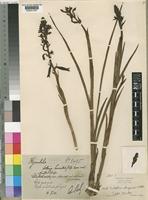
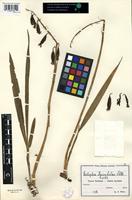
Type of Eulophia ukingensis Schltr. [family ORCHIDACEAE]
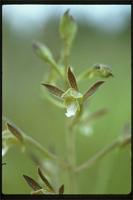
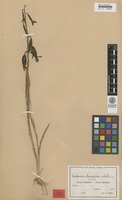
Eulophia kyimbilae Schltr. from Tanzania
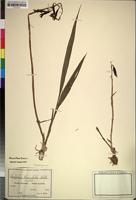
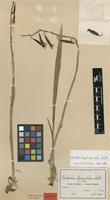
Isotype of Eulophia kyimbilae Schltr. [family ORCHIDACEAE]
Type of Eulophia ukingensis Schltr. [family ORCHIDACEAE]
Isotype of Eulophia kyimbilae Schltr. [family ORCHIDACEAE]
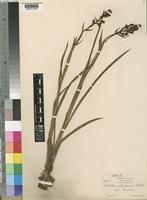
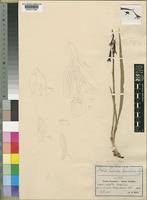
Eulophia kyimbilae Schltr. [family ORCHIDACEAE]
Previous
Next

Name

Identification
Eulophia kyimbilae Schltr. [family ORCHIDACEAE ]
Related name
  • Eulophia kyimbilae

Flora

Entry for Eulophia kyimbilae Schltr. [family ORCHIDACEAE]
Herbarium
Royal Botanic Gardens, Kew (K)
Collection
Flora Zambesiaca
Resource Type
Reference Sources
Entry From
FZ, Vol 11, Part 2, (1998) Author: I. la Croix & P.J. Cribb
Names
Eulophia kyimbilae Schltr. [family ORCHIDACEAE], in Bot. Jahrb. Syst. 53: 584 (1915). —Cribb in F.T.E.A., Orchidaceae pt. 3: 446 (1989). —la Croix et al., Orch. Malawi: 314 (1991). —Geerinck in Fl. Afr. Centr., Orchidaceae pt. 2: 702 (1992). —Stewart, Orch. Kenya: 119 (1996). Type from Tanzania.
Information
Terrestrial herb 35–85 cm tall.Perennating organs subterranean, 2–3.5 cm long, 1–2.5 cm high, conical-ovoid, forming chains.Roots white, 1.5 mm in diameter.Leaves 3–5, forming a fan or tuft, 20–55 × 0.8–1.6(4.5) cm, linear-lanceolate to lanceolate, ribbed, well developed at flowering time.Inflorescence laxly up to 9-flowered; peduncle almost covered by 4–5 sheaths up to 6.5 cm long.Sepals and petals green or greenish-brown; lip purple or green or dull yellow at base, the mid-lobe deep pink or mauve.Pedicel and ovary 15–21 mm long; bracts spreading, 6–35 mm long, lanceolate, acuminate.Dorsal sepal 9–12 × 2–3 mm, linear-lanceolate, acute; lateral sepals 9–17 × 2–5 mm, oblanceolate, acute, oblique.Petals 8–12 × 2.5–5 mm, narrowly elliptic, acute.Lip 9–15 × 6–10 mm, 3-lobed in apical third; side lobes erect, oblong, rounded; mid-lobe 3–5 × 3–4 mm, oblong-flabellate, rounded or truncate; callus of 3 fleshy ridges in basal half of lip and several rows of papillae on the mid-lobe.Spur 1.5–3 mm long, cylindrical, incurved.Column 4–6 mm long, with a foot 2 mm long.Capsule c. 25 mm long, pendent.
Habitat
Perennial swampy grassland and seasonal dambo, sometimes in shallow standing water of flooded dambo, also in black cotton soil of dried swamp
Altitude range
600–1750 m.
1750
600
Distribution
Botswana N off Mboma/Xhamu Channel, fl. 10.xii.1979, P.A. Smith 2920 (K; SRGH).Zambia B 40 km north of Mongu, fl. 12.xii.1965, E.A. Robinson 6732 (K).Zimbabwe C 19 km east of Harare, 1360 m, fl. xii.1958, Greatrex 76 (K; SRGH).Malawi N Nkhata Bay Distr., Mzenga Dambo, 600 m, fl. 10.i.1983, la Croix 418 (K).Zambia N Mbala Distr., Kawimbe, Lumi Marsh, 1740 m, fl. 26.ii.1959, McCallum-Webster in Richards 10997 (K).Zambia S Choma Distr., Mapanza north, 1060 m, fl. 2.ii.1957, E.A. Robinson 2128 (K).Malawi C Kasungu Distr., dambo near Kasungu Hill, 1100 m, fl. 14.i.1959, Robson & Jackson 1160 (K).Zambia C c. 10 km east of Lusaka, 1270 m, fl. 25.xi.1957, King 387 (K).
Distribution (external)
Kenya
Uganda
Tanzania
Zaire
Notes
Eulophia kyimbilae resembles E. elegans Schltr., but the latter has a conical spur and longer and more numerous papillae on the mid-lobe of the lip, and the flowers are usually larger and the leaves broader.la Croix 948 (K) and 950 (K) from northern Malawi have flowers which agree with those of E. kyimbilae, but have the broad leaves of E. elegans.

Related Materials

  • Terms and Conditions
  • Privacy Policy
  • Cookie Policy
  • Cookie Settings
  • Accessibility
  • Help
  • Contact Us
  • Facebook
  • Twitter
ITHAKA

JSTOR is part of ITHAKA, a not-for-profit organization helping the academic community use digital technologies to preserve the scholarly record and to advance research and teaching in sustainable ways.

©2000-2026 ITHAKA. All Rights Reserved. JSTOR®, the JSTOR logo, JPASS®, Aluka®, and ITHAKA® are registered trademarks of ITHAKA.

╳