JSTOR Global Plants Home
  • Home
  • Browse
  • About
  • Access
  • Account
    • Saved Items
    • Profile
  • Log in

Global Plants

Skip to Main Content
  • JSTOR Global Plants Home
  • Global Plants

    • Browse
    • About
    • Access
    • Account
      • Saved Items
      • Profile
Log in
  • Browse
  • About
  • Access
  • Account
    • Saved Items
    • Profile
Advanced Search

Compilation
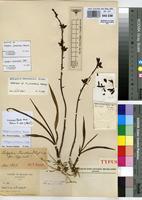
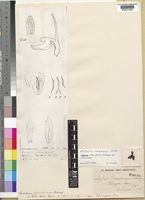
Eulophia junodiana

2 Images see all

Holotype of Eulophia junodiana Kraenzl. [family ORCHIDACEAE]
Eulophia hereroensis Schltr. [family ORCHIDACEAE]
Previous
Next

Name

Identification
Eulophia junodiana Kraenzl. [family ORCHIDACEAE ] Verified by Not on sheet, Eulophia hereroensis Schltr. [family ORCHIDACEAE ] (stored under name); Verified by Cieslicka Dorota, 2006
Related name
  • Eulophia junodiana
  • Eulophia hereroensis

Flora

Entry for EULOPHIA junodiana Kränzl. [family ORCHIDACEAE]
Herbarium
Royal Botanic Gardens, Kew (K)
Collection
Flora Capensis
Resource Type
Reference Sources
Entry From
Flora Capensis, Vol 5, Part 3, page 3, (1913) Author: (By R. A. ROLFE.)
Names
EULOPHIA junodiana Kränzl. [family ORCHIDACEAE], in Bull. Herb. Boiss. v. 634
Information
stem leafy, with spathaceous basal sheaths, which are dotted with red or black; leaves linear-lanceolate, acuminate (immature), 6 in. long, over 1/3 in. broad; scape 1 1/4–2 ft. long, flexuous, with a few short sheaths; racemes few- to many-flowered; bracts lanceolate, acute, minute; sepals oblong, acute or obtuse, 1/3 in. long, green; petals rather broader than the sepals, otherwise similar; lip purple with darker veins, obsoletely 3-lobed, compressed, cordate-ovate, recurved at the apex, margin crisped or undulate; side lobes nearly obsolete; disc with 2 thickened undulate keels extending nearly to the apex, and a smaller central and 2 outer keels; spur broad, compressed, didymous, strongly incurved; column slightly curved, acute, half as long as the sepals. null
Distribution
EASTERN REGION Delagoa Bay, Junod, 122.
Notes
Only known to me from the description, in which it is compared with the Madagascar E. pulchra, Lindl.

Related Materials

  • Terms and Conditions
  • Privacy Policy
  • Cookie Policy
  • Cookie Settings
  • Accessibility
  • Help
  • Contact Us
  • Facebook
  • Twitter
ITHAKA

JSTOR is part of ITHAKA, a not-for-profit organization helping the academic community use digital technologies to preserve the scholarly record and to advance research and teaching in sustainable ways.

©2000-2026 ITHAKA. All Rights Reserved. JSTOR®, the JSTOR logo, JPASS®, Aluka®, and ITHAKA® are registered trademarks of ITHAKA.

╳