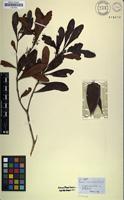
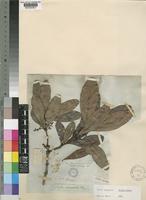
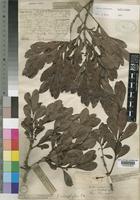
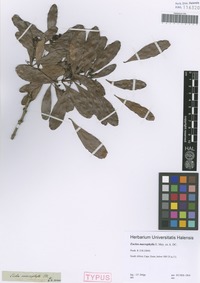
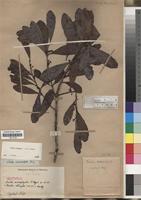
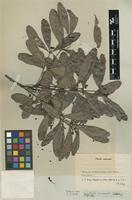
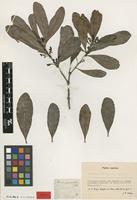
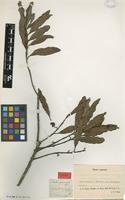
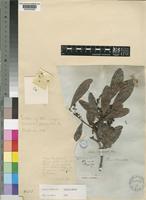
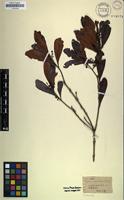
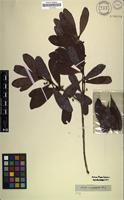
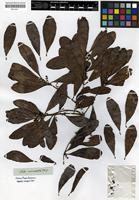
a shrub, 2–10 ft. high or more; branches glabrate, dusky; branchlets puberulous at the apex, leafy; leaves alternate, obovate-oblong, rounded or obtuse at the apex, wedge-shaped at the base, coriaceous, glabrescent, dark green and somewhat glossy above, paler or slightly reddish beneath, wavy or nearly plane on the narrowly revolute margin, not very conspicuously veined, 2–4 in. long, 1/2–1 1/4 in. broad; petioles 1/4– 1/2 in. long; cymes axillary, 1/2–1 in. long, racemose or paniculate, 8- to many-flowered, shortly pubescent; pedicels very short or about as long as the flowers, dilated upwards in fruit to the articulation with the consolidated tube of the calyx; bracts small, deciduous; flowers 4–5-merous, 1/8– 1/6 in. long, diœcious or hermaphrodite, yellow; calyx deeply lobed, about or less than half the length of the corolla, shortly hairy in flower, glabrescent in fruit; lobes ovate or lanceolate, acute or pointed; corolla deeply lobed, nearly or quite glabrous; segments at length spreading in a stellate manner, ovate-oblong, obtuse; stamens 16; anthers more or less hispid; filaments glabrous, short or very short; in the female and hermaphrodite flowers the ovary hirsute, subglobose, 4-celled; styles 2, slender, glabrous; fruit globose, dusky, subglabrous, 1/4– 1/3 in. in diam., 1-celled; seed solitary, globose, black, marked outside with three longitudinal lines; albumen somewhat ruminated. null