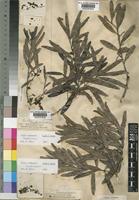
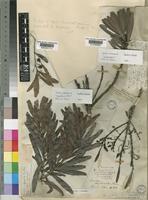
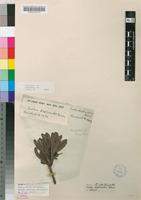
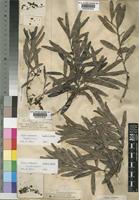
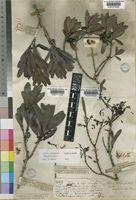
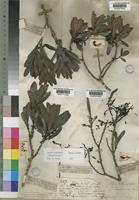
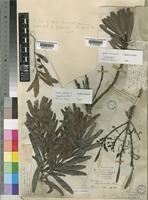
a glabrous, usually shining shrub of 2–7 ft. or more, or a low tree, sometimes thorny; branches ashy; branchlets numerous, alternate, opposite or subverticillate, leafy; bark white; leaves alternate, opposite or verticillate three together, linear- or oblanceolate-oblong, rounded or obtuse at the apex, wedge-shaped at the subsessile thickly articulate base, often suberect, rigidly coriaceous, flat or somewhat wavy on the narrowly revolute margin, entire, 1–3 in. long, 1/6– 1/2 in. broad; racemes axillary, shorter than the leaves, 2/5–1 1/5 in. long, spreading or drooping, 9–21-flowered; flowers diœcious or subhermaphrodite, whitish or yellowish; pedicels 1/20– 1/4 in. long. Male flowers tetramerous, nearly glabrous, 1/8 in. long; calyx cleft half-way down, short; corolla campanulate, cleft nearly half-way down; lobes rounded, erect; stamens 12–16, glabrous below; ovary rudimentary, glabrous. Female flowers 4–5-merous, numerous, glabrous, 1/10 in. long; calyx 1/30 in. long, cleft half-way down; corolla openly campanulate, 1/15 in. long, cleft nearly half-way down; lobes obtuse; staminodes 0 or 4 or 8, glabrous, very short; ovary ovoid, glabrous, 1/25 in. long, 4–6-celled; styles 2 or 3, 1/25 in. long, thick; stigmas bilobed at the apex, exserted, reddish, truncate, furrowed along the inner side; ovules or seeds solitary; fruit globose, 1/4 in. in diam., dusky, glabrous, 1-celled; seed solitary; fruiting calyx small or minute; albumen not ruminated, but the testa is introverted at the apex of the seed. null