

Compilation
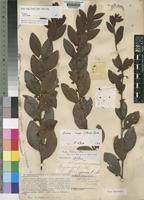
Euclea bakerana
1 Images see all
Name
Identification
Euclea bakerana Brenan [family EBENACEAE ] Verified by Brenan, J.P.M., Euclea crispa (Thunb.) Gürke [family EBENACEAE ] (stored under name); Verified by White, F., Euclea crispa (Thunb.) Gürke [family EBENACEAE ] Verified by White, F., Gymnosporia ferruginea Baker [family CELASTRACEAE ]
Related name
- Gymnosporia ferruginea
- Euclea bakerana
- Euclea crispa
Flora
Entry for Euclea crispa subsp. crispa [family EBENACEAE]
Herbarium
Royal Botanic Gardens, Kew (K)
Collection
Flora Zambesiaca
Resource Type
Reference Sources
Entry From
FZ, Vol 7, Part 1, page 248, (1983) Author: F. White
Names
Euclea crispa subsp. crispa [family EBENACEAE], — F. White in Bull. Jard. Bot. Nat. Belg. 50: 396 (1980). TAB. 67, fig. A.
Euclea crispa var. crispa [family EBENACEAE], — de Winter in Bothalia, 7: 403 (1960); in F.S.A. 26: 92, t. 11 fig. la–j (1963).
Euclea lanceolata E. Mey. ex A.DC. [family EBENACEAE], Prodr. 8: 218 (1844). — Hiern in Trans. Camb. Phil.Soc. 12: 97 (1873), pro parte. — S.Moore in Journ. Linn. Soc., Bot. 40: 134(1911). — R.E. Fr., Wiss. Ergebn. Schwed. Rhod.–Kongo–Exped. 1: 256 (1916). Type from South Africa.
Gymnosporia ferruginea Baker [family EBENACEAE], in Kew Bull. 1897: 247 (1897). Type: Malawi, Zomba Mt., male fl. xii.1896, Whyte s.n. (K, holotype), synon.nov.
Euclea dekindtii Gürke [family EBENACEAE], in Engl. Bot. Jahrb. 32: 138 (1908). — F. White, F.F.N.R.: 333 (1962). Type from Angola, synon. nov.
Euclea baumii Gürke [family EBENACEAE], in Warb. Kunene–Sambesi–Exped, Baum: 327(1903). Type from Angola, synon. nov.
Euclea bakerana Brenan [family EBENACEAE], in Mem. N.Y. Bot. Gard. 8: 238 (1953). Type as for Gymnosporia ferruginea, synon. nov.
Information
Rhizomatous suffrutex, shrub or small bushy tree up to 8 m. high. Leaves sometimes glaucous; lamina less than 7 times as long as broad, up to 8·5 cm. long and 3 cm. broad, usually straight, very rarely subfalcate, apex usually muticous, rarely shortly mucronate, margin not undulate, branchlets usually puberulous, very rarely subglabrous. Chromosome number: 2n = 30.
Habitat
In various types of woodland, especially in rocky places. Also on termite mounds and near dambos, and at edges of montane forest.It can tolerate high concentrations of nickel in the soil.
Altitude range
1220–2380 m.
2380
1220
Distribution
Mozambique MS Mount Umtereni, 1220 m., male fl 11.ix.1906, Sviynnerton 1306 (K; SRGH).Mozambique Z Serra Patapane, 5 km. from Lioma, 1500 m., female fl. 13.xi.1967, Torre & Correia 16066 (C; FHO; LISC; MO; SRGH; WAG).Malawi C Lilongwe, female fl. 15.xi.1951, Jackson 643 (BM; EA; K).Malawi S Mt. Mulanje, Lukulezi valley, 1675–1830 m., male fl. 10.x.1959, Chapman 457 (BM; FHO; PRE).Zimbabwe S Belingwe Distr., Mt. Buhwa 1250 m., fr. l.v.1973, Biegeletal. 4249 (FHO; SRGH).Zimbabwe E Umtali Distr., Nyamaganu Peak, 1220 m., fl. 3.i.1960, Chase 7246 (BM; FHO; SRGH).Zimbabwe C 16 km. S. of Marandellas, 1370 m., fl. 16.xii.1962, Moll 317 (FHO; SRGH).Zambia C Katanino, male fl. 3.xi.1955, Fanshauie 2568 (K).Zambia W Kasempa, fr. 12.viii.1961, Fanshawe, 6672 (FHO).Mozambique N Ribáuè Distr., Serra Mepáluè, 1700 m., fi. 11.xii.1967, Torre & Correia 16433 (COI; K; LISC; LMU).Malawi N Mafingi Mts., 2380 m., male fl. 22.xi.1952, Angus 836 (FHO).Zimbabwe W Matopos Hills, Besna Kobila, fl. 30.i.1973, White 10073a (FHO).Zambia N Mbala Distr., top of Sunzu Hill, 2040 m, female fl. 18.xi.1952, White; 3704 (FHO; K).
Distribution (external)
Angola
South Africa
Notes
In different parts of its range E. crispa subsp. crispa adopts a different habit. In Zambia it is almost invariably a suffrutex less than 0·5 m. tall, whereas on the mountains of Malawi and Mozambique its characteristic growth form is a 1–2 m. high shrub. In Zimbabwe it ranges from a 30 cm. high suffrutex to a tree 8 m. tall. In leaf shape E. crispa subsp. crispa is sometimes very similar to E. divinorum and the two species have often been confused. The leaves of E. crispa, however, are usually crenulate, broadest above the middle and are cuneate, not slightly concave, at the base. The venation is also prominent on the upper surface and not reddish beneath. In addition, E. crispa normally has hairy branchlets, a shorter petiole and only 1 inflorescence in each leaf–axil.