

Compilation
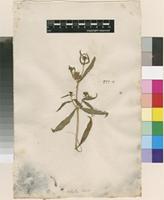
Ethulia bidentis
1 Images see all
Name
Identification
Ethulia bidentis L. [family ASTERACEAE ] (stored under name); Verified by Not on sheet, Flaveria bidentis (L.) Kuntze [family ASTERACEAE ] Verified by Not on sheet,
Related name
- Ethulia bidentis
- Flaveria bidentis
Common name
- Coastal plain yellowtops, Flora of North America Vol. 21
Flora
Entry for Flaveria bidentis (Linnaeus) Kuntze [family COMPOSITAE]
Herbarium
Flora of North America (FNA)
Collection
Flora of North America
Resource Type
Reference Sources
Entry From
Flora of North America, Vol 21,
Names
Flaveria bidentis (Linnaeus) Kuntze [family COMPOSITAE], Revis. Gen. Pl., 3([3]): 148. 1898
Ethulia bidentis Linnaeus [family COMPOSITAE], Mant. Pl., 1: 110. 1767
Treatment Author(s)
Sharon C. Yarborough
A. Michael Powell
Information
Annuals, to 100 cm (delicate or robust, sparsely villous). Stems erect. Leaves petiolate (proximal, petioles 3–15 mm) or sessile (distal); blades lanceolate-elliptic, 50–120(–180) × 10–25(–70) mm, bases (distal) connate, margins serrate or spinulose serrate. Heads 20–100+ in tight subglomerules in scorpioid, cymiform arrays. Calyculi of 1–2 linear bractlets 1–2 mm. Involucres oblong-angular, 5 mm. Phyllaries 3(–4), oblong. Ray florets 0 or 1; laminae pale yellow, ovate-oblique, to 1 mm (not or barely surpassing phyllaries). Disc florets (2–)3–8; corolla tubes ca. 0.8 mm, throats funnelform, 0.8 mm. Cypselae oblanceolate or subclavate, 2–2.5 mm (those of ray florets longer); pappi 0. 2n = 36.
Phenology
year round
Altitude range
0–10 m;
Distribution
West IndiesCentral AmericaSouth Americaalso introduced in Europe (Great Britain) and Africa (Egypt and south).USA Ala.USA Fla.USA Ga.USA Mass.
Discussion
In the United States, Flaveria bidentis often occurs on ballast and waste ground near wharfs and the shore, locations that suggest its introduction from sailing vessels. The species is widespread and well established in South America, where it is thought to be native. Its floral structure appears to be the least advanced among the annual species of Flaveria, the heads being in somewhat scorpioid arrays. Distinguishing characteristics are 3(–4) phyllaries, 2–8 florets per head, reduced ray corollas, pubescent stems, and lanceolate-elliptic, bluish green, sometimes pubescent leaves. Flaveria bidentis is probably most closely related to F. campestris and F. trinervia.
Native/Introduced
introduced;