JSTOR Global Plants Home
  • Home
  • Browse
  • About
  • Access
  • Account
    • Saved Items
    • Profile
  • Log in

Global Plants

Skip to Main Content
  • JSTOR Global Plants Home
  • Global Plants

    • Browse
    • About
    • Access
    • Account
      • Saved Items
      • Profile
Log in
  • Browse
  • About
  • Access
  • Account
    • Saved Items
    • Profile
Advanced Search

Compilation
Erythroxylum caffrum

5 Images see all

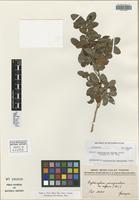
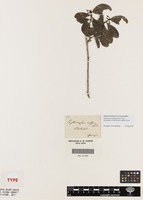
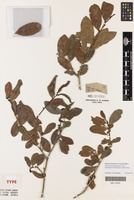
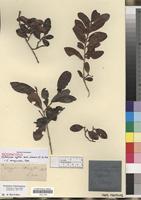
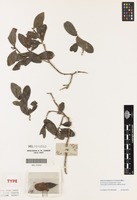
Isosyntype of Erythroxylum caffrum Sond. [family ERYTHROXYLACEAE]
Previous
Next

Name

Identification
Erythroxylum caffrum Sond. [family ERYTHROXYLACEAE ] (stored under name); Verified by Not on sheet,
Related name
  • Erythroxylum caffrum
  • Erythroxylum emarginatum

Flora

Entry for Erythroxylum emarginatum Thonn. [family ERYTHROXYLACEAE]
Herbarium
Royal Botanic Gardens, Kew (K)
Collection
Flora Zambesiaca
Resource Type
Reference Sources
Entry From
FZ, Vol 2, Part 1, page 102, (1963) Author: N. K. B. Robson
Names
Erythroxylum monogynum var. caffrum Sond. Eyles [family ERYTHROXYLACEAE], in Trans. Roy. Soc. S. Afr. 5: 387 (1916). Type as for E. caffrum.
Erythroxylum monogynum [family ERYTHROXYLACEAE], sensu Sim, For. Fl. Port. E. Afr.: 21 (1909) pro parte.
Erythroxylum caffrum Sond. [family ERYTHROXYLACEAE], in Linnaea, 23: 22 (1850); in Harv. & Sond., F.C. 1: 233 (1860). Type from Natal.
Erythroxylum emarginatum var. caffrum Sond. O.E.Schulz [family ERYTHROXYLACEAE], tom. cit.: 136 (1907). — Bak. f. in Journ. Linn. Soc., Bot. 40: 34 (1911). — Phillips in S. Air. Journ. Sci. 32: 310 (1935). — Burtt Davy & Hoyle, loc. cit. — Suesseng. in Proc. & Trans. Rhod. Sci. Ass.43: 108 (1951). Type as for E. caffrum.
Erythroxylum emarginatum var. angustifolium O.E.Schulz [family ERYTHROXYLACEAE], tom. cit.: 136 (1907). — Burtt Davy & Hoyle, loc. cit. Type: Nyasaland, Buchanan 971 (K).
Erythroxylum emarginatum Thonn. [family ERYTHROXYLACEAE], in Schum. & Thonn., Beskr. Guin. Pl.: 224 (1827) (“Erytroxylon emarginatus ”). — Oliv., F.T.A. 1: 274 (1868). — O.E. Schulz, Pflanzenr., IV, 134: 135 (1907). — Steedman, Trees, etc. S. Rhod.: 27, t. 23 (1933). — Burtt Davy & Hoyle, N.C.L.: 42 (1936). — Brenan, T.T.C.L.: 194 (1949); in Mem. N.Y. Bot. Gard. 8, 3: 230 (1953). — Exell & Mendonça, C.F.A. 1, 2: 248 (1951). — Keay, F.W.T.A. ed. 2, 1, 2: 356 (1958). — White, F.F.N.R.: 168 (1962). TAB. 12 fig. B. Type from Ghana.
Information
Shrub or small tree (1) 1·5–9 m. high, occasionally taller (up to 18 m.), evergreen, glabrous; branches rather stout, somewhat flattened and with raised lines decurrent from the petiole-bases when young, soon terete, pale grey or grey-brown, almost smooth; bark vertically fissured, dark grey or grey-brown, sometimes pink-tinged. Leaves petiolate; lamina (1·5) 2–12·5 (15) × (0·6) 1–4·5 (5) cm., varying from oblanceolate or rhombic (rarely obovate) to elliptic (rarely sub-circular), rounded or shortly acuminate towards the apex but always ± shallowly emarginate at the tip, narrowly to broadly cuneate (rarely rounded or truncate) at the base, coriaceous, bright to dark green or bluish-green and shining above, paler green or pale reddish-brown below, with midrib and ± loosely reticulate venation prominent on both sides; petiole 1·5–6 mm. long, rather slender, grooved above; stipules completely united, 1–2 mm. long, broadly triangular, acute, with entire membranous margin, persistent. Flowers solitary or in fascicles of 2–8 in the leaf-axils, usually borne in clusters on stem regions with short internodes; pedicels 5–14 mm. long, rather slender, angular. Sepals c. 1 mm. long, triangular, acute, united for about 1/4 of their length. Petals white, c. 4 mm. long, oblong, rounded at the apex, shortly unguiculate; ligule 1–1·5 mm. long, shortly fimbriate, inserted 1/4 of the length above the base. Short-styled flowers: stamens equal, 4 mm. long; stamen-cup equal to the sepals, usually with 10-denticulate margin; ovary c. 1·5 mm. long, slightly longer than stamen-cup, obovoid; styles 3–1·5 mm. long, free. Long-styled flowers: stamens unequal, the antisepalous 1·75 mm. and antipetalous 3·5 mm. long; stamen-cup as above; ovary as above; styles 3, 3–3·5 mm. long, free. Drupe 8–12 mm. long, bright red, ampullaceous at first but occasionally becoming broadly ellipsoid.
Habitat
In the understorey of evergreen forest, forest margins, thickets and fringing forest, and also sometimes on rocky outcrops, sandy soils or sand dunes
Range
from Guinea to Kenya and Tanganyika
Altitude range
0–c. 1900 m.
1900
0
Distribution
Mozambique M Namaacha, near Fonte de Goba, fl. 25.xi.1944, Mendonça 3054 (LISC).Mozambique GI Zavala, Quissico, fl. 6.xii.1944, Mendonça 3283 (LISC).Mozambique MS Manica, Dombe-Sambanhe km. 11, Matindire, fl. 29.x.1953, Pedro 4512 (K; LISC; PRE).Mozambique Z Lugela, Namagoa, fl. & fr. xi.1946, Faulkner K.117 (COI; K; SRGH).Malawi S Cholo Distr., Nswadzi R., fl. 29.ix.1946, Brass 17866 (BM; K; SRGH).Zimbabwe S Fort Victoria, Mtilitswa R., fl. xi.1956, Davies 2181 (SRGH).Zimbabwe E Chimanimani Mts., fl. 26.ix.1906, Swynnerton 1364 (BM; K).Zimbabwe C Chilimanzi, 6·4 km. Umvuma-Gwelo, fr. 6.ii.1951, Greenhow 615/51 (SRGH).Zimbabwe W Matopos, Diana’s Pool, fl. ix.1947, Hodgson 8/47 (SRGH).Zambia S Mazabuka Distr., Choma to Namwala, km. 48, Ngongo R., fr. 22.vi.1952, White 2957 (FHO; K).Zambia W Mwinilunga Distr., Zambezi R. 6–4 km. N. of Kalene Hill Mission, fl. 20.ix.1952, Angus 495 (BM; FHO; K; PRE).Mozambique N Niassa, Unango Mission, fl. 1.xi.1934, Torre 598 (COI; LISC),Malawi C Dowa Distr., Nchisi Mt., fr. 19.ii.1959, Robson 1670 (BM; K; LISC; SRGH).Zimbabwe N Urungwe, Nyagugutu R., fr. 21.xi.1957, Goodier 398 (K; SRGH).Zambia N Abercorn to Tunduma, 40 km., fl. 22.i.1947, Brenan & Greenway 8182 (BM; FHO; K).Mozambique T Moatize, Mt. Zobue, fl. 18.x.1943, Torre 6057 (LISC).
Distribution (external)
Angola
Natal
Transvaal
Cape Province
Notes
The leaves of E. emarginatum are very variable in shape and size. Narrow-leaved and small-leaved forms have been distinguished as var. angustifolium and var. caffrum respectively; but although these extreme forms appear distinct, they are connected with the typical ones by continuous series of intermediates and cannot therefore be given separate taxonomic rank.E. fischeri Engl., an East African species, is found in the south of Tanganyika and may well occur also in our area. It can be easily distinguished from E. emarginatum by the longer anthers (1–1·25 mm. as against 0·5 mm.) and the cylindric or triquetrous fruits.

Related Materials

  • Terms and Conditions
  • Privacy Policy
  • Cookie Policy
  • Cookie Settings
  • Accessibility
  • Help
  • Contact Us
  • Facebook
  • Twitter
ITHAKA

JSTOR is part of ITHAKA, a not-for-profit organization helping the academic community use digital technologies to preserve the scholarly record and to advance research and teaching in sustainable ways.

©2000-2026 ITHAKA. All Rights Reserved. JSTOR®, the JSTOR logo, JPASS®, Aluka®, and ITHAKA® are registered trademarks of ITHAKA.

╳