

Compilation
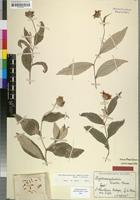
Erythrocephalum bicolor
1 Images see all
Name
Identification
Erythrocephalum bicolor Merxm. [family COMPOSITAE ] Verified by Not on sheet, Erythrocephalum zambesianum Oliv. & Hiern [family COMPOSITAE ] (stored under name); Verified by Wild, H., 1971
Related name
- Erythrocephalum zambesianum
- Erythrocephalum bicolor
Flora
Entry for Erythrocephalum zambesianum Oliv. & Hiern [family COMPOSITAE]
Herbarium
Royal Botanic Gardens, Kew (K)
Collection
Flora Zambesiaca
Resource Type
Reference Sources
Entry From
FZ, Vol 6, Part 1, (1992) Author: G. V. Pope
Names
Erythrocephalum zambesianum Oliv. & Hiern [family COMPOSITAE], in F.T.A. 3: 441 (1887). —O. Hoffm. in Engl., Pflanzenw. Ost-Afr. C: 420 (1895). —S. Moore in Journ. Linn. Soc., Bot. 40: 123 (1911). —Eyles in Trans. Roy. Soc. S. Afr. 5: 522 (1916). —C. Jeffrey in Kew Bull. 21: 203 (1967). —Wild in Kirkia 8: 174 (1972). —Lisowski, Aster. Fl. Afr. Centr. [in Fragm. Flor. Geobot.36, Suppl. 1]: 529 (1991). TAB. 5. Syntypes: Malawi, Shire R., Waller (K); Malawi, Manganja Hills, Kirk s.n. (K).
Erythrocephalum zambesianum var. angustifolium S. Moore [family COMPOSITAE], in Journ. Linn. Soc., Bot. 35 (1904). Type: Malawi, Simons (BM, holotype).
Erythrocephalum castellaneum Busc. & Muschl. [family COMPOSITAE], in Engl., Bot. Jahrb. 49: 509 (1913). Type: Zambia, Luapula, Aosta 1040 (B†).
Erythrocephalum helenae Busc. & Muschl. [family COMPOSITAE], in Engl., Bot. Jahrb. 49: 508 (1913). Type: Zambia, between Kabwe and Bwana Mkubwa, Aosta 191 (B†).
Erythrocephalum aostae Busc. & Muschl. [family COMPOSITAE], in Engl., Bot. Jahrb. 49: 508 (1913). Type: Mozambique, Aosta 6 (B†).
Erythrocephalum bicolor Merxm. [family COMPOSITAE], Mitt. Bot. Staatss. Münch., 1, 6: 207 (1953). Type: Zimbabwe, Rusape, Dehn S.43/52 (M, holotype).
Erythrocephalum niassae Wild [family COMPOSITAE], in Kirkia 8: 169; 176 (1972). Type: Mozambique, Niassa, Lichinga (Vila Cabral), Torre 8 (COI, holotype; LISC).
Erythrocephalum longifolium Benth. ex Oliv. [family COMPOSITAE], in Trans. Linn. Soc. Lond. 29: 102 (1873). —C. Jeffrey in Kew Bull. 21: 203 (1967). —Lisowski, Aster. Fl. Afr. Centr. [in Fragm. Flor. Geobot. 36, Suppl. 1]: 530 (1991). Type from Tanzania.
Erythrocephalum nutans Benth. ex Oliv. [family COMPOSITAE], in Trans. Linn. Soc. Lond. 29: 102 (1873). Type from Tanzania.
Information
An erect suffrutex 12–80 cm. tall, from a woody rootstock with numerous spreading thong-like roots. Stems annual, usually single, simple or branching above, somewhat zigzag above, leaves ± crowded in upper part, whitish-grey araneose-lanate with long fine matted-appressed hairs usually interspersed with few to numerous purplish patent larger hairs. Leaves discolorous, sessile, mostly 7–22 x 1.5–7.5 cm., elliptic to lanceolate, ± tapering-acute to the apex, semi-amplexicaul and subauriculate below, margins sharply serrulate often bi-serrulate; upper surface green, thinly araneose, glabrescent; lower surface persistently appressed greyish araneose-lanate, sometimes with scattered large brownish hairs on both surfaces. Capitula solitary and terminal on the stem, or 2–6 terminal on branches. Involucres mostly 10–22 x 12–35 mm., broadly campanulate, truncate at the base, araneose-lanate to glabrescent. Outer phyllaries 6–30(38) mm. long, lanceolate, fimbriate-denticulate on the margins, attenuate above or with a caudate appendage-like apical portion 3–22 mm. long, this sometimes elongating to c. 30 mm. long and then greatly exceeding inner phyllaries; inner phyllaries up to c. 25 mm. long, tapering-lorate, grading into receptacular paleae; phyllary margins narrowly membranous often purple, fimbriate-denticulate with linear teeth 0.5–3 mm. long, sometimes inner phyllary apices expanded. Receptacular paleae 10–15 mm. long, triangular-lorate, reddish-purple-tipped and denticulate about the apex. Ray-florets deep-red, 14–30 mm. long, with exserted stamens and style, ovary rudimentary; rays 9–22 mm. long widening to apex, 2.5–9 mm. at broadest part, 3-fid with lobes c. 2 mm. long, inner lip of 2 linear lobes 4.5–6 mm. long; pappus of a few caducous setae 4–5 mm. long. Disk-florets deep-red, 11–14 mm. long, narrowly tubular below with a deeply lobed campanulate limb 5–6.5 mm. long, lobes 4–5 mm. long linear, ovary fertile. Achenes 5–6 x 2.5–3 mm., angular-barrel-shaped, 5-ribbed, minutely puberulous, carpopodium swollen; pappus of caducous barbellate setae 6–9 mm. long.
Habitat
High rainfall miombo woodland, Brachystegia/Uapaca woodland, and grassland. Often in sandy soil or rocky hillsides.
Distribution
Mozambique MS Chimoio, Gondola, 24.i.1948, Mendonça 3693 (LISC).Mozambique T Moatize, 11.i.1966, Correia 368 (LISC).Mozambique Z Quelimane Distr., Munguluni Mission, ii.1949, Faulkner in Kew 110 (COI; K).Malawi S Matenje Road, c. 2 km. N. of Limbe, c. 1190 m., 7.ii.1970, Brummitt 8448 (K; LISC; MAL; PRE; SRGH).Malawi C Kasungu Distr., Chimaliro Forest, Phaso Road, 10.i.1975, Pawek 8877 (K; MAL; MO).Zimbabwe E Mutare Distr., Kukwanisa, c. 1492 m., 5.i.1966, Biegel 1641 (K; SRGH).Zambia E Kapatamoyo, near Chipata, c. 1200 m., 5.i.1959, Robson 1037 (BM; K; LISC; PRE; SRGH).Zambia C Kabwe, 6.ii.1965, Fanshawe 9181 (K; NDO; SRGH).Mozambique N near Mandimba, 18.xii.1941, Hornby 3521 (K).Malawi N Mzimba Distr., Mzuzu, Marymount, c. 1371 m., 31.i.1969, Pawek 1671 (K).Zimbabwe C Makoni Distr., c. 15 km. W. of Rusape, 12.ii.1974, Pope 1167 (K; SRGH).Zambia N Kawimbe Rocks, c. 1740 m., 17.i.1964, Richards 18823 (K; M; MO; SRGH).
Distribution (external)
Tanzania
Zaire
Notes
In addition to typical Erythrocephalum zambesianum, with leaves elliptic and 7–12 × 2–3(4) cm., 4 variants based on leaf shape, size and indumentum can be recognised:Variant 1, from the Lichinga Plateau in northern Mozambique, has leaves more narrowly lanceolate than those of typical Erythrocephalum zambesianum from further south. These leaves often have somewhat revolute margins and an impressed nervation on the upper surface which gives them a slightly bullate appearance (especially towards the apex, and at least when dry). Material of this form was described as Erythrocephalum niassae by Wild. However, no satisfactory discontinuity in variation in these or other features is seen and the two taxa cannot be kept separate at the species level. Examples of specimens intermediate between the taxa are; in Zambia, Brummitt et at. 16968 (K) from the Kundalila Falls, Hooper & Townsend 645 (K) from Mkushi and Wright 288 (K) from Chipata; in Malawi, Lawrence 538 (K) from Soche Mt. (Blantyre).Variant 2, occurs in central and eastern Zambia and adjacent parts of Malawi. It is a large-leaved form with leaves up to c. 20 × 5 cm. and oblong-lanceolate in shape. Examples of this are; in Zambia, Fanshawe 1816 (K) and Robson 1037 (K) from Kapiri Mposhi and Chipata respectively; and in Malawi, Pawek 8877 (K) and Richards 10544 (K) from Chimaliro Forest (Kasungu) and Kaziwizwi River (Rumphi) respectively.Variant 3, from the Isoka-Mbala area of northern Zambia, represented by Richards 216 & 17518 (K), and adjacent areas in Tanzania, is a large-leaved somewhat robust plant. Leaves are elliptic, up to c. 20 × 7 cm., with sharply irregularly serrate-dentate margins and involucres up to c. 3.5 cm. in diam.Variant 4 is characterised by all the Zimbabwean material seen so far, as well as some specimens from adjacent Mozambique. It has leaves which are persistently thinly araneose on the upper surface and which tend to be broader and more elliptic-lanceolate in shape than typical E. zambesianum. Similar material is found in the Iringa and Mbeya Districts of Tanzania.