

Compilation
Erythrina hastifolia
1 Images see all
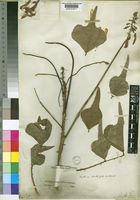
Name
Identification
Erythrina hastifolia G.Bertol. [family LEGUMINOSAE-PAPILIONOIDEAE ] Erythrina caffra Thunb. [family LEGUMINOSAE-PAPILIONOIDEAE ] Erythrina humeana Spreng. [family LEGUMINOSAE-PAPILIONOIDEAE ] (stored under name);
Related name
- Erythrina humeana
- Erythrina hastifolia
- Erythrina caffra
Flora
Entry for Erythrina humeana Spreng. [family LEGUMINOSAE]
Herbarium
Royal Botanic Gardens, Kew (K)
Collection
Flora Zambesiaca
Resource Type
Reference Sources
Entry From
FZ, Vol 3, Part 5, (2001) Author: B. Mackinder, R. Pasquet, R. Polhill and B. Verdcourt
Names
Erythrina humeana Spreng. [family LEGUMINOSAE], in Syst. Veg. 3: 243 (1826). —Collett in Bothalia 4: 225 (1941). —Hennessy, South African Erythrinas: 21, t. 20 (1972). —Codd in Bothalia 11: 269 (1974). —Krukoff & Barneby in Lloydia 37: 408, fig. on p. 408 (1974); in Allertonia 3: 131, t. 110 (1982). —Lock, Leg. Afr. Check-list: 410 (1989) excl. distr. Zimbabwe. —Mackinder in Kirkia 14: 115, fig. 1 (1993). TAB. 3.5.2. Lectotype chosen by Codd (1974): t. 736A in Bot. Reg. 9 (1823).
Erythrina princeps A. Dietr. [family LEGUMINOSAE], in Otto & Dietrich, Allg. Gartenzeitung 2: 305 (1834). Type a cultivated plant of unknown origin from Berlin Botanic Garden. See note at end of species.
Erythrina humei E. Mey. [family LEGUMINOSAE], Comment. Pl. Afr. Austr.: 150 (1836). —Harvey in F.C. 2: 237 (1862). Type from South Africa (Eastern Cape).
Erythrina raja Meisn. [family LEGUMINOSAE], in London J. Bot. 2: 96 (1843). Type from South Africa (KwaZulu-Natal).
Erythrina hastifolia G. Bertol. [family LEGUMINOSAE], Mem. Reale Accad. Sci. Ist. Bologna 2: 568, t. 38 (1850). Type: Mozambique, not traced, but probably Fornasini (BOLO).
Erythrina humei var. raja Meisn. Harv. [family LEGUMINOSAE], in F.C. 2: 237 (1862).
Erythrina humei var. hastifolia G. Bertol. Baker f. [family LEGUMINOSAE], Legum. Trop. Africa: 370 (1929).
Information
Suffrutex with woody rootstock, rarely a small tree to 4 m tall, stems armed with scattered prickles, to 8 mm long. Leaflets 4.8–13.5 × 4.5–12.2 cm, ovate to broadly ovate, apiculate, often hastate with long apices, rarely narrowly oblong and acuminate, glabrous except when young; midvein and principal veins sparsely aculeate; petioles 2.5–13 cm long, usually armed with prickles; petiolules 3–5 mm long; stipules minute, caducous; stipels minute, glandular. Inflorescence a terminal or axillary pseudoraceme, many-flowered; peduncle 7.7–28 cm long, glabrous; rhachis 5–13.5 cm long, glabrous; pedicels 2–6 mm long, ferruginous tomentose when young. Calyx 5-lobed, ferruginous tomentose when young; tube 7–10 mm; lobes 1.5–3 mm long, narrowly to broadly triangular. Corolla scarlet, glabrous; standard 2.4–4.8 × 1.6–2.4 cm, elliptic to obovate; wings 6–8 × 4–6 mm; keel 3–6 × 2–5 mm, the petals fused along their lower margins. Vexillary stamen free almost to the base, others fused along two-thirds their length. Ovary 1–1.6 cm long, narrowly cylindrical, appressed hairy. Pod black, 10–25 cm long, woody, moniliform, 4–11-seeded, 1–3 aborting. Seeds red, 6–8 × 4–5 × 4–5 mm, reniform, with a black elliptic hilum.
Habitat
In open grassland with scattered shrubs
Altitude range
up to 100 m.
100
0
inferred only top
Distribution
Mozambique M between Manhiça and Bobole, fl. 23.iv.1947, Barbosa 182 (K; LMA).Mozambique GI Inhambane Distr., c. 37 km south of Maxixe, fl. 12.x.1963, Leach & Bayliss 11915 (K; SRGH).Mozambique MS Manica e Sofala, without precise locality, fl. 3.ix.1965, Whellan 2217 (K; SRGH).
Distribution (external)
Swaziland
eastern parts of South Africa
Notes
Krukoff & Barneby in Phytologia 25: 17 (1972) consider E. princeps A. Dietr. to be conspecific with E. lysistemon Hutch. in which case the former name being the older would be the correct name for the species. Codd, on the other hand, in Bothalia 11: 267 (1974), treats E. princeps as a synonym of E. humeana Spreng. Codd's interpretation is here considered to be correct. E. princeps is a later synonym of E. humeana, distinct from E. lysistemon. In the latter the petiole is unarmed or at most bears one or two prickles, while that in E. princeps has numerous scattered prickles, as does E. humeana. Furthermore the inflorescence in E. lysistemon is compact with flowers obscuring the rhachis, while in E. princeps and E. humeana the inflorescence is more lax, the rhachis visible between the fascicles of flowers (at least in the lower two-thirds). E. humeana Spreng. is reported from Zimbabwe by Krukoff & Barneby (loc. cit., 1974), but no specimens were seen and it is unlikely that it occurs this far north