

Compilation
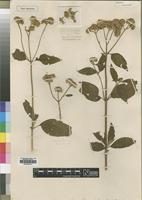
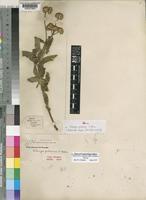
Erlangea pubescens
2 Images see all
Name
Identification
Bothriocline tomentosa (Oliv.&Hiern) Wild&G.V.Pope [family ASTERACEAE ] (stored under name); Erlangea pubescens S.Moore [family ASTERACEAE ]
Related name
- Bothriocline longipes
- Erlangea pubescens
- Bothriocline tomentosa
Flora
Entry for Bothriocline longipes Oliv. & Hiern N.E. Br. [family COMPOSITAE]
Herbarium
Royal Botanic Gardens, Kew (K)
Collection
Flora Zambesiaca
Resource Type
Reference Sources
Entry From
FZ, Vol 6, Part 1, (1992) Author: G. V. Pope
Names
Bothriocline longipes Oliv. & Hiern N.E. Br. [family COMPOSITAE], in Bull. Misc. Inf., Kew1894: 389 (1894). —Wild & G.V. Pope in Kirkia10: 372, fig. 10E, p. 384 (1977). —C. Jeffrey in Kew Bull.43: 262 (1988). TAB. 26 fig. A. Type from Sudan.
Bothriocline schimperi var. tomentosa Oliv. & Hiern [family COMPOSITAE], in F.T.A. 3: 266 (1877). Type from Tanzania.
Erlangea longipes Oliv. & Hiern S. Moore [family COMPOSITAE], in Journ. Bot. 35: 313 (1902); in Journ. Linn. Soc., Bot. 40: 104 (1911). —R.E. Fr., Wiss. Ergebn. Schwed. Rhod.-Kongo-Exped. 1911–1912, 1: 319 (1916). —Robyns, Fl. Sperm. Parc Nat. Alb. 2: 431 (1947). Type as above.
Erlangea spissa S. Moore [family COMPOSITAE], in Journ. Bot. 35: 313 (1902). Type from E. Africa.
Erlangea tomentosa Oliv. & Hiern S. Moore [family COMPOSITAE], in Journ. Bot. 46: 158 (1908). Type as above.
Erlangea pubescens S. Moore [family COMPOSITAE], in Journ. Bot. 46: 158 (1908). Types from Uganda.
Erlangea tomentosa var. acuta R.E. Fr. [family COMPOSITAE], in Ada Hort. Berg. 9: 112 (1929). Type from Kenya.
Erlangea eupatorioides Hutch. & Burtt [family COMPOSITAE], in Rev. Bot. Zool. Afr. 23: 36 (1932). Type a cultivated specimen from Zambia (K, holotype; BR).
Bothriocline tomentosa Oliv. & Hiern Wild & G.V. Pope [family COMPOSITAE], in Kirkia 10: 323 (1977). Type as for Bothriocline schimperi var. tomentosa.
Bothriocline eupatorioides Hutch. & Burtt Wild & G.V. Pope [family COMPOSITAE], in Kirkia 10: 321; 374 (1977).
Bothriocline schimperi var. longipes Oliv. & Hiern [family COMPOSITAE], in F.T.A. 3: 266 (1877). —O. Hoffm. in Engl., Pflanzenw. Ost-Afr. C: 402 (1895). Type as above.
Information
An erect bushy suffrutex, with sterns 1–2.5 m. tall from a woody rootstock. Stems herbaceous becoming woody below, leafy, branching above, puberulous, tomentellous on young growth, glabrescent below; indumentum of short-stalked asymmetric T-shaped hairs, the ± excentric terminal cell somewhat flattened and distorted. Leaves opposite; petiole to c. 4 cm. long; lamina mostly 4–20 x 1.5–9 cm., lanceolate, or the upper leaves somewhat ovate, apex tapering-acute, base rounded to broadly cuneate, margins serrate to serrate-dentate with callose-tipped teeth, upper surface sparsely puberulous to glabrescent, lower surface more densely puberulous to tomentellous, the hairs excentric T-shaped or flagelliform. Capitula small, numerous, at first in densely subglobose clusters at the ends of branches, becoming laxly corymbiform cymose; capitula stalks 0–5 mm. long. Involucres 4–7 x 3–6 mm., becoming spreading cyathiform-campanulate. Phyllaries appressed-imbricate, membranous-scarious with ± broad subhyaline margins, minutely pectinate-ciliate about the apex, puberulous soon glabrescent, sparsely glandular, from c. 1 mm. long outside to c. 6 mm. long inside, ovate-oblong to oblong-lanceolate, ± abruptly narrowed to tapering-obtuse mucronate at the apex. Corollas mauve or purplish, 4–7 mm. long, funnel-shaped, sparsely glandular otherwise glabrous. Achenes pale-brown, 1–1.8 mm. long, narrowly obovoid-oblong, with 4–5 low broad ribs, or 7–8-ribbed with the development of secondary ribs, ribs separated by narrower dark-brown, gland-filled grooves, achenes rounded above with a shallow apical depression, glabrous; pappus of few, very caducous, barbellate setae to c. 2 mm. long.
Habitat
Submontane tall grassland, usually on rocky outcrops and in evergreen forest margins at higher altitudes, in long grass in high-rainfall wooded grassland, often in riverine vegetation at lower altitudes.
Distribution
Malawi C Nkhota Kota Game Res., S. of Chipata Mt., c. 1200 m., 17.vi.1970, Brummitt 11509 (K, MAL; SRGH).Zambia E Nyika Nat. Park, c. 500 m. S. of Zambian Govt. Rest House, c. 2260 m., 17.iv.1986, Philcox, Pope & Chisumpa 9958 (BR; K; NDO; SRGH).Malawi N Mzimba Distr., Mzuzu, Lusangadzi (Katoto Estate), c. 1371 m., 22.ix.1972, Pawek 5760 (K; SRGH).Zambia N Mbala, Ndundu, c. 1740 m., 15.v.1967, Richards 22239 (K; M; SRGH).
Distribution (external)
Sudan
Rwanda
Burundi
Uganda
Kenya
Tanzania
Zaire
Angola