JSTOR Global Plants Home
  • Home
  • Browse
  • About
  • Access
  • Account
    • Saved Items
    • Profile
  • Log in

Global Plants

Skip to Main Content
  • JSTOR Global Plants Home
  • Global Plants

    • Browse
    • About
    • Access
    • Account
      • Saved Items
      • Profile
Log in
  • Browse
  • About
  • Access
  • Account
    • Saved Items
    • Profile
Advanced Search

Compilation
Eriosema velutinum

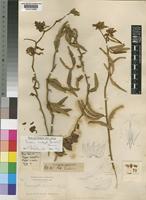
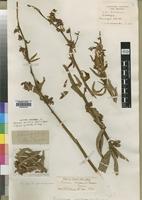
2 Images see all

Eriosema vanderystii (De Wild.) Hauman [family LEGUMINOSAE-PAPILIONOIDEAE]
Holotype of Eriosema velutinum Baker f. & Haydon [family LEGUMINOSAE]
Previous
Next

Name

Identification
Eriosema velutinum Baker f. & Haydon [family LEGUMINOSAE ] Eriosema vanderystii (DeWild.) Hauman [family LEGUMINOSAE ] (stored under name); Verified by Verdcourt,B.,
Related name
  • Eriosema glomeratum
  • Eriosema velutinum
  • Eriosema vanderystii

Flora

Entry for Eriosema vanderystii De Wild. Hauman [family LEGUMINOSAE]
Herbarium
Royal Botanic Gardens, Kew (K)
Collection
Flora Zambesiaca
Resource Type
Reference Sources
Entry From
FZ, Vol 3, Part 5, (2001) Author: B. Mackinder, R. Pasquet, R. Polhill and B. Verdcourt
Names
Eriosema vanderystii De Wild. Hauman [family LEGUMINOSAE], in F.C.B. 6: 227 (1954). —Verdcourt in F.T.E.A., Leguminosae, Pap.: 773, fig. 113 (1971). —Baudet in Bull. Jard. Bot. Belg. 43: 28 (1973); Distr. Pl. Afr. 7: 184 (1973). —Lock, Leg. Afr. Check-list: 408 (1989). TAB. 3.5.45. Type from Dem. Rep. Congo.
Glycine vanderystii De Wild. [family LEGUMINOSAE], in Repert. Spec. Nov. Regni Veg. 13: 372 (1914); in Bull. Jard. Bot. État 5: 273 (1919). —Haydon in E.G. Baker, Legum. Trop. Africa: 364 (1929).
Eriosema velutinum Baker f. & Haydon [family LEGUMINOSAE], in Legum. Trop. Africa: 510 (1929). —Milne-Redhead in Kew Bull. 5: 357, figs. 5, 6 (1951). —Hauman in F.C.B. 6: 227 (1954). —Torre in C.F.A. 3: 340 (1966). Type from Tanzania.
Information
Perennial herb forming clumps 0.6–1 m tall. Stems arching or ± prostrate, somewhat zigzag, strongly flattened above, up to 1.5 m long, with a dense ferruginous velvety tomentum (apparently grey-green silky in life) and sometimes long spreading hairs as well but at length only pubescent and purplish. Leaflets 3–5 (where 4–5 the 4 lower petiolules are confocal at the base of the rhachis or the rhachis is absent), paler beneath, 2.7–7.5 × 0.5–2 cm, narrowly oblong or elliptic, rounded to emarginate but apiculate at the apex, cuneate to rounded at the base, margins narrowly inrolled, densely velvety tomentose on both surfaces; petiole 2–3 mm long; rhachis c. 3.5 mm long; petiolules c. 3 mm long; stipules 5–10 × 1.8–6 mm, triangular to obliquely ovate, velvety, veined. Racemes axillary, often running together at the apices of the branches, frequently held erect due to twisting of the flattened stem, 2–3.5 cm long above a velvety tomentose peduncle 5–15 × 1.5–2.2 mm; pedicels 1–2 mm long; bracts 4–5 × 2 mm, narrowly ovate, hairy at first, very conspicuous in young racemes but quickly falling. Calyx appressed pubescent and glandular, 3–5 mm long; lobes triangular, shorter than the tube. Standard yellow or orange-yellow, (6)7–10 × (3)5.5–6.5(8) mm, obovate, practically glabrous outside but with a few hairs and sparse to dense glands in middle area; wings and keel whitish, glandular. Pods 8–12 × 6.5–10 mm, ovate or subcircular, with long ± appressed hairs and glands. Seeds pale brown, 4 × 3 × 1.5 mm, oblong; rim aril cream-coloured.
Habitat
Moist dambos, drier parts of old river beds and rough grassland
Altitude range
900–1200 m.
1200
900
Distribution
Zambia W Copperbelt Distr., Mufulira, fl. & fr. 18.i.1973, Fanshawe 11745 (K; NDO).Mozambique N between Nampula and Mecubúri, fl. 20.i.1937, Torre 1243 (LISC).Zambia N Kasama Distr., Chambeshi Flats, fl. 7.i.1962, Astle 1305 (K).
Distribution (external)
Central African Republic
Dem. Rep. Congo
Uganda
Kenya
Tanzania
north-eastern Angola
Notes
E.G. Baker’s suggestion that Glycine vanderystii might belong in Teramnus is quite wrong and probably made solely from De Wildeman’s description.

Related Materials

  • Terms and Conditions
  • Privacy Policy
  • Cookie Policy
  • Cookie Settings
  • Accessibility
  • Help
  • Contact Us
  • Facebook
  • Twitter
ITHAKA

JSTOR is part of ITHAKA, a not-for-profit organization helping the academic community use digital technologies to preserve the scholarly record and to advance research and teaching in sustainable ways.

©2000-2026 ITHAKA. All Rights Reserved. JSTOR®, the JSTOR logo, JPASS®, Aluka®, and ITHAKA® are registered trademarks of ITHAKA.

╳