Global Plants
Skip to Main Content
Global Plants
Browse
About
Access
Account
Saved Items
Profile
Log in
Browse
About
Access
Account
Saved Items
Profile
Filter search by
Names
Names with Synonyms
Places
People
Free Text
Search
Search
Advanced Search
Compilation
Eriophyllum croceum
4 Images
see all
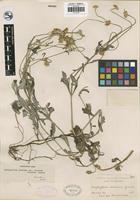
Holotype of Eriophyllum croceum Greene [family ASTERACEAE]
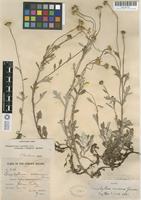
Isotype of Eriophyllum croceum Greene [family ASTERACEAE]
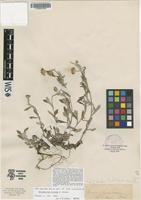
Type? of Eriophyllum croceum Greene [family ASTERACEAE]
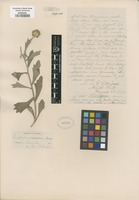
Original material of Eriophyllum croceum Greene [family ASTERACEAE]
Previous
Next
Name
Identification
Isotype of Eriophyllum croceum
Greene
[family
ASTERACEAE
] (stored under name); Verified by Not on sheet,
Related name
Eriophyllum croceum
Eriophyllum lanatum
Flora
Entry for Eriophyllum lanatum (Pursh) J. Forbes var. croceum (Greene) Jepson [family COMPOSITAE]
Herbarium
Flora of North America (FNA)
Collection
Flora of North America
Resource Type
Reference Sources
Entry From
Flora of North America, Vol 21,
Names
Eriophyllum lanatum
(Pursh) J. Forbes
var. croceum (Greene) Jepson [family
COMPOSITAE
], Man. Fl. Pl. Calif., 1118. 1925
Eriophyllum croceum
Greene
[family
COMPOSITAE
], Erythea, 3: 124. 1895
Treatment Author(s)
Dale E. Johnson
John S. Mooring
Information
Perennials (sometimes stoloniferous; roots branched). Proximal leaves mostly alternate; blades narrow-oblanceolate to obovate, coarsely serrate or shallowly lobed distally, ultimate margins toothed or entire, revolute, abaxial faces densely silky-woolly, adaxial glabrate. Heads 2–4 per array or borne singly. Peduncles 3–8 cm. Involucres 10–12 mm diam. Ray florets 10–14; laminae 8–10 mm. Cypselae 2–2.5(–4) mm; pappi 0–0.1 mm. 2n = 16, 32.
Phenology
may (spring), jun (summer)
Altitude range
1000–1700 m;
Distribution
USA Calif.
Discussion
Variety croceum, one of the less frequently collected taxa of the complex, closely resembles var. arachnoideum.
Related Materials
╳