JSTOR Global Plants Home
  • Home
  • Browse
  • About
  • Access
  • Account
    • Saved Items
    • Profile
  • Log in

Global Plants

Skip to Main Content
  • JSTOR Global Plants Home
  • Global Plants

    • Browse
    • About
    • Access
    • Account
      • Saved Items
      • Profile
Log in
  • Browse
  • About
  • Access
  • Account
    • Saved Items
    • Profile
Advanced Search

Compilation
Eriogonum glaucum

4 Images see all

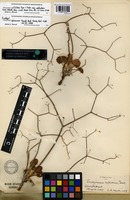
Isotype of Eriogonum glaucum Sm. [family POLYGONACEAE]
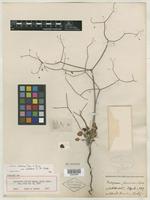
Type? of Eriogonum glaucum Small [family POLYGONACEAE]
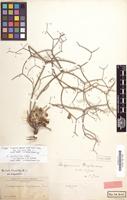
Isotype of Eriogonum glaucum Small [family POLYGONACEAE]
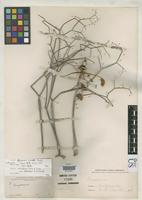
Isotype of Eriogonum glaucum Small, J.K. 1898 [family POLYGONACEAE]
Previous
Next

Name

Identification
Isotype of Eriogonum glaucum Small [family POLYGONACEAE ] Verified by Not on sheet., Eriogonum inflatum [family POLYGONACEAE ] (stored under name); Verified by Not on sheet.,
Related name
  • Eriogonum inflatum
  • Eriogonum glaucum
Common name
  • bottle stopper, Flora of North America Vol. 5
  • Indian pipeweed, Flora of North America Vol. 5
  • Desert trumpet, Flora of North America Vol. 5

Flora

Entry for Eriogonum inflatum Torrey & Frémont [family POLYGONACEAE]
Herbarium
Flora of North America (FNA)
Collection
Flora of North America
Resource Type
Reference Sources
Entry From
Flora of North America, Vol 5,
Names
Eriogonum inflatum Torrey & Frémont [family POLYGONACEAE], in J. C. Frémont, Rep. Exped. Rocky Mts., 317. 1845
Eriogonum glaucum Small [family POLYGONACEAE]
Eriogonum inflatum var. deflatum I. M. Johnston [family POLYGONACEAE]
Eriogonum trichopes Torrey subsp. glaucum (Small) S. Stokes [family POLYGONACEAE]
Treatment Author(s)
James L. Reveal
Information
Herbs, erect, perennial, occasion-ally flowering first year, 1–10(–15) dm, glabrous, usually glaucous, grayish. Stems: caudex compact; aerial flowering stems erect, solid or hollow and fistulose, (0.2–)2–5 dm, glabrous, usually glaucous, occasionally hirsute proximally. Leaves basal; petiole 2–6 cm, hirsute; blade oblong-ovate to oblong or rounded to reniform, (0.5–)1–2.5(–3) × (0.5–)1–2(–2.5) cm, short-hirsute and grayish or greenish on both surfaces, sometimes less so or glabrous and green adaxially, margins occasionally undulate. Inflorescences cymose, open, spreading to erect, 5–70 × 5–50 cm; branches occasionally fistulose, glabrous, usually glaucous; bracts 3, scalelike, 1–2.5(–5) × 1–2.5 mm. Peduncles erect, straight, filiform to capillary, 0.5–2(–3.5) cm, glabrous. Involucres turbinate, 1–1.5 × 1–1.8 mm, glabrous; teeth 5, erect, 0.4–0.6 mm. Flowers (1–)2–3(–4) mm; perianth yellow with greenish or reddish midribs, densely hirsute with coarse curved hairs; tepals monomorphic, narrowly ovoid to ovate; stamens exserted, 1.3–2.5 mm; filaments glabrous or sparsely pubescent proximally. Achenes light brown to brown, lenticular to 3-gonous, 2–2.5 mm, glabrous. 2n = 32.
Altitude range
-30–1800(–2000) m;
Distribution
Mexico (Baja California).Mexico (Sonora).USA Ariz.USA Calif.USA Colo.USA Nev.USA N.Mex.USA Utah
Discussion
The cause of the fistulose stem and inflorescence branches in Eriogonum inflatum was imaginatively attributed by A. M. Stone and C. T. Mason (1979) to the larvae of gall insects. This fallacy continues to appear in the literature. Greenhouse studies have shown that stems of this and some other species of the genus inflate without the presence of any insects. Other researchers have shown that the inflation involves a build-up of CO2 within the stems, which take over as the primary photosynthetic body as leaves wilt or eventually dry up and fall away from the plant (C. D. Osmond et al. 1987). Not all individuals of E. inflatum will have fistulose stems and branches, as this feature is partly a function of available moisture: the drier the conditions, the less pronounced the inflation. Stems produced in the summer tend to be inflated less frequently than those produced in the spring.
The “annual” phase of Eriogonum inflatum is distinct from its truly annual relatives. Its flowering stems and inflorescence branches are distinctly grayish, whereas those of the true annuals are green or yellowish green.
As circumscribed here, Eriogonum inflatum occurs in Arizona, southern and east-central California, western Colorado, northwestern New Mexico, central and southern Nevada, and southern and eastern Utah.
Some Native Americans occasionally ate newly emerged stems of Eriogonum inflatum (S. A. Weber and P. D. Seaman 1985; M. L. Zigmond 1981). The hollow stems were used as drinking tubes (Weber and Seaman) and pipes (E. W. Gifford 1936). This wild buckwheat is a food plant for the desert metalmark butterfly (Apodemia mormo deserti).

Related Materials

  • Terms and Conditions
  • Privacy Policy
  • Cookie Policy
  • Cookie Settings
  • Accessibility
  • Help
  • Contact Us
  • Facebook
  • Twitter
ITHAKA

JSTOR is part of ITHAKA, a not-for-profit organization helping the academic community use digital technologies to preserve the scholarly record and to advance research and teaching in sustainable ways.

©2000-2026 ITHAKA. All Rights Reserved. JSTOR®, the JSTOR logo, JPASS®, Aluka®, and ITHAKA® are registered trademarks of ITHAKA.

╳