JSTOR Global Plants Home
  • Home
  • Browse
  • About
  • Access
  • Account
    • Saved Items
    • Profile
  • Log in

Global Plants

Skip to Main Content
  • JSTOR Global Plants Home
  • Global Plants

    • Browse
    • About
    • Access
    • Account
      • Saved Items
      • Profile
Log in
  • Browse
  • About
  • Access
  • Account
    • Saved Items
    • Profile
Advanced Search

Compilation
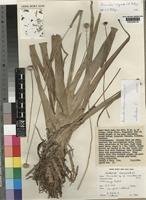
Eriocaulon mesanthemoides

5 Images see all

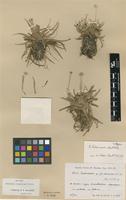
Isotype of Eriocaulon friesiorum Bullock [family ERIOCAULACEAE]
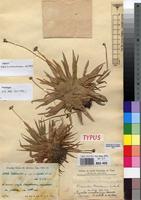
Type of Eriocaulon mesanthemoides Ruhland [family ERIOCAULACEAE]
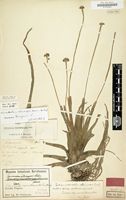
Type of Eriocaulon friesiorum Bullock [family ERIOCAULACEAE]
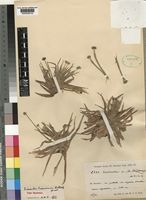
Eriocaulon iringense S.M.Phillips [family ERIOCAULACEAE]
Previous
Next

Name

Identification
Eriocaulon mesanthemoides Ruhland [family ERIOCAULACEAE ] Verified by Moldenke, H.N., Eriocaulon schimperi Körn. [family ERIOCAULACEAE ] (stored under name); Verified by Not on sheet.,
Related name
  • Eriocaulon mesanthemoides
  • Eriocaulon schimperi
  • Eriocaulon decipiens
  • Eriocaulon sp.
  • Eriocaulon friesiorum
  • Eriocaulon iringense

Flora

Entry for ERIOCAULON mesanthemoides Ruhland [family ERIOCAULACEAE]
Herbarium
Royal Botanic Gardens, Kew (K)
Collection
Flora of Tropical Africa
Resource Type
Reference Sources
Entry From
Flora of Tropical Africa, Vol 8, page 230, (1902) Author: (By N. E. Brown.)
Names
ERIOCAULON mesanthemoides Ruhland [family ERIOCAULACEAE], in Engl. Jahrb. xxvii. 79. —Engl. Jahrb. xxviii. 356.
Information
Leaves erect, 3 1/2–10 in. long, (1 1/3 in. broad at the base, ex Ruhland), 1/2 in. broad in the specimen seen, but much dilated in the sheathing portion, gradually tapering to a very obtuse apex, many-nerved, glabrous. Peduncles several to a plant (3 in the specimen seen), much longer than the leaves, 1–1 1/4 lin. thick, terete, with 10–11 remarkably prominent ribs, as seen in thin transverse section in water, glabrous; their sheaths shorter than the leaves, very lax, mostly 3-fid at the apex, glabrous. Heads about 6–7 lin. in diam., semiglobose, monœcious, densely white-pubescent (somewhat glabrous, ex Ruhland). Involucral-bracts 1 3/4–2 1/2 lin. long, 1–1 1/3 lin. broad, white (greenish-fuscous, ex Ruhland), glabrous. Flowering-bracts 1 3/4–2 lin. long, 3/4–1 lin. broad, cuneate-rhomboid, abruptly very acute, white, densely bearded with short white hairs on the apical part. Female flowers shortly pedicellate. Sepals 3, equal, 1 1/3 lin. long, 1/3 lin. broad, oblong, boat-shaped, flaccid, blackish, bearded and ciliate with white hairs on the apical part. Petals 3, unequal, 1–1 1/3 lin. long, 1/4 lin. broad, linear-subspathulate (oblong-spathulate, ex Ruhland), white, all slightly hairy on the inner face (ciliate, ex Ruhland) with a black gland near the apex, the larger bearded on the back at the apex, the smaller with only a small apical tuft of white hairs. Male flowers pedicellate. Sepals connate into a funnel-shaped body about 1 1/4 lin. long, open down one side, trifid at the apex, blackish, densely bearded with white hairs on the apical part. Stipes between the sepals and petals exceedingly short, about 1/8 lin. or less long. Petals 3, unequal, 2/3–1 lin. long, 1/8– 1/5 lin. broad, linear-cuneate, whitish, densely bearded with white hairs on the apical part, and with a linear black gland near the apex. Anthers black.
Distribution
German East Africa Mozamb. Dist. Ukami; on the Lukwangula Plateau in the Uluguru district, Stuhlmann, 9143, Goetze, 293!
Notes
In the very imperfect description given by Ruhland the flower-heads are described as somewhat glabrous (glabriusculis), and the involucral-bracts as greenish-fuscous. I have not seen Stuhlmann's 9143, but in the plant collected by Goetze (from which I have made the above description), the heads are densely white-pubescent, and the involucral-bracts white. The numerous, narrow, very prominent ribs on the peduncle are quite different from those of any other African species I have examined.

Related Materials

  • Terms and Conditions
  • Privacy Policy
  • Cookie Policy
  • Cookie Settings
  • Accessibility
  • Help
  • Contact Us
  • Facebook
  • Twitter
ITHAKA

JSTOR is part of ITHAKA, a not-for-profit organization helping the academic community use digital technologies to preserve the scholarly record and to advance research and teaching in sustainable ways.

©2000-2026 ITHAKA. All Rights Reserved. JSTOR®, the JSTOR logo, JPASS®, Aluka®, and ITHAKA® are registered trademarks of ITHAKA.

╳