JSTOR Global Plants Home
  • Home
  • Browse
  • About
  • Access
  • Account
    • Saved Items
    • Profile
  • Log in

Global Plants

Skip to Main Content
  • JSTOR Global Plants Home
  • Global Plants

    • Browse
    • About
    • Access
    • Account
      • Saved Items
      • Profile
Log in
  • Browse
  • About
  • Access
  • Account
    • Saved Items
    • Profile
Advanced Search

Compilation
Eriocaulon friesiorum

4 Images see all

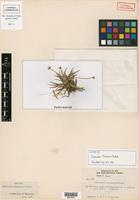
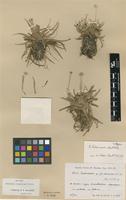
Isotype of Eriocaulon friesiorum Bullock [family ERIOCAULACEAE]
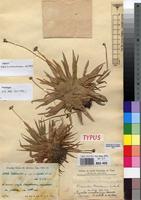
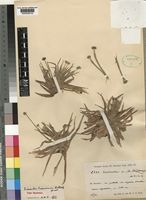
Type of Eriocaulon friesiorum Bullock [family ERIOCAULACEAE]
Previous
Next

Name

Identification
Isotype of Eriocaulon friesiorum Bullock [family ERIOCAULACEAE ] Verified by Not on sheet, Eriocaulon mesanthemoides Ruhland [family ERIOCAULACEAE ] (stored under name); Verified by Not on sheet,
Related name
  • Eriocaulon mesanthemoides
  • Eriocaulon decipiens
  • Eriocaulon sp.
  • Eriocaulon friesiorum

Flora

Entry for ERIOCAULON mesanthemoides Ruhland [family ERIOCAULACEAE]
Herbarium
Royal Botanic Gardens, Kew (K)
Collection
Flora of Tropical East Africa
Resource Type
Reference Sources
Entry From
Flora of Tropical East Africa, page 1, (1997) Author: SYLVIA PHILLIPS
Names
ERIOCAULON mesanthemoides Ruhland [family ERIOCAULACEAE], in E.J. 27: 79 (1899); N.E. Br. in F.T.A. 8: 244 (1901); S.M. Phillips in K.B. 51: 336 (1996). Type: Tanzania, Morogoro District, Uluguru Mts., Lukwangule Plateau, Ukami, 6 Nov. 1894, Stuhlmann 9143 (B, holo.!)
ERIOCAULON friesiorum Bullock [family ERIOCAULACEAE], in K.B. 1932: 507 (1932). Type: Kenya, Aberdare Mts., R.E. & T.C.E. Fries 2402 (K, holo.!)
Information
Robust tufted perennial from a short rhizome. Leaves narrowly lanceolate, 7–30 cm. long, 6–10 mm. wide, firm, gradually tapering to a narrowly obtuse tip. Scapes 1–5, stout, 10–60 cm. high, 8–9-ribbed; sheaths usually shorter than the leaves, loose, the limb subacute. Capitulum depressed-globose, 12–19 mm. diameter, white speckled with darker bracts; involucral bracts large and scarious, as wide as the capitulum, pallid, flushed grey or blackish, ovate to ovate-oblong, 4.5–6.0 mm. long, acute, finally reflexing; floral bracts narrowly oblong, flushed grey, concave, densely white-villous above the middle, long-acuminate; receptacle thinly hairy; flowers trimerous, 3.5–4.5 mm. long. Male flowers: sepals grey, unequally connate below or up to the middle, the two lateral lightly keeled, the third concave, white-pilose across the tips; petals ligular, exserted from the calyx, glandular and white-villous, dimorphic, the longest 2.1–3.5 mm. long; anthers black. Female flowers: sepals oblong, grey, deeply concave, thickened and spongy along the midline and sometimes expanded into a narrow wing, villous along the lower margins inside, white-pilose at the tip; petals and ovary sessile; petals oblong-spathulate, glandular and white-villous upwards, the mid-petal longer. Seeds ellipsoid to broadly ellipsoid, 0.8–1.0 mm. long, mid-brown or reddish brown. Fig. 2/8.
Range
DISTR. K 3, 4; T 6
Altitude range
2400–3100 m.
Distribution
KENYA Nyeri District Aberdare National Park, E. side of plateau, 9 Apr. 1975, Hepper & Field 4943! & near W. part of Nyeri track, 16 July 1948, Hedberg 1602! & Karimu R. near the Gura Falls, 14 Mar. 1964, Verdcourt 3997!TANZANIA Morogoro District Uluguru Mts., Lukwangule Plateau, 19 Sept. 1970, Thulin & Mhoro 1051! & 2 Jan. 1975, Polhill & Wingfield 4667! & 27 Jan. 1976, Cribb & Grey-Wilson 10469.!
Distribution (external)
; Malawi (Nyika Plateau)
Notes
E. mesanthemoides appears to be almost restricted to the Ulugurus in Tanzania and the Aberdares in Kenya, but is so similar in facies and habitat requirements to the commoner E. schimperi that it may have been overlooked elsewhere in East Africa. The pointed involucral bracts are larger and thinner than in E. schimperi, radiating across the full width of the capitulum base and the leaves are more tapering, especially in larger specimens. The female sepals of E. schimperi are never villous inside.

Related Materials

  • Terms and Conditions
  • Privacy Policy
  • Cookie Policy
  • Cookie Settings
  • Accessibility
  • Help
  • Contact Us
  • Facebook
  • Twitter
ITHAKA

JSTOR is part of ITHAKA, a not-for-profit organization helping the academic community use digital technologies to preserve the scholarly record and to advance research and teaching in sustainable ways.

©2000-2026 ITHAKA. All Rights Reserved. JSTOR®, the JSTOR logo, JPASS®, Aluka®, and ITHAKA® are registered trademarks of ITHAKA.

╳