JSTOR Global Plants Home
  • Home
  • Browse
  • About
  • Access
  • Account
    • Saved Items
    • Profile
  • Log in

Global Plants

Skip to Main Content
  • JSTOR Global Plants Home
  • Global Plants

    • Browse
    • About
    • Access
    • Account
      • Saved Items
      • Profile
Log in
  • Browse
  • About
  • Access
  • Account
    • Saved Items
    • Profile
Advanced Search

Compilation
Erigeron incomptus

8 Images see all

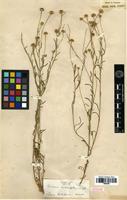
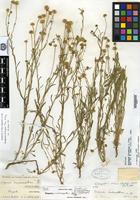
Syntype of Erigeron incomptus A.Gray [family ASTERACEAE]
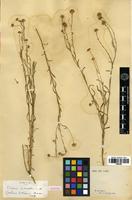
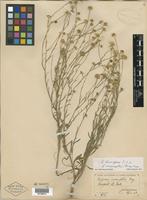
Type? of Erigeron incomptus A.Gray [family ASTERACEAE]
Filed as Erigeron divergens Torr. & A. Gray [family ASTERACEAE]
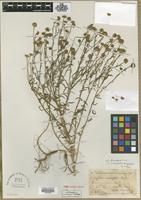
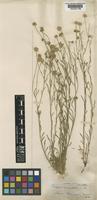
Holotype of Erigeron incomptus A. Gray [family ASTERACEAE]
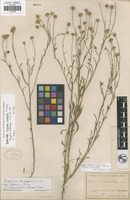
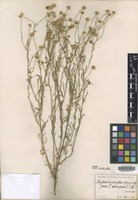
Type of Erigeron incomptus A. Gray [family ASTERACEAE]
Erigeron incomptus A. Gray [family COMPOSITAE]
Type? of Erigeron incomptus A. Gray [family ASTERACEAE]
Previous
Next

Name

Identification
Erigeron incomptus A. Gray [family ASTERACEAE ] (stored under name); Verified by A. Gray, 1884 Erigeron incomptus A. Gray [family ASTERACEAE ] Verified by A. Gray, 1884 Erigeron divergens Torrey & A. Gray [family ASTERACEAE ] Verified by G. Nesom, 1989 Erigeron incomptus A. Gray [family ASTERACEAE ] Verified by Not on Sheet,
Related name
  • Erigeron incomptus
  • Erigeron divergens
Common name
  • Spreading fleabane, Flora of North America Vol. 20

Flora

Entry for Erigeron divergens Torrey & A. Gray [family COMPOSITAE]
Herbarium
Flora of North America (FNA)
Collection
Flora of North America
Resource Type
Reference Sources
Entry From
Flora of North America, Vol 20,
Names
Erigeron divergens Torrey & A. Gray [family COMPOSITAE], Fl. N. Amer., 2: 175. 1841
Erigeron divaricatus Nuttall [family COMPOSITAE], Trans. Amer. Philos. Soc., n.s., 7: 311. 1840,. not Michaux 1803
Erigeron accedens Greene [family COMPOSITAE]
Erigeron incomptus A. Gray [family COMPOSITAE]
Erigeron solisaltator G. L. Nesom [family COMPOSITAE]
Treatment Author(s)
Guy L. Nesom
Information
Annuals or short-lived perennials, (7–)12–40(–70) cm; taprooted, caudices simple if perennial. Stems (single or multiple from bases) erect to ascending, densely and evenly puberulous-hirsutulous (hairs spreading to spreading-descending or -ascending, often crinkly, bases not thickened), minutely glandular at least distally, usually throughout. Leaves basal (usually deciduous) and cauline; basal blades obovate-spatulate, 10–70 × 4–-14 mm, cauline gradually reduced distally, margins entire or with 2–3 pairs of teeth or lobes, faces hirsute to loosely strigoso-hirsute, sometimes sparsely glandular. Heads (in early season, 1–)5–100+ (buds nodding). Involucres 3–4 × (5–)7–11 mm. Phyllaries in 3–4 series, hirsute, minutely glandular. Ray florets 75–150; corollas white, drying lilac, without abaxial midstripe, (2–)4–9.5 mm, laminae not coiling or reflexing (remaining relatively straight). Disc corollas 1.8–2.3 mm (throats indurate and slightly inflated). Cypselae 0.9–1.2 mm, 2-nerved (nerves whitish), faces sparsely strigose; pappi: outer of setae or scales, inner of 6–9(–12) bristles. 2n = 18, 27, 36.
Phenology
feb (winter), apr-may (spring), jun-aug (summer), sep-oct (fall)
Altitude range
60–2000(–2700) m;
Distribution
Mexico (Baja California).Mexico (Chihuahua).Mexico (Coahuila).Mexico (Durango).Mexico (Sonora).Mexico (and southward).USA Ariz.USA Calif.USA Colo.USA IdahoUSA Mont.USA Nebr.USA Nev.USA N.Mex.USA N.Dak.USA Okla.USA Oreg.USA S.Dak.USA Tex.USA UtahUSA Wash.USA Wyo.Canada Alta.Canada B.C.
Discussion
Polyploidy and agamospermy apparently are common in Erigeron divergens and contribute to the variability and, probably to some extent, the polymorphism characteristic of this species. Diploids appear to be scattered through the range of the species, at least in its southern part.
The form of Erigeron divergens with persistent, deeply pinnatifid basal leaves with relatively long petioles and tendency toward perenniality (woody taproots) has been named E. accedens [occurs at 200–1000(–1200) m and flowers Feb–Apr(–May)]. Such plants have sometimes been identified as E. lobatus, and it is possible that they may have originated as hybrids with it; in most ways they are similar to E. divergens and apparently intergrade with it. The E. accedens form occurs in California, Arizona, New Mexico, southwest Texas, Baja California, northern Sonora, Durango, and Chihuahua, apparently sympatrically with more typical E. divergens, suggesting that the former is stabilized and self-reproductive (probably agamospermic). Available chromosome counts are triploid. Rare plants (e.g., E. incomptus) may have filiform rays barely extending past the involucre.
Another common form of Erigeron divergens in the broad sense (mostly in Chihuahua, also southern Texas, New Mexico, and Arizona) has bowl-shaped plants with decumbent stems, a discrete taproot, persistent, lobed basal leaves, and solitary heads topping usually simple stems, and usually is early-season in phenology. Further comments related to variation in E. divergens are found under 163. Erigeron multiceps.

Related Materials

  • Terms and Conditions
  • Privacy Policy
  • Cookie Policy
  • Cookie Settings
  • Accessibility
  • Help
  • Contact Us
  • Facebook
  • Twitter
ITHAKA

JSTOR is part of ITHAKA, a not-for-profit organization helping the academic community use digital technologies to preserve the scholarly record and to advance research and teaching in sustainable ways.

©2000-2026 ITHAKA. All Rights Reserved. JSTOR®, the JSTOR logo, JPASS®, Aluka®, and ITHAKA® are registered trademarks of ITHAKA.

╳