JSTOR Global Plants Home
  • Home
  • Browse
  • About
  • Access
  • Account
    • Saved Items
    • Profile
  • Log in

Global Plants

Skip to Main Content
  • JSTOR Global Plants Home
  • Global Plants

    • Browse
    • About
    • Access
    • Account
      • Saved Items
      • Profile
Log in
  • Browse
  • About
  • Access
  • Account
    • Saved Items
    • Profile
Advanced Search

Compilation
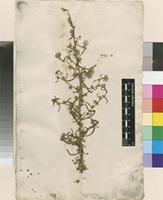
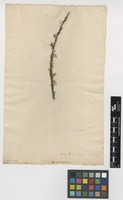
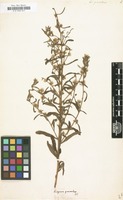
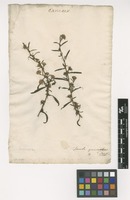
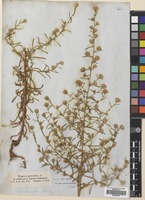
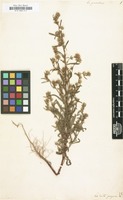
Erigeron graveolens

6 Images see all

Lectotype of Erigeron graveolens L. [family ASTERACEAE]
Filed as Inula graveolens (L.) Desf. [family ASTERACEAE]
Filed as Erigeron graveolens [family COMPOSITAE]
Filed as Inula graveolens (L.) Desf. [family ASTERACEAE]
Filed as Dittrichia graveolens (L.) Greuter [family COMPOSITAE]
Filed as Erigeron graveolens [family COMPOSITAE]
Previous
Next

Name

Identification
Erigeron graveolens L. [family ASTERACEAE ] (stored under name); Verified by Not on sheet, Dittrichia graveolens (L.) Greuter [family ASTERACEAE ] Verified by Not on sheet,
Related name
  • Dittrichia graveolens
  • Erigeron graveolens
Common name
  • Stinkwort, Flora of North America Vol. 19

Flora

Entry for Dittrichia graveolens (Linnaeus) Greuter [family COMPOSITAE]
Herbarium
Flora of North America (FNA)
Collection
Flora of North America
Resource Type
Reference Sources
Entry From
Flora of North America, Vol 19,
Names
Dittrichia graveolens (Linnaeus) Greuter [family COMPOSITAE], Exsicc. Genav. Conserv. Bot. Distrib. Fasc., 4: 71. 1973
Erigeron graveolens Linnaeus [family COMPOSITAE], Cent. Pl. I, 28. 1755
Inula graveolens (Linnaeus) Desfontaines [family COMPOSITAE]
Treatment Author(s)
Robert E. Preston
Information
Plants viscid, rank smelling, 20–130 cm; stems ± pilose and stipitate-glandular. Leaf blades linear to lance-linear, 1–3(–7) cm × 1–3(–10) mm, margins entire or denticulate, apices acute, faces pilosulous to hirtellous and minutely stipitate-glandular. Phyllaries 1–8 mm. Ray florets (6–)10–12(–16); corolla laminae 2–5(–7) mm. Disc florets 9–14+; corollas 3–4 mm. Cypselae 1.5–2 mm; pappi 3–4(–5) mm. 2n = 18 (Morocco).
Phenology
sep-nov (fall)
Altitude range
0–200 m;
Distribution
Europe (Balkan Peninsula)Europe (sw Italy)Asia (India)Africa (South Africa)Australia.USA Calif.USA N.J.USA N.Y.
Discussion
Dittrichia graveolens was collected as a ruderal in Connecticut in the 1930s, and collections from New York in the late 1940s recorded it as abundant in areas where road construction was underway. It appears to be recently introduced in California, where it has spread rapidly and has the potential to become a noxious weed (R. E. Preston 1997). Dittrichia graveolens has been shown to cause allergic contact dermatitis (J. N. Burry and P. M. Kloot 1982). The plants produce sesquiterpene lactones (G. S. d’Alcontres et al. 1973; A. Rustaiyan et al. 1987; R. Lanzetta et al. 1991), which have been shown for many composites to be linked to allergic contact dermatitis in humans (J. C. Mitchell and G. Dupuis 1971). Little evidence exists that the plants are toxic, although oxalate poisoning has been reported to be associated with grazing (kind of animals not reported) of D. graveolens (C. Lamp and F. Collet 1979), and fishermen in southern Italy reportedly use the macerated leaves to stun fish (Lanzetta et al.). Livestock deaths due to ingestion of D. graveolens have been linked to enteritis caused by the barbed pappus bristles puncturing the small intestine (C. A. Gardner and H. W. Bennetts 1956; D. J. Schneider and J. L. Du Plessis 1980).
Native/Introduced
introduced;

Related Materials

  • Terms and Conditions
  • Privacy Policy
  • Cookie Policy
  • Cookie Settings
  • Accessibility
  • Help
  • Contact Us
  • Facebook
  • Twitter
ITHAKA

JSTOR is part of ITHAKA, a not-for-profit organization helping the academic community use digital technologies to preserve the scholarly record and to advance research and teaching in sustainable ways.

©2000-2026 ITHAKA. All Rights Reserved. JSTOR®, the JSTOR logo, JPASS®, Aluka®, and ITHAKA® are registered trademarks of ITHAKA.

╳