JSTOR Global Plants Home
  • Home
  • Browse
  • About
  • Access
  • Account
    • Saved Items
    • Profile
  • Log in

Global Plants

Skip to Main Content
  • JSTOR Global Plants Home
  • Global Plants

    • Browse
    • About
    • Access
    • Account
      • Saved Items
      • Profile
Log in
  • Browse
  • About
  • Access
  • Account
    • Saved Items
    • Profile
Advanced Search

Compilation
Erigeron floribundus

12 Images see all

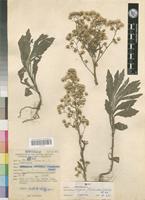
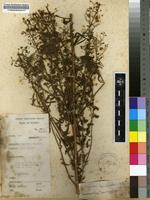
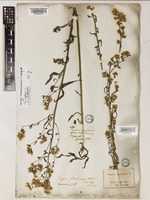
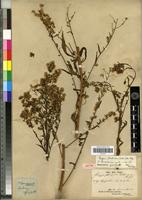
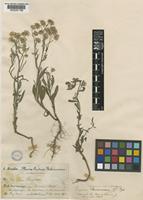
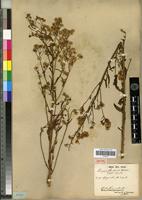
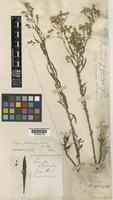
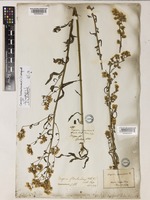
Erigeron floribundus (Kunth) Sch.Bip. [family ASTERACEAE]
Filed as Erigeron floribundus (Kunth) Sch.Bip. [family ASTERACEAE]
Conyza bonariensis (L.) Cronquist [family COMPOSITAE]
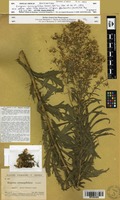
Type? of Conyza floribunda Kunth [family ASTERACEAE]
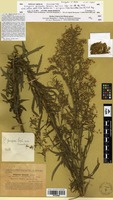
Isosyntype of Erigeron coronopifolius Sennen [family ASTERACEAE]
Type? of Conyza floribunda Kunth [family ASTERACEAE]
Erigeron canescens Sch. Bip. [family COMPOSITAE]
Conyza sumatrensis (Retz.) E. Walker [family COMPOSITAE]
Conyza bonariensis (L.) Cronquist [family COMPOSITAE]
Isosyntype of Erigeron gonzaloi Sennen [family ASTERACEAE]
Isosyntype of Erigeron coronopifolius Sennen [family ASTERACEAE]
Erigeron floribundus (Kunth) Sch.Bip.
Previous
Next

Name

Identification
Erigeron floribundus (Kunth) Sch.Bip. [family ASTERACEAE ]
Related name
  • Erigeron floribundus
Common name
  • bị́bị́ị́mbẹ́lẹ́mọ́ (KW) (NIGERIA, IJO-IZON (Kolokuma)), Burkill, H.M. 1985. The useful plants of west tropical Africa, Vol. 1
  • nεwa (FCD) (SIERRA LEONE, KISSI), Burkill, H.M. 1985. The useful plants of west tropical Africa, Vol. 1
  • gotuba (A&AA) (IVORY COAST, KRU-GUERE), Burkill, H.M. 1985. The useful plants of west tropical Africa, Vol. 1
  • ázụ́ghụ̀zụ́ (AJC) (NIGERIA, IGBO (Umuahia)), Burkill, H.M. 1985. The useful plants of west tropical Africa, Vol. 1
  • zo a gili (Har.) (LIBERIA, MANO), Burkill, H.M. 1985. The useful plants of west tropical Africa, Vol. 1

Flora

Entry for CONYZA bonariensis (L.) Cronquist [family COMPOSITAE]
Herbarium
Royal Botanic Gardens, Kew (K)
Collection
Flora of Tropical East Africa
Resource Type
Reference Sources
Entry From
Flora of Tropical East Africa, page 315, (2002) Author: H.J. BEENTJE
Names
CONYZA bonariensis (L.) Cronquist [family COMPOSITAE], Bull. Torrey Bot. Cl. 70: 632 (1943); F.P.U.: 178 (1962); Wild & Pope in Kirkia 10: 42 (1975); Maquet in Troupin, Fl. Rwanda 3: 588 (1985); Lisowski, Aster. Fl. Afr. Centr. 1: 59, fig. 13 (1991); U.K.W.F. ed. 2: 207 (1994). Lectotype designated by D'Arcy in Ann. Miss. Bot. Gard. 62: 1021 (1975): South America [America australe], LINN 994.11 (LINN, lecto., microfiche!)
Erigeron bonariensis L. [family COMPOSITAE], Sp. Pl.: 863 (1753); DC., Prodr. 5: 289 (1836); Burtt in K.B. 1948: 369 (1948); C.D. Adams in F.W.T.A. ed. 2, 2: 253 (1963)
Erigeron sumatrensis Retz. [family COMPOSITAE], Obs. Bot. 5: 28 (1789); Willd., Sp. Pl. ed. 4, 3: 1955 (1804); DC., Prodr. 5: 295 (1877). Type: Indonesia, Sumatra, Wennenberg s.n. (ubi? see note)
Erigeron linifolius Willd. [family COMPOSITAE], Sp. Pl. ed. 4, 3: 1955 (1804); Oliv. & Hiern in F.T.A. 3: 308 (1873) (as linifolium). Type: none mentioned
Conyza floribunda Kunth [family COMPOSITAE], in Humb., Bonpl. & Kunth, Nov. Gen. & Sp. 4: 73 (1820); DC., Prodr. 5: 380 (1836). Type: Equador, Quito, Humboldt & Bonpland 3100 (P!, holo.); see note
Erigeron floribundus (Kunth) Sch. Bip. [family COMPOSITAE], in Bull. Soc. Bot. France 12: 81 (1865) & Linnaea 34: 534 (1865-66); Burtt in K.B. 1948: 372 (1948); F.P.U.: 178, t. 118 (1962); C.D. Adams in F.W.T.A. ed. 2, 2: 253 (1963), as floribundus
Conyza sumatrensis (Retz.) E. Walker [family COMPOSITAE], in Journ. Jap. Bot. 46, 3: 72 (1971); Wild & Pope in Kirkia 10: 43 (1975); Maquet in Troupin, Fl. Rwanda 3: 588, fig. 178/3 (1985); Lisowski, Aster. Fl. Afr. Centr. 1: 61, fig. 14 (1991); A.J. Scott in Fl. Masc. 109: 110, t. 34 (1993); U.K.W.F. ed. 2: 206 (1994)
Conyza sumatrensis (Kunth) J.B. Marshall var. floribunda [family COMPOSITAE], in Watsonia 10 (2): 167 (1974)
Information
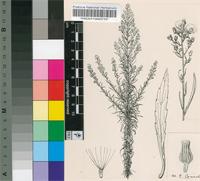
Annual herb 0.4–1.5(–2) m high; stems erect, simple or branched, cylindrical, striate, densely pubescent to scabrid. Leaves pale grey-green, sessile, linear to narrowly lanceolate or rarely pinnatilobed, 2.5–15 cm long, 0.2–3 cm wide, base cuneate, margins entire or dentate, apex acute, scabrid-pubescent on both surfaces and particularly on the veins and margins, the upper leaves or inflorescence bracts also glandular. Capitula 4–8 mm long, grouped in terminal lax leafy panicles of 10 or more cymes of several laxly arranged capitula; stalks of individual capitula 0.2–3 cm long, scabrid-pubescent; phyllaries pale green, occasionally with red or purple apex, 2–3-seriate, ± 40, 1.5–5.6 mm long, 0.2–0.5 mm wide, with or without hyaline margins, pubescent; receptacle flat or slightly convex, not or slightly toothed. Marginal florets whitish or cream with pink to purple tips, 60 to several hundred, tube 2.5–3.3 mm long and glabrous or slightly pilose, ray erect and 0.4–0.6 mm long and 2–3-toothed at apex, style 3.4–4.2 mm long; central florets white to yellow, 4–17, tube 2.8–3.5 mm long, lobes 0.3–0.7 mm long; anthers 0.7–1.1 mm long with narrowly triangular to filiform appendage; style 3.3–4.4 mm long with short, slightly swollen, papillose branches. Achenes oblong-cylindrical, flattened or not, 1–2 mm long, 2-ribbed, pilose to pubescent; pappus of many white to pale yellow setae 2.5–5 mm long. Fig. 105 (page 507). 
Range
DISTR. U 1–4; K 1–7; T 1–8; pantropical weed, originally from S America, and widespread in tropical Africa; Arabia
Altitude range
300–2850 m
Distribution
UGANDA Kigezi District Kachwekano Farm, Apr. 1949, Purseglove 2747!;KENYA Northern Frontier District Moyale, Apr. 1952, Gillett 12898!;TANZANIA Ngara District Keza, Bushubi, Nov. 1959, Tanner 4474!;UGANDA Teso District Serere, Dec. 1931, Chandler 185!;UGANDA Mengo District Bukoto, Oct. 1931, Lab. Staff 2310!KENYA Embu District Castle Forest Station, Jan. 1967, Perdue & Kibuwa 8414!;KENYA Teita District Bachuma, May 1971, Nganga 130!TANZANIA Tanga District Kwamkoro Forest Reserve, Oct. 1986, Borhidi et al. 86263!;TANZANIA Songea District Matengo Hills, Jan. 1956, Milne-Redhead & Taylor 8080!
Notes
C. bonariensis and C. floribunda are very close, and even collectors such as Greenway have been accused of mixing the two taxa in a single collection. Extremes are fairly easy to key out on numbers of central florets (6–9(–12) in floribunda, 12–17 in bonariensis) and pappus colour (pale yellow in floribunda, white or pinkish in bonariensis) and to a lesser extent on the shape of the inflorescence (a compound pyramidal panicle in floribunda, racemose to paniculate in bonariensis). Sadly, the bulk of East African material seems to overlap the borders in one or more of these characters. The taxa occur over the same range of altitude, in the same habitat, and in the same areas.Other characters suggested by various authors (phyllaries with appressed or spreading hairs; degree of pubescence of achenes; width of leaves) do not hold up in our area; although size of capitula is larger in bonariensis -like material and this seems to be associated with red-tipped phyllaries. I have yet to see a key (for Africa, or elsewhere) which works convincingly and consistently. For the time being, and for our area only, I treat these taxa as a single variable one, but this should not be seen as a definitive decision on a worldwide basis. In this I follow Cronquist in Fl. Europaea 4: 120 (1976).The type of sumatrensis has not been seen by anyone since the original description was drawn up; both Willdenow and De Candolle state they have not seen it. Retzius' description is very general and might apply to bonariensis as well as to floribunda, if these are seen as separate (flosculi disci ... pauci; pappus simplex, copiosus). For the sake of clarity I agree with Burtt and Adams in F.W.T.A. and I prefer to use floribunda for the taxon with smaller heads and fewer central florets, while considering sumatrensis as a doubtful synonym. McClintock & Marshall designated a neotype for sumatrensis in Watsonia 17 (2): 172 (1988): Sumatra, Berastagi, Feb. 1921, Ridley s.n. (K!, neo.), but this does not clarify the status of the original type. ADDENDUM/ERRATUM (published in Compositae - Part 3, 2005): the synonym taxon Conyza floribunda Kunth was published in 1818 on p. 57 of the earlier folio edition, vol. 4.

Related Materials

  • Terms and Conditions
  • Privacy Policy
  • Cookie Policy
  • Cookie Settings
  • Accessibility
  • Help
  • Contact Us
  • Facebook
  • Twitter
ITHAKA

JSTOR is part of ITHAKA, a not-for-profit organization helping the academic community use digital technologies to preserve the scholarly record and to advance research and teaching in sustainable ways.

©2000-2026 ITHAKA. All Rights Reserved. JSTOR®, the JSTOR logo, JPASS®, Aluka®, and ITHAKA® are registered trademarks of ITHAKA.

╳