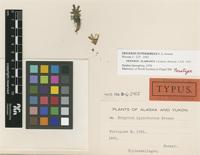
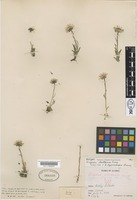
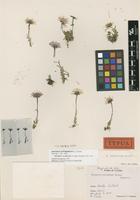
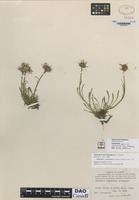
Erigeron alaskanusCronquist [family ASTERACEAE ] (stored under name); Verified by Not on sheet, Erigeron hyperboreusGreene [family ASTERACEAE ] Verified by Hultén, E., Erigeron hyperboreusGreene [family ASTERACEAE ] Verified by Spongberg, S., 1970
Related name
Erigeron hyperboreus
Erigeron alaskanus
Common name
Tundra fleabane, Flora of North America Vol. 20
Flora
Entry for Erigeron hyperboreus Greene [family COMPOSITAE]
Perennials, 3–15 cm; rhizomatous, fibrous-rooted, sometimes with branched, rhizomelike caudices. Stems erect to basally ascending, hirsute to hirsuto-villous (hair cross walls purplish black), minutely glandular (conspicuously so near heads). Leaves mostly basal (persistent) or basal and cauline; basal blades narrowly oblanceolate to narrowly oblanceolate-spatulate 10–50(–60) × 1.5–6 mm, cauline linear and reduced distally, margins entire (apices acute to obtuse), faces hirsute, eglandular. Heads 1. Involucres 5–8 × 9–15 mm. Phyllaries in 2(–3) series (usually dark purple), hirsute to villous (hair cross walls purplish black), minutely glandular. Ray florets 30–60; corollas white to blue, drying white or pink, purple, or blue, 7–15 mm (mostly 1–2 mm wide), laminae coiling. Disc corollas 3.5–5 mm. Cypselae 1.7–2 mm, 2-nerved, faces densely strigoso-hirsute; pappi: outer of setae (inconspicuous), inner of 15–20 bristles. 2n = 18.
Phenology
jun-aug (summer)
Altitude range
(30–)100–900(–2400) m;
Distribution
USA Alaska.Canada Yukon
Discussion
Some plants in each of two collections of Erigeron hyperboreus from Alaska (Parker 755, ALA; Murray 8514, ALA) have glabrous or glabrate leaves, stems, and phyllaries; other plants of the same populations are more typical and intermediacy is evident.