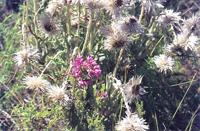
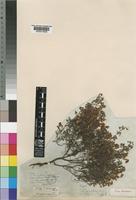
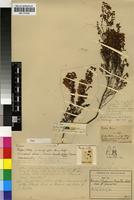
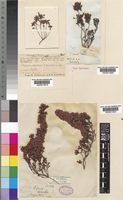
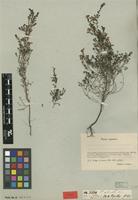
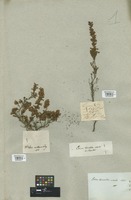
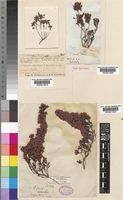
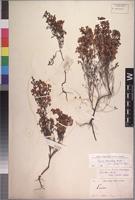
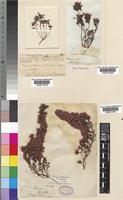
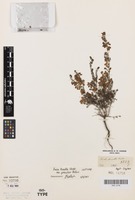
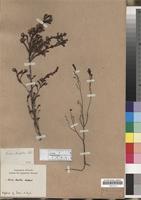
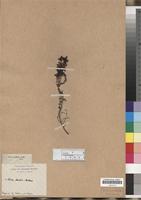
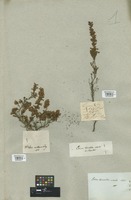
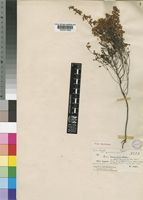
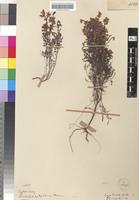
erect, 1–1 1/2 ft. or more high, generally more slender than any of the four preceding species; branches ascending, grey-pubescent; leaves erect or spreading, linear, acute or subobtuse, keeled, glabrous or sparsely hairy and becoming so, mostly about 2 lin. long; flowers crowded on short branchlets at the ends of the branches, mostly forming a pseudo-raceme; pedicels puberulous, red, 1–2 lin. long; bracts remote, small; sepals mostly ovate-lanceolate, rarely subovate, acute or acuminate, keeled, glabrous, glossy, usually dark red, 3/4–1 1/4 lin. long; corolla urceolate or ovoid-urceolate, constricted at the throat, but always somewhat wide-mouthed, white or pale rose, 2–3 lin. long; segments mostly rather large and well-spreading, more rarely erect, sometimes darker-coloured than the tube, from 1/5– 1/4 the length of the tube; anthers included, somewhat variable in shape and length, from transversely semiovate-cuneate to oblong-cuneate, minutely ciliolate on the margin, the width at the base sometimes equal to the length, sometimes a little narrower, from 1/4– 2/5 lin. long, crested; pore 1/3– 2/3 the length of the cell; crests always immediately deflexed close to the cells, subulate to lanceolate, or lanceolate-falcate, finely fimbriate, mostly entire or slightly lobed or lacerate, 1/2– 2/3 the length of the cells, rarely even a little longer than them; style mostly included, rarely subexserted; stigma capitate; ovary glabrous. null