JSTOR Global Plants Home
  • Home
  • Browse
  • About
  • Access
  • Account
    • Saved Items
    • Profile
  • Log in

Global Plants

Skip to Main Content
  • JSTOR Global Plants Home
  • Global Plants

    • Browse
    • About
    • Access
    • Account
      • Saved Items
      • Profile
Log in
  • Browse
  • About
  • Access
  • Account
    • Saved Items
    • Profile
Advanced Search

Compilation
Erica sulcata

6 Images see all

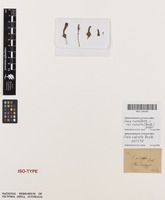
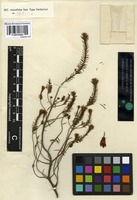
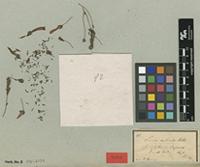
Isotype of Erica sulcata Benth. [family ERICACEAE]
Erica sulcata Benth. [family ERICACEAE]
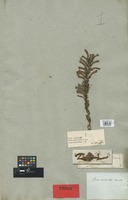
Type of Erica sulcata Benth. [family ERICACEAE]
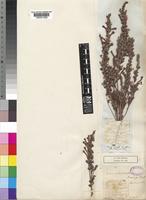
Holotype of Erica sulcata Hornem. [family ERICACEAE]
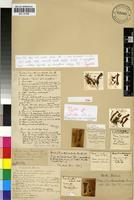
Type? of Erica sulcata Benth. [family ERICACEAE]
Previous
Next

Name

Identification
Erica sulcata Benth. [family ERICACEAE ] Verified by Not on sheet, Erica curviflora L. [family ERICACEAE ] (stored under name); Verified by Not on sheet,
Related name
  • Erica sulcata
  • Erica unrecorded
  • Erica curviflora

Flora

Entry for ERICA sulcata Benth. [family ERICACEAE]
Herbarium
Royal Botanic Gardens, Kew (K)
Collection
Flora Capensis
Resource Type
Reference Sources
Entry From
Flora Capensis, Vol 4, page 2, (1909) Author: By H. BOLUS, F. GUTHRIE, and N. E. BROWN.
Names
ERICA sulcata Benth. [family ERICACEAE], in DC. Prodr. vii. 632
Information
erect; leaves 4-nate, incurved, narrow or broadish linear, blunt, deeply sulcate, sometimes slightly open-backed, the upper copiously and softly long ciliate, 1 1/2–2 1/2 lin. long; flowers solitary, subsessile; bracts subremote, minute, sepal-like: sepals ovate, or subcuneate and retuse, apiculate, scarious, about 1/2 lin. long; corolla clavate-tubular, incurved, tomentose-pubescent, dry, 10–12 lin. long; limb 1 1/4 lin. long, spreading, somewhat fleshy; filaments widening towards the anther; anthers subexserted, oblong, mid-dorsifixed, muticous, 3/4–1 lin. long; ovary glabrous. null
Distribution
COAST REGION George Div.; Devils Kop, near George, Niven, 190!
Notes
Closely allied to E. curviflora, var. Burchellii, and might perhaps be regarded as another variety of that with minute sepals. Bentham also says that “it has the habit of E. tubiflora, Willd. ” [E. curviflora, L. ]

Related Materials

  • Terms and Conditions
  • Privacy Policy
  • Cookie Policy
  • Cookie Settings
  • Accessibility
  • Help
  • Contact Us
  • Facebook
  • Twitter
ITHAKA

JSTOR is part of ITHAKA, a not-for-profit organization helping the academic community use digital technologies to preserve the scholarly record and to advance research and teaching in sustainable ways.

©2000-2026 ITHAKA. All Rights Reserved. JSTOR®, the JSTOR logo, JPASS®, Aluka®, and ITHAKA® are registered trademarks of ITHAKA.

╳