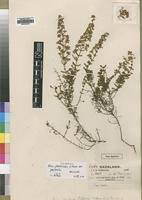
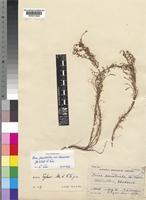
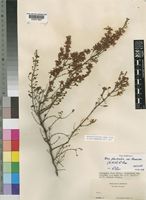
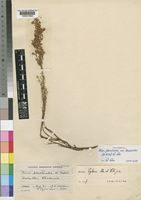
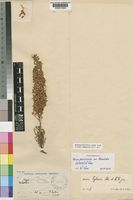
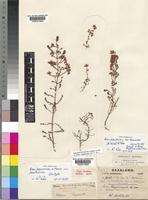
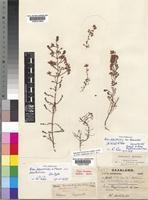
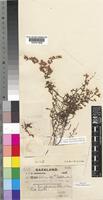
A much branched sub–shrub 0·3–1·0 m. tall. Branchlets slender, the finest 0·2–0·3 mm. in diameter, without infrafoliar ridges, densely pubescent with very short simple hairs, and many longer hairs, some of them c. 0·15 mm. long and with side branches to the tip, others which may be either eglandular, 0·4–0·5 mm. long, with side branches on the lower part and often forked above, or glandular, 0·15–0·4 mm. long, with side branches on the lower part of the longer ones. Leaves in whorls of 3, patent to ascending, narrowly ovate to ovate, acute, 1·0–3·5 mm. long, 0·3–1·5 mm. wide, the margins reflexed from very slightly to so strongly that they meet along the mid line at the back of the leaf, glabrous, or with a single hair at the tip c. 0·2 mm. long with simple, glandular or occasionally forked tips, or with a row of hairs 0·1–0·3 mm. long along the apparent margin of the leaf or, where the margins of the leaf are scarcely reflexed, along a curved ridge about equidistant between mid–rib and leaf margin, these hairs with simple, glandular or forked tips; petioles 0·2–0·5 mm. long, glabrous. Flowers in clusters of 6–12 at the tips of the numerous side branches which become shorter and more closely spaced towards the apex of the stem. Pedicels 1·5–4 mm. long, pubescent with short simple hairs and longer hairs that may be glandular and unbranched or eglandular with side branches below and simple or forked tips. Bract varying in position from basal to near the calyx, leaf–like, 1·5–2·5 mm. long; bracteoles also varying in position and distance above the bract from near the base of the pedicel to just below the calyx, from 1·5 mm. long and leaf–like above to 0·5 mm. long, membranous throughout and very narrow; bracts and bracteoles with ciliate margins, the cilia glandular or eglandular with simple or forked tips. Calyx segments united at the base only, triangular to linear with acute to obtuse tips, 0·8–1·5 mm. long, with ciliate margins, the cilia 0·1–0·2 mm. long, glandular, forked or simple at the tip, sometimes with side branches at the base. Corolla urceolate to tubular–campanulate, pale purple to pink to white, glabrous, 1·5–4·5 mm. long, 1·0–3·0 mm. broad, lobes rounded, sinuses acute, c. 0·5 mm. deep. Stamens 4–8, equalling the corolla to exceeding it by c. 2 mm.; filaments flattened, slightly geniculate; anthers normally with aristate appendages 0·2–0·3 mm. long, these sometimes fused to a greater or lesser extent to the filaments, but rarely anthers muticous. Ovary globose, pubescent, style 2·5–4·5 mm., exceeding the stamens by c. 1 mm., usually glabrous, occasionally pubescent below, stigma capitate.