JSTOR Global Plants Home
  • Home
  • Browse
  • About
  • Access
  • Account
    • Saved Items
    • Profile
  • Log in

Global Plants

Skip to Main Content
  • JSTOR Global Plants Home
  • Global Plants

    • Browse
    • About
    • Access
    • Account
      • Saved Items
      • Profile
Log in
  • Browse
  • About
  • Access
  • Account
    • Saved Items
    • Profile
Advanced Search

Compilation
Erica pallida

10 Images see all

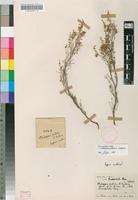
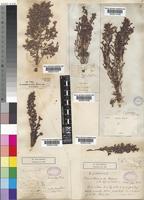
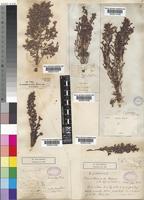
Isotype of Philippia pallida L.Guthrie [family ERICACEAE]
Filed as Erica pallida Salisb. [family ERICACEAE]
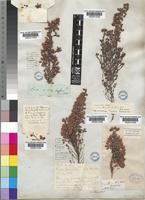
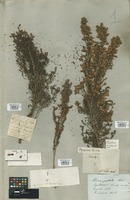
Holotype of Erica peltata Andrews [family ERICACEAE]
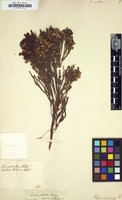
Erica pubescens L. [family ERICACEAE]
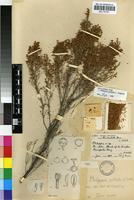
Filed as Erica pallida Salisb. [family ERICACEAE]
Erica pubescens L. [family ERICACEAE]
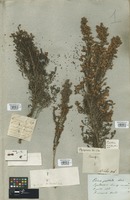
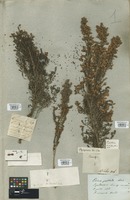
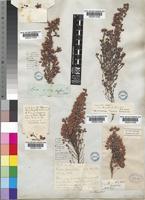
Type of Erica pubescens unrecorded var. pilosa Thunb. [family ERICACEAE]
Erica pubescens L. [family ERICACEAE]
Filed as Erica pallida [family ERICACEAE]
Previous
Next

Name

Identification
Erica pallida Salisb. [family ERICACEAE ] Erica pubescens L. [family ERICACEAE ] (stored under name); Erica pubescens unrecorded [family ERICACEAE ] Erica grisca Soland. [family ERICACEAE ] Erica plebeia Soland. [family ERICACEAE ] Erica rudis Soland. [family ERICACEAE ] Erica villosiuscula Roxb. [family ERICACEAE ]
Related name
  • Erica rudis
  • Erica plebeia
  • Erica villosiuscula
  • Erica pallida
  • Erica grisca
  • Erica pubescens

Flora

Entry for ERICA pubescens Linn. [family ERICACEAE]
Herbarium
Royal Botanic Gardens, Kew (K)
Collection
Flora Capensis
Resource Type
Reference Sources
Entry From
Flora Capensis, Vol 4, page 2, (1909) Author: By H. BOLUS, F. GUTHRIE, and N. E. BROWN.
Names
ERICA pubescens Linn. [family ERICACEAE], Sp. Pl. ed. 2, 506, not of others
ERICA pubescens Thunb. var. pilosa [family ERICACEAE], Diss. Erica, 39.
ERICA incana Wendl. [family ERICACEAE], Eric. Ic. fasc. 18, 89, t. 34 (good!).
ERICA pallida Salisb. [family ERICACEAE], in Trans. Linn. Soc. vi. 326; Benth. in DC. Prodr. vii. 673.
ERICA purialis Hort. ex Sinclair [family ERICACEAE], Hort. Eric. Wob. 20; Benth. l.c.
Information
erect, 1–1 1/2 ft. high; branches clothed with a close greyish tomentum, and long scattered hairs; leaves 3-nate, upper suberect, lower spreading, linear, blunt, sulcate, or sometimes lanceolate and open-backed, pubescent, pale green, about 1 1/2 lin. long; flowers 3-nate to subumbellate; pedicels pubescent, 3 lin. long; bracts subapproximate or remote, foliaceous, less than 1 lin. long; sepals lanceolate, subobtuse, margins recurved, foliaceous, densely velvety-puberulous, ciliate or naked, 1–1 1/4 lin. long, reaching from 1/4 to nearly 1/2 the height of the corolla; corolla narrow- or broadish-ovoid-urceolate, not, or slightly, contracted at the throat, velvety-pubescent, white or pale rosy, mostly 2 1/2 or rarely 2 lin. long; segments erect, obtuse, 1/4– 1/3 the length of the tube; filaments broadest at the base, bent at the apex; anthers included, oblong, obtuse, somewhat tapering to the base, the cells subdistant, about 3/4 lin. long, subcristate; pore about 1/2 the length of the cell; appendages oblong and denticulate below, subulate-acuminate towards the apex, about 1/2 as long as the cells, or subulate-aristate throughout, ciliolate, and only 1/3 the length of the cells; style stout, just exserted; stigma capitate; ovary villous. null
Distribution
COAST REGION from 800–2800 ft.: Clanwilliam Div.; Middle Berg, Cederberg Range, Leipoldt, 742! Cape Div.; mountains around Cape Town, Thunberg, Niven, 20! 127! Bolus, 2959! and in Herb. Norm. Aust.-Afr., 32! Guthrie, 1378! Wolley Dod, 2336! Ecklon, 290!SOUTH AFRICA without locality, Sieber, 174! Herb. Salisbury!
Notes
Allied to E. tomentosa, but easily distinguished by the size and relative proportions of the sepals and corolla. Also near to E. Lerouxiæ, differing, however, in several characters. Leipoldt's specimens agree in all substantial characters, but the flowers are a little smaller than the others, either from their not being fully developed, or from their station in a drier climate. They were distributed as E. hirta, Thunb., which may possibly prove to be a form of the present species.

Related Materials

  • Terms and Conditions
  • Privacy Policy
  • Cookie Policy
  • Cookie Settings
  • Accessibility
  • Help
  • Contact Us
  • Facebook
  • Twitter
ITHAKA

JSTOR is part of ITHAKA, a not-for-profit organization helping the academic community use digital technologies to preserve the scholarly record and to advance research and teaching in sustainable ways.

©2000-2026 ITHAKA. All Rights Reserved. JSTOR®, the JSTOR logo, JPASS®, Aluka®, and ITHAKA® are registered trademarks of ITHAKA.

╳