JSTOR Global Plants Home
  • Home
  • Browse
  • About
  • Access
  • Account
    • Saved Items
    • Profile
  • Log in

Global Plants

Skip to Main Content
  • JSTOR Global Plants Home
  • Global Plants

    • Browse
    • About
    • Access
    • Account
      • Saved Items
      • Profile
Log in
  • Browse
  • About
  • Access
  • Account
    • Saved Items
    • Profile
Advanced Search

Compilation
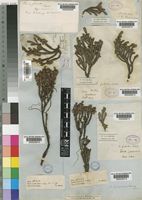
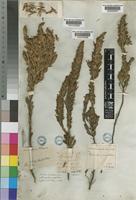
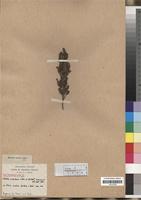
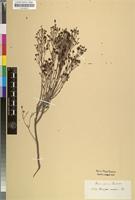
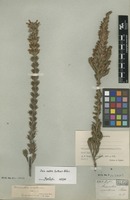
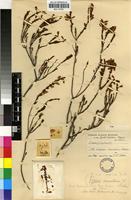
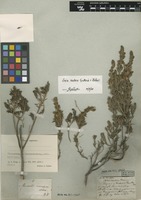
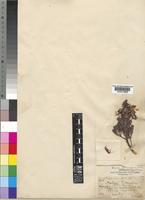
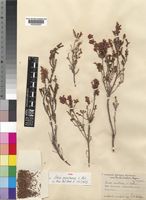
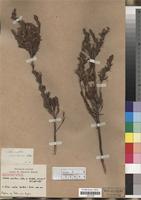
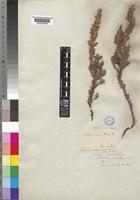
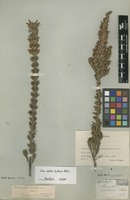
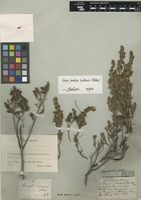
Erica montana

13 Images see all

Erica lycopodiastrum Lam. [family ERICACEAE]
Nabea montana Lehm. [family ERICACEAE]
Isosyntype of Erica nabea Guthrie & Bolus [family ERICACEAE]
Type of Erica montana L.Bolus [family ERICACEAE]
Filed as Erica nabea Guthrie & Bolus [family ERICACEAE]
Erica petiveri unrecorded var. willdenowii [family ERICACEAE]
Type of Erica montana L.Bolus [family ERICACEAE]
Isosyntype of Erica nabea Guthrie & Bolus [family ERICACEAE]
Nabea montana Lehm. Kl. [family ERICACEAE]
Filed as Philippia montana Klotzsch [family ERICACEAE]
Filed as Erica nabea Guthrie & Bolus [family ERICACEAE]
Previous
Next

Name

Identification
Erica montana L.Bolus [family ERICACEAE ] Verified by Not on sheet, Erica lateralis Willd. [family ERICACEAE ] (stored under name); Verified by Not on sheet,
Related name
  • Erica lateralis
  • Erica nabea
  • Erica petiveri
  • Erica montana
  • Erica follicularis
  • Erica oreina
  • Erica lycopodiastrum
  • Erica sebana
  • Erica fabrilis

Flora

Entry for ERICA Lycopodiastrum Lam. [family ERICACEAE]
Herbarium
Royal Botanic Gardens, Kew (K)
Collection
Flora Capensis
Resource Type
Reference Sources
Entry From
Flora Capensis, Vol 4, page 2, (1909) Author: By H. BOLUS, F. GUTHRIE, and N. E. BROWN.
Names
ERICA Lycopodiastrum Lam. [family ERICACEAE], Ill. ii. 428, t. 287, fig. 4
ERICA fabrilis Salisb. [family ERICACEAE], in Trans. Linn. Soc. vi. 338; Benth. in DC. Prodr. vii. 655.
ERICA confertifolia Wendl. [family ERICACEAE], Eric. Ic. fasc. 20, 121, t. 46.
ERICA montana Sinclair [family ERICACEAE], Hort. Eric. Wob. 15.
ERICA confertiflora Steud. [family ERICACEAE], Nom. ed. 2, i. 570.
Information
“a dwarf plant” (Bentham); branches erect, rigidly flexuous, tomentose-puberulous, 10–15 in. long; leaves 3-nate, nearly erect, closely and very regularly imbricate, oblong, subacute, concave above, round-backed, sulcate, thick, glabrous, shining, 1 1/2–2 lin. long; flowers 3-nate, terminal on short lateral branchlets, or sometimes (by their partial arrest) sublateral; pedicels tomentose, decurved, 1 1/2–2 lin. long; bracts mostly approximate, more rarely submedian, ovate, acute, keeled, rigid, scarious, 1–1 1/4 lin. long; sepals like the bracts, but slightly larger, 1 1/4 lin. long, 1/2– 3/4 the length of the corolla; corolla obconic-cyathiform, slightly widened to the mouth, glabrous, 1 1/2 lin. long (flesh-coloured, Wendland); segments slightly spreading, rounded, 1/2– 2/3 of the tube in length; filaments slender; anthers included, subterminal; cells bipartite, distant, stalked upon the slender connective, narrow-obovate, subobtuse, pale brown, membranous, about 1/3 lin. long, broad-aristate; pore 1/3– 1/2 the length of the cell; awns affixed to the connective and free from the filament, pendulous, subulate, acuminate, toothed, a little over 1/2 the cell in length; style included, short; stigma capitellate; ovary glabrous or with a few hairs at the summit; ovules ovoid (Bentham found them compressed, which our observations do not confirm). null
Distribution
COAST REGION Paarl Div.; French Hoek, by the river, Niven, 55!SOUTH AFRICA without locality, Masson, Drège, Herb. Salisbury! Herb. Lamarck (641)! and cultivated specimens!
Notes
Connects §§ Trigemma and Eurystoma, yet has hardly the longer corolla-limb of the latter. In appearance it has some resemblance to the two succeeding species, but is distinct by its peculiarly thin membranous subterminal anthers, and their narrow appendages. Wendland describes the leaves (from a cultivated plant) as 4-nate, which we have not seen. The plant appears to be now rare.

Related Materials

  • Terms and Conditions
  • Privacy Policy
  • Cookie Policy
  • Cookie Settings
  • Accessibility
  • Help
  • Contact Us
  • Facebook
  • Twitter
ITHAKA

JSTOR is part of ITHAKA, a not-for-profit organization helping the academic community use digital technologies to preserve the scholarly record and to advance research and teaching in sustainable ways.

©2000-2026 ITHAKA. All Rights Reserved. JSTOR®, the JSTOR logo, JPASS®, Aluka®, and ITHAKA® are registered trademarks of ITHAKA.

╳