JSTOR Global Plants Home
  • Home
  • Browse
  • About
  • Access
  • Account
    • Saved Items
    • Profile
  • Log in

Global Plants

Skip to Main Content
  • JSTOR Global Plants Home
  • Global Plants

    • Browse
    • About
    • Access
    • Account
      • Saved Items
      • Profile
Log in
  • Browse
  • About
  • Access
  • Account
    • Saved Items
    • Profile
Advanced Search

Compilation
Erica laricina

3 Images see all

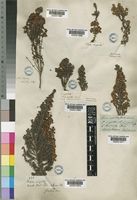
Erica calycina unrecorded [family ERICACEAE]
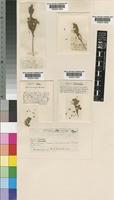
Erica nigrita L. [family ERICACEAE]
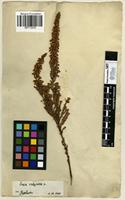
Filed as Erica laricina P.J.Bergius [family ERICACEAE]
Previous
Next

Name

Identification
Erica nigrita L. [family ERICACEAE ] (stored under name); Erica vespertina L.f. [family ERICACEAE ] Erica laricina Bergi. [family ERICACEAE ]
Related name
  • Erica vespertina
  • Erica laricina
  • Erica volutaeflora
  • Erica nigrita
  • Erica calycina

Flora

Entry for ERICA calycina Linn. [family ERICACEAE]
Herbarium
Royal Botanic Gardens, Kew (K)
Collection
Flora Capensis
Resource Type
Reference Sources
Entry From
Flora Capensis, Vol 4, page 2, (1909) Author: By H. BOLUS, F. GUTHRIE, and N. E. BROWN.
Names
ERICA calycina Linn. [family ERICACEAE], Sp. Pl. ed. 2, 507, not of some others;—Thunb. Diss. Erica, 47.
ERICA nigrita Linn. [family ERICACEAE], Mant. 65; Andr. Heathery, t. 31, and Col. Heaths, t. 41; Wendl. Eric. Ic. fasc. 12, 11; Lodd. Bot. Cab. t. 54; Benth. in DC. Prodr. vii. 687.
ERICA laricina Berg. [family ERICACEAE], Desc. Pl. Cap. 94, not of Spreng. f.
ERICA vespertina Linn. f. [family ERICACEAE], Suppl. 221; Benth. l.c. 686.
ERICA gnidiæfolia Salisb. [family ERICACEAE], in Trans. Linn. Soc. vi. 336.
ERICA lyrigera Salisb. [family ERICACEAE], l.c.
ERICA nigrita Roxb. ex Salisb. [family ERICACEAE], l.c.
ERICA volutæflora Salisb. [family ERICACEAE], l.c. 335.
ERICA munda Salisb. [family ERICACEAE], l.c. 337.
ERICA acutangula Lodd. [family ERICACEAE], Bot. Cab. t. 1868.
ERICA emarginata Andr. [family ERICACEAE], Heathery, t. 214.
ERICA marginata Benth. [family ERICACEAE], l.c. 687.
ERICA nitidula Hort. ex Benth. [family ERICACEAE], l.c. 687.
ERICA Dickensonia Sinclair var. alba [family ERICACEAE], Hort. Eric. Wob. 8.
ERICA cucullata Tausch [family ERICACEAE], in Flora, 1834, 615, acc. to Ind. Kew.
ERICA nigrescens Steud. [family ERICACEAE], Nom. ed. 2, ii. 7.
ERICA nigricans Lodd. ex G. Don [family ERICACEAE], in Loud. Hort. Brit. 151, fide Ind. Kew.
ERICA divaricata Lodd. ex Steud. [family ERICACEAE], Nom. ed. 1, 305.
Information
generally stout, erect, rigid, 1 1/2–2 ft. high, with numerous, ascending, subvirgate, rarely white-pubescent branches; leaves suberect and imbricate, or sometimes spreading, or squarrose-recurved, crowded, linear or narrow-lanceolate, subtrigonous, acute or subobtuse, sulcate, glabrous, ciliolate or naked, mostly 1 1/2–2 lin. long; flowers often crowded on short branchlets, more rarely scanty, calycine or subcalycine; pedicels mostly densely white-tomentose, more or less with plumose hairs intermixed with simple (occurring sometimes on the branches), spreading, 1 1/2–2 1/2 lin. long; bracts subremote (or the lowest remote) to subapproximate, lax or more rarely imbricating the sepals, ovate or oblong, coloured, scarious or cartilaginous, about 1 lin. long; sepals ovate to orbicular or subrhomboidal, imbricate for a greater or less distance from the base upwards, scarious or cartilaginous, keeled or keel-tipped, white, ciliate or naked, 1–1 1/2 lin. long, or mostly from 2/3– 3/4 the length of the corolla (rarely 1/2 only); corolla obconic-cyathiform, white, 1 1/2–2 (rarely 2 1/2) lin. long; segments in full flower spreading or recurved, but very soon becoming erect, oblong or ovate, obtuse or subacute, from equal to the tube to a little shorter than it; anthers included, but manifest, terminal or subterminal; cells partite to the base, oblong or semilanceolate, acute or obtuse, scaberulous, 2/3–1 lin. long, cristate; pore 1/2– 2/3 the length of the cell; crests free, coarsely toothed or incised or crested-aristate; awns free, short, subulate, ciliate or hairy; style stout, straight, shortly exserted; stigma simple or clavate; ovary pallid, glabrous or hispidulous at the apex. null
Distribution
COAST REGION from Clanwilliam Div. on the north, throughout the Coast Region generally, eastward as far as Grahamstown, usually at an elevation of from 2000 to 5000 ft.; Thunberg, Niven, 114, 219! Burchell, 7685! Drège, 7778 b! Zeyher, 341! 3253! 3254! 3280! 3286! MacOwan, 1260! Bolus, 1579! 3294! 3294β! 3771! 3991! 5186! 5466! 6337! 9368! MacOwan. Herb. Norm. Austr.-Afr., 36! Guthrie, 648α! Schlechter, 1733! 5509! 8915! Wolley Dod, 1272! 3258! Galpin, 3688! Leipoldt, 550! 1046! Marloth, 2687! Var. β: Niven, 57! MacOwan, Herb. Norm. Austr.-Afr., 938! Bolus, 5185! 5454! Guthrie, 3669! Schlechter, 5592! Var. γ: Swellendam Div.; summit of Zuurbraak Mountain, 4900 ft., Galpin, 3693! (Schlechter, 5400! and Zeyher, 3295! probably belong to this species, but are immature).SOUTH AFRICA without locality, Herb. Salisbury! and cultivated specimens!
Notes
The examination of a very large number of specimens has obliged us to unite the four species to which Bentham reduced the still larger number cited above. It is evident that he still suspected the identity of three of these; and our additional material has confirmed the suspicion. Like all widely distributed species it varies somewhat in habit and in every organ, so that if every variation were regarded as distinctive, it would be necessary to make 8 or even 10 varieties or species. Those forms which have been collected northwards towards Clanwilliam diverge from the others by a poorer growth and smaller leaves and flowers, the result probably of climatic influences; but the floral structure differs little; the anthers are more lateral, but even these pass by gradations into the usual or commoner, more southern, form. The var. γ looks distinct, but the real differences are not great; and it is connected with var. β by such a form as Bolus, 5454, which has almost exactly the same anther. One of Bentham's distinctions of E. fragrans was the opposite leaves; but Galpin's 3693, which is undoubtedly the same as Andrews' fig. t. 163, has the 3-nate leaves of the section.

Related Materials

  • Terms and Conditions
  • Privacy Policy
  • Cookie Policy
  • Cookie Settings
  • Accessibility
  • Help
  • Contact Us
  • Facebook
  • Twitter
ITHAKA

JSTOR is part of ITHAKA, a not-for-profit organization helping the academic community use digital technologies to preserve the scholarly record and to advance research and teaching in sustainable ways.

©2000-2026 ITHAKA. All Rights Reserved. JSTOR®, the JSTOR logo, JPASS®, Aluka®, and ITHAKA® are registered trademarks of ITHAKA.

╳